
If you often do small loads
You want to be able to hang up your shorts while another load is already on the way. So look at the usable hanging space and bear in mind how long things take to dry in your room.


A heated airer is worth considering if cotton shorts won’t dry indoors in time for your next small load. If you have enough time for them to dry, a standard airer is an alternative that uses no electricity for heating. When choosing, consider the available hanging space, its size when in use and when stored, the stated wattage, care labels and ventilation. Your shorts won’t necessarily dry faster just because the wattage is higher.
You want to be able to hang up your shorts while another load is already on the way. So look at the usable hanging space and bear in mind how long things take to dry in your room.
You can set up the airer while your clothes are drying, but want to put it away compactly afterwards. Its size when in use and when stored are not the same.
You’re weighing up heating against drying without electric heat, and need to consider how to ventilate moist air while your clothes dry.
A heated airer could be a good fit if small loads follow one another quickly and you want extra drying support. Otherwise, an unheated airer may be enough.
Choose this if: successive small loads aren’t drying indoors in time and you want to put the airer away between uses.
Bear in mind: electricity use and floor space while it’s in use; moisture from the washing still needs to be ventilated.
Choose this if: you want a compact floor layout and only need to use some of the tiers for a small load.
Bear in mind: shorts need to hang freely without resting on a lower tier. For the Dry:Soon Mini 3-Tier, check the plug, mains voltage and specification of the model you’re considering.
Choose this if: your next load doesn’t need to wait for drying space and you want to avoid the electricity used for heating.
Bear in mind: hanging space and ventilation still matter; compare compact models with larger airers to find one that suits your space.
| Buying consideration | What to look for | Who is it for? |
|---|---|---|
| Hanging space per load | Check how many usable rails there are and whether shorts can hang without overlapping, with the legs hanging freely. | If the next small load is ready while your shorts are still hanging up, clear hanging space matters more than the maximum load alone; around 31% of consumers prioritise keeping small loads moving. |
| Space when in use and when stored | Measure both the available floor space and the storage space; a drying tower and a winged airer take up space in different ways. | If you have little floor or storage space, you need to be able to fit the airer both when it’s open and when it’s put away; around 25% of consumers prioritise finding the right size. |
| Electricity use | Compare the stated wattage with how long you expect to use the airer; a standard airer uses no electricity for heating. | If you plan to switch the airer on often, you’ll want to know how its wattage and running time affect your electricity use; around 25% of consumers prioritise electricity use per load. |
| Indoor moisture and clothing care | Check the care label on each pair of shorts and choose a spot where you can ventilate the room. | If you dry clothes indoors, you’ll need to consider both the room and the care instructions on each pair of shorts; around 19% of consumers prioritise indoor moisture and clothing care. |
Even with a heated airer, moisture from your shorts enters the indoor air. Milieu Centraal describes ventilation as bringing in fresh air and removing stale air.
Before you buy, consider where the airer can go and how you can ventilate the room while your clothes dry.
The stated wattage doesn’t tell you how long your shorts will take to dry. Electricity use also depends on how long the airer is switched on.
Multiply the wattage in kW by the running time in hours; compare the result with an unheated airer without assuming a particular drying time.
An airer that takes up little space when stored could still get in the way when it’s in use.
Before buying, measure both the space for the open airer and the area where you plan to store it. Also check that your shorts can hang freely.
The AD 7821 is a foldable heated winged airer.
The Mini 3-Tier is an example of a heated drying tower.
The EH1156 is a heated winged airer.
Leifheit offers unheated airers as an alternative when you have enough time for your clothes to dry.
Brabantia describes a range of airer styles, including foldable airers and drying towers.
The Joybuy products below include a foldable heated winged airer and a portable heated clothes dryer; the second product is not an airer.
 Image unavailable
Suitable if you want to dry small loads indoors and fold the airer away between uses.
The airer has a central drying area and two fold-out side wings. Its stated dimensions when open are 144 × 53 × 91 cm.
Use it on a stable, level surface with good ventilation and at least 31 cm of clearance from walls. Check the mains voltage on the rating plate and plug it into an earthed socket.
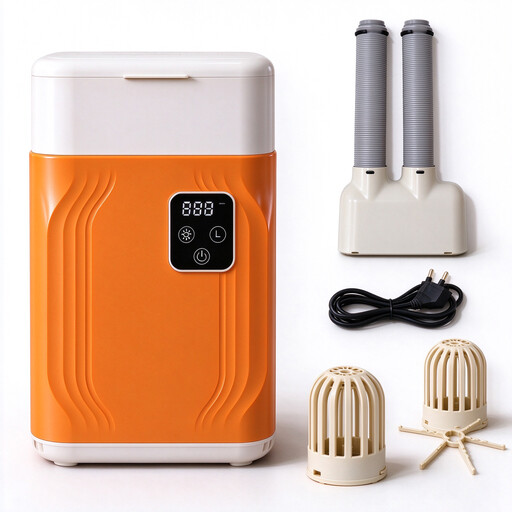 Image unavailable
This is a portable heated clothes dryer, not an airer; only choose it if this is the type of appliance you’re specifically looking for.
The description mentions a timer and adjustable drying cycles.
Keep the appliance at least 50 cm away from flammable materials, don’t block the air vents and don’t touch the hot air outlet.
It can help if cotton shorts won’t dry indoors in time for your next load. If drying time isn’t an issue, an unheated airer may be enough; you can’t tell whether your shorts will dry faster from the stated wattage alone.
Multiply the wattage in kW by the number of hours the appliance is switched on. Adler states that the AD 7821 has a wattage of 220 W: if it runs continuously for four hours at its full stated wattage, that’s 0,220 × 4 = 0,88 kWh. Actual electricity use may vary; then multiply the result by your own price per kWh.
You can’t tell from the word ‘cotton’ alone. Check the care label on each pair of shorts and follow the fabric and usage restrictions for the airer you choose.
Choose a stable spot where you can ventilate the room, and follow the instructions for your model. Brandweer Nederland advises fully unwinding a cable reel if you use one. Check the appliance instructions for how to switch it off and let it cool before cleaning.