
People with limited floor space
If you want to hang your pyjamas indoors without permanently blocking your walkway, compare the airer’s dimensions both opened out and folded away.


A heated airer could work if you want to spread out your pyjamas indoors and can put the airer away after use. First, measure the available space with it fully opened out. Heat does not remove moisture, so choose somewhere you can ventilate well. Then compare the hanging layout, folded dimensions and stated wattage, and check the instructions and model-specific conformity documentation before buying.
If you want to hang your pyjamas indoors without permanently blocking your walkway, compare the airer’s dimensions both opened out and folded away.
When drying clothes indoors, it’s important to consider how the room will be ventilated beforehand; extra heat is no substitute for fresh air.
If you regularly dry small items of clothing, consider the hanging layout, running time and electricity use when choosing an airer.
First, measure the available space and work out how you can ventilate the drying area. Then compare the hanging layout, folded dimensions and wattage with what you need for your pyjamas.
| What to consider | What should you look for? | Who should pay particular attention? |
|---|---|---|
| Fit and storage | Measure the space with the airer opened out, then compare it with the folded dimensions and the distance to a power socket. | I want to put the airer away after use, so available floor space and keeping the walkway clear come first; around 28% of consumers say fit and storage are their main concern when buying. |
| Removing moisture | Choose a spot where air can circulate and which can be ventilated well while clothes are drying. | If I dry pyjamas indoors, I want to avoid moisture building up in a poorly ventilated room; around 22% of consumers put moisture control first. |
| Hanging space | Check the position and layout of the rails, the stated drying length and the maximum load. | I want to hang pyjama pieces separately, possibly alongside small items of washing; around 22% of consumers give usable hanging space top priority. |
| Electricity use | Compare the stated wattage and calculate based on how long you use it: kWh = kW × hours. A calculation based on rated power is not a measurement of actual consumption. | If you want to know in advance what regular heating could mean for your electricity use, put running costs first; around 17% of consumers do. |
| Safe use and fabric | Check the care label, the instructions for the exact model and the model-specific conformity documentation. | I want to check the instructions and whether my pyjamas are suitable first; around 11% of consumers put safe use and fabric suitability first. |
Milieu Centraal recommends paying attention to ventilation when drying washing indoors. A heated airer does not remove the need to vent moist air.
An airer may take up very little space when folded away, but still occupy part of the floor or block a walkway when in use.
Measure the space with the airer fully opened out and check where the power socket is, too.
Milieu Centraal points out that drying washing adds moisture to the air indoors. Heating does not remove that moisture from your home by itself.
First choose a well-ventilated place to dry your clothes, and don’t rely on extra heat alone if you already have a damp problem.
An airer’s heat-up time doesn’t tell you how quickly a particular pair of pyjamas will dry. Wattage alone is also not a measure of drying time or electricity use per drying cycle.
Only compare drying claims when the test conditions match, and calculate electricity use based on the wattage and how long you use the airer.
DOMO describes the DO7117DR as a slim heated airer that can be used freestanding or wall-mounted; its hanging style differs from that of a winged airer.
According to Brabantia, its range includes folding, hanging and tower airers, among other unheated alternatives.
Leifheit showcases wall-mounted and hanging airers, among other space-saving drying solutions.
This selection includes a heated wall-mounted airer, a heated folding winged airer and a folding indoor clothes airer. Before buying a heated model, check the documentation for applicable conformity requirements and the required CE marking; a product listing alone does not prove that a specific model meets them.
 No image available
Could work if you have limited floor space and a suitable place to mount it on the wall.
The product description lists a 58,5 × 55 cm wall-mounted model with touch controls, a digital temperature display and a top shelf. Check that the mounting location is suitable.
 No image available
Could work if you want to spread out your pyjamas and can put the airer away after use.
The stated wattage is 230 W and the dimensions are 144 × 53 × 91 cm. The product instructions specify indoor use on a stable, level surface, good ventilation and a clearance of at least 31 cm from walls. They also require an earthed socket and recommend switching off and unplugging the airer after use.
 No image available
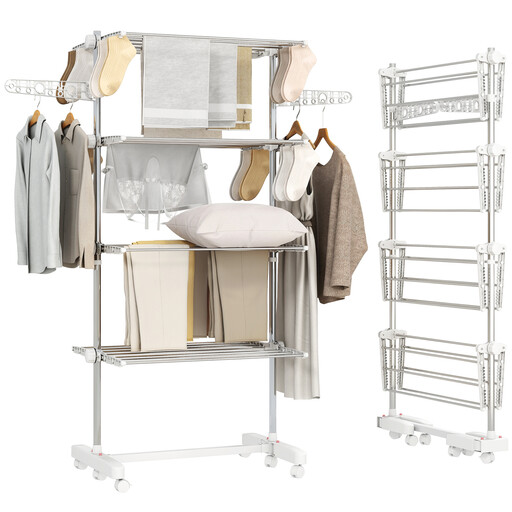
Could work if you need several places to hang clothes and have enough room to open out the airer.
The product description lists four main tiers and two side wings with hanger spaces. The dimensions when in use are 172 × 142 × 55 cm; folded, the airer measures 172 × 80 × 13 cm. Measure the space available when it’s set up.
Measure the available floor space with the airer opened out, keep a clear walkway and follow the placement and connection instructions for the exact model. Make sure moisture can be vented from the drying area, too; a heated airer won’t do that by itself.
Multiply the wattage in kilowatts by the number of hours it’s used to get an estimate in kilowatt-hours. Actual consumption and drying time depend on how you use the airer and the conditions; a calculation based on rated power is not a measurement.
Follow the instructions for the exact model and don’t use the airer if its cable is damaged. The instructions for one model say to switch it off, unplug it and let it cool before cleaning; don’t assume this guidance applies to other versions.
For a standard online consumer purchase, you generally have a 14-day statutory cooling-off period after delivery, subject to applicable exceptions. You’re also entitled to a product that meets reasonable expectations: if it breaks sooner than you could reasonably expect under normal use, the seller must put things right under the applicable guarantee rules.
Electrical appliances placed on the market in the Netherlands are subject to applicable European product rules. The required CE marking is the manufacturer’s declaration that the product meets the relevant rules; it is not an independent practical test. Check the documentation for the exact model and follow the instructions.