
Regular indoor dryer
If you dry several pillowcases indoors when the seasons change, focus on whether you can hang them separately. Silvergear and DOMO product information shows a range of airer designs.


If you regularly dry several pillowcases indoors and want to put them away sooner, a heated airer could be a good fit, provided you can hang the cases separately and have room for the airer when it’s fully open. For occasional use, an unheated airer is another option that uses no electricity; you’ll still need to ventilate the room when drying indoors. If you choose an electric model, check that the specific product carries the CE mark.
If you dry several pillowcases indoors when the seasons change, focus on whether you can hang them separately. Silvergear and DOMO product information shows a range of airer designs.
If you want to free up floor space after drying, compare a folding model with a compact or wall-mounted option. DOMO describes the DO7117DR as suitable for both freestanding and wall-mounted use.
If you only dry a few pillowcases now and then, you can weigh up an unheated airer against an electric model. Milieu Centraal recommends drying laundry on a washing line where possible, outdoors or in an unheated room.
Suitable if: you regularly dry laundry indoors, have room for an airer when it’s open and can spread the pillowcases across separate rails.
Consider: the airer takes up floor space while in use and uses electricity; a cover doesn’t replace ventilation.
Suitable if: you have less floor width available and the design suits the shape and size of your pillowcases.
Consider: a more compact footprint doesn’t necessarily mean a wide pillowcase will fit without being folded in half; also check the wall-mounting instructions.
Suitable if: you only dry pillowcases occasionally and want to avoid using electricity for the airer.
Consider: ventilation is still important when drying indoors; drying time depends on factors including the fabric, how damp it is and the humidity.
| What to consider | What to look for | Who it matters most to |
|---|---|---|
| Drying speed | Compare the usable rail length and spacing with your pillowcases. Silvergear lists 20 heated bars for the rail airer reviewed. | If I dry several pillowcases indoors when the seasons change, I want to put them away promptly without assuming a set drying time. Around 33% of consumers prioritise drying speed. |
| Hanging capacity | Check how many separate hanging spaces there are and whether the pillowcases fit without bunching up; don’t just look at the number of rails. | If I want to hang several pillowcases separately at the same time, the usable layout matters most. Around 27% of consumers consider having enough hanging space their main priority. |
| Space and storage | Measure the space available for the airer when it’s in use and check how it folds or can be mounted. DOMO describes the DO7117DR as suitable for both freestanding and wall-mounted use. | If a wide airer gets in the way at home, I want a design that takes up less room once the laundry is dry. Around 20% of consumers prioritise positioning and storage. |
| Electricity and ventilation | Compare the stated wattage with how long you expect to use the airer and your electricity tariff. Make sure the room is ventilated when drying indoors, too; Milieu Centraal explains the importance of fresh air coming in and stale air going out. | If I want to limit electricity use and clear humid air effectively, I weigh up heating against an unheated airer. Around 20% of consumers prioritise energy use and the indoor climate. |
The stated power rating doesn’t tell you how long your pillowcases will take to dry or how much electricity they’ll use.
Compare the wattage with how long you expect to use the airer and your own electricity tariff. If speed isn’t essential, consider an unheated airer as well.
A heat cover won’t automatically remove humid air from your home; ventilation is still needed when drying indoors.
Plan how you’ll ventilate the drying area and follow the instructions for the cover supplied with the specific model.
A similar appearance or power rating doesn’t prove that two airers are the same brand and model.
Before buying, compare the brand, full model name and the features that matter to you.
Silvergear offers heated rail airers with covers and heated drying towers; the designs vary in how much space they take up.
According to DOMO, the DO7117DR can be used freestanding or wall-mounted, making it an option if a wide floor-standing airer won’t fit.
These Joybuy products are folding airers for hanging and spreading out laundry, including an electrically heated model. Check that your pillowcases fit in the available hanging spaces.
 No image available
The fold-out side wings provide extra space to spread out laundry; the airer folds away for storage after use.
Power: 230 W. Dimensions: 144 × 53 × 91 cm.
Use indoors on a stable, flat surface, with adequate ventilation and at least 31 cm of clearance from walls.
 No image available
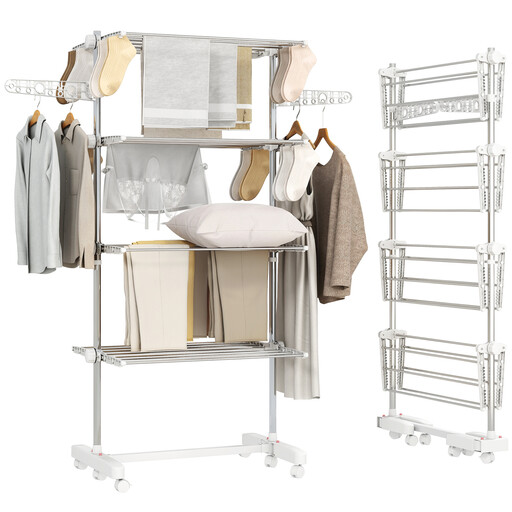
The shelves and rotating side wings provide several drying positions; the folding design is made to store more compactly after use.
Four shelves and two side wings with slots for hangers. Maximum load: 30 kg; load each shelf with a maximum of 6 kg.
Lock the wheels during use and distribute the laundry evenly.
Yes. Heating doesn’t automatically remove moisture from your home. Milieu Centraal explains that ventilation requires both fresh air coming in and stale air going out, and identifies drying laundry as a source of moisture in the home.
Divide the stated power in watts by 1,000, then multiply it by the number of hours you use the airer to calculate the energy used in kWh. Multiply this by your own price per kWh. Silvergear lists 230 W for the rail airer reviewed, but that power rating doesn’t tell you how long your pillowcases will take to dry.
Only if the instructions for the exact model allow it and the intended location is suitable. DOMO lists IPX4 and freestanding or wall-mounted use for the DO7117DR; these model-specific details don’t mean that every location or other airers are suitable.
According to the Netherlands Food and Consumer Product Safety Authority, a CE mark is required for electrical products covered by the applicable product regulations. The mark is the manufacturer’s declaration of conformity, not proof of independent testing; check the mark and product information for the specific item.