
A host short on drying time
You want a small number of clean flannels dry before your guests arrive, and are looking for a suitable drying set-up with adjustable settings. The time needed to dry them will depend on the fabric and the conditions.


If you need a few clean flannels ready before family visit, a compact airer is a sensible starting point, as long as you can hang the flannels separately. A larger model is a better fit if you regularly dry more textiles at once. Heating and a timer don’t guarantee a drying time, and good ventilation and a suitable place to set up the airer remain important.
You want a small number of clean flannels dry before your guests arrive, and are looking for a suitable drying set-up with adjustable settings. The time needed to dry them will depend on the fabric and the conditions.
You need somewhere to dry a few flannels without having a large airer taking up space in your home. The space available and the choice between a freestanding model and wall mounting are key considerations.
You want to hang flannels alongside other textiles and weigh up the drying space against the floor space required, ventilation and electricity use.
Start by thinking about where the airer can stand or be mounted, and how much washing you want to dry at once. Then compare heated models with natural drying: the stated wattage alone won’t tell you how long a flannel will take to dry.
| What to consider | What to look for | Who is this important for? |
|---|---|---|
| Drying time | Check whether you can hang the flannels separately and whether there’s a timer; check for yourself that they’re dry. | I want to hang the flannels separately before my guests arrive and check for myself that they’re dry. Around 36% of consumers put drying time first. |
| Space | Measure the space available and check whether a freestanding airer or wall-mounted model will fit. | If space is limited, I want to be able to put the airer where I’ll use it. For around 29% of consumers, having a suitable place to set it up is the top priority. |
| Ventilation and positioning | Follow the instructions on where to set it up and make sure the room is ventilated when drying indoors. | I want to dry clothes indoors without trapping moisture, and only set up the airer where the instructions say it can go. Positioning and ventilation are top priorities for around 21% of consumers. |
| Electricity use | Compare both wattage and how long it’s used for; don’t assume a set drying time or a particular saving. | For a small load, I want to know whether heating is worthwhile compared with taking longer to dry naturally. Running costs are the biggest consideration for around 14% of consumers. |
Milieu Centraal recommends extra ventilation when drying washing indoors. When discussing the SpeedDryer, Consumentenbond lists fabric thickness, humidity and room temperature among the factors that affect drying time; this is not a drying-time test for heated airers.
A stated temperature doesn’t prove that a flannel has been hygienically cleaned.
Wash the flannels according to the care label and use an airer for drying, not as a substitute for washing.
Wattage alone doesn’t tell you how long drying will take or how much electricity one drying cycle will use.
Compare wattage and usage time for a similar load. If you have enough time, you could also consider drying naturally.
Using the airer for longer may use more electricity, so take account of how long it will be switched on.
Drying clothes indoors releases moisture; Milieu Centraal recommends extra ventilation.
Plan for ventilation and follow the set-up and usage instructions for the specific model.
The DOMO DO7117DR is a compact heated towel rail which, according to the manufacturer, can be freestanding or wall-mounted.
The Warmmat is a heated winged airer with temperature and timer settings, designed for anyone who wants to hang more textiles at once.
The 21m electric model is designed for larger loads of washing and comes with a cover.
This selection includes a wall-mounted heated towel rail, a folding electric airer and a portable heated clothes dryer. Electrical products placed on the market in the Netherlands must meet the applicable EU safety requirements and carry CE marking. The Netherlands Food and Consumer Product Safety Authority and Ondernemersplein also describe the requirements for an EU declaration of conformity; check the required marking and documentation for the specific model.
 No image available
Could suit you if you don’t want a freestanding airer and have a suitable place for wall mounting.
Wall-mounted, with touch controls, a digital temperature display and a top shelf.
 No image available
A good fit if you want to hang several flannels separately and have space for a folding airer.
Dimensions: 144 × 53 × 91 cm. Use indoors on a stable, level surface, with ventilation and at least 31 cm of clearance from walls.
 No image available
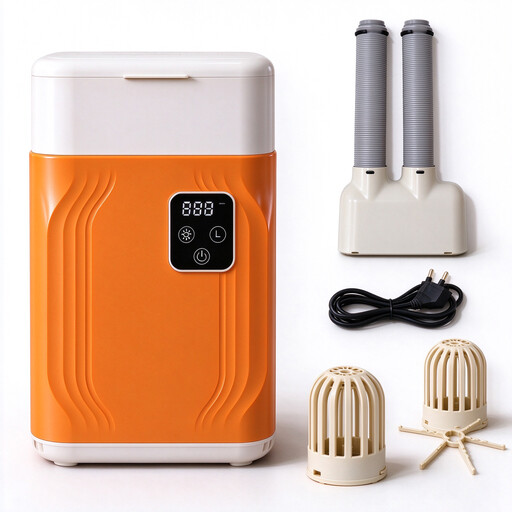
Could suit you if you’re looking for a portable heated drying solution; this is a clothes dryer, not an airer.
Use indoors only. According to the product description, keep it 50 cm away from flammable materials, don’t block the air vents and don’t touch the hot air outlet.
Hang them without overlapping and leave space for air to circulate. Check for yourself that the thicker parts are dry too; a timer sets how long the airer runs but doesn’t guarantee a drying time.
No, don’t assume that based on the product category. DOMO lists IPX4 for the DO7117DR, but check the instructions and suitable set-up location for the model you choose.
Multiply the power in kilowatts by the number of hours it’s used to calculate the energy consumption in kWh. A 230 W model switched on for 3 hours works out at 0.69 kWh; this doesn’t establish the actual electricity use or the drying time needed.
Electrical products placed on the market in the Netherlands must meet the applicable EU safety requirements and carry CE marking. The Netherlands Food and Consumer Product Safety Authority and Ondernemersplein also describe the EU declaration of conformity; a general product description doesn’t prove that a particular item meets the requirements.
Yes, if you have enough time and can dry your washing in a suitable place. Milieu Centraal recommends extra ventilation when drying indoors; don’t rely on a set drying time if you need the flannels ready for guests.