
A small weekend wash
You wash a few face cloths at a time and want to know whether heat offers any benefit over spreading them out on a standard airer. Milieu Centraal recommends hanging washing out whenever possible.


For a small load of flannels before the working week, you don’t necessarily need heat. If you can hang them out separately in good time and ventilate the room, a standard airer uses no electricity. Milieu Centraal recommends hanging washing out whenever possible, while Consumentenbond points out that drying time depends on factors including the fabric, how wet it is and the room temperature. Choose a heated model if you want to add warmth indoors, but compare the dimensions, hanging space and controls. The stated wattage alone won’t tell you how long your cloths will take to dry or what a drying session will cost.
You wash a few face cloths at a time and want to know whether heat offers any benefit over spreading them out on a standard airer. Milieu Centraal recommends hanging washing out whenever possible.
You dry clothes indoors and need room for the airer when it’s open, as well as space for ventilation. A tower and a flat airer make different use of the available drying space.
You often dry small loads and want to consider electricity use and safe operation, rather than looking only at the wattage on the packaging.
Choose this when: you can spread out a small load and have time to let it dry.
Consider: the airer itself uses no electricity, but drying time depends on factors including humidity, temperature and how you hang the fabric. Milieu Centraal recommends ventilating indoors when drying washing.
Choose this when: you dry small loads and have room for the open airer, with space between the cloths.
Consider: heated rails use electricity. Check which rails heat up on each model and how the controls work. Wattage alone doesn’t predict drying time per load.
Choose this when: you want to hang several cloths or other washing and have limited floor space.
Consider: the height and the space between hanging items determine whether the layout works for your washing. Check the dimensions and instructions for the specific model.
| What to consider | What to check before buying | Who is this most important to? |
|---|---|---|
| Drying in time | How many cloths you can hang separately, which rails heat up and whether the timer suits your routine. | If I need the cloths dry before the working week, I want to be able to hang them separately. Around 33% of consumers prioritise drying in time. |
| Space and spacing | The dimensions when open and how much room is left between the cloths; compare the layout of a flat airer with that of a tower. | I want the airer to fit in my space without having to hang the cloths too close together. Around 27% of consumers prioritise available space. |
| Electricity use | The stated power and the operating time, using the same basis for comparison. Calculate kWh as kW × hours and use your own electricity tariff to estimate the cost. | If I’m considering heat, I want to know how much it adds to electricity use compared with a standard airer. Around 20% of consumers put electricity use at the top of their list. |
| Safe indoor use | The model-specific instructions for positioning and connecting the airer, and whether you can ventilate the room. | I want to be able to position the airer as instructed and let moisture escape from my home. Around 20% of consumers make safe indoor use their top priority. |
Without knowing the operating time and comparing like-for-like loads, a lower stated power rating per hour won’t tell you what a full drying session costs.
Compare energy use on the same time and load basis. Use your own electricity tariff to calculate the cost, and don’t treat this as a measurement of an actual drying session.
Even when using a heated airer, moisture from washing drying indoors needs to be able to escape from your home.
Choose a spot where you can ventilate the room and follow the instructions for covering the specific model.
Airers with a similar design may differ in model, dimensions and instructions for use.
Check the brand, full model name and key specifications before applying features or instructions from one airer to another.
The details below apply to specific models and come from the manufacturers; they are not the result of independent drying tests. A brand being mentioned does not, by itself, tell you which models are available on Joybuy.
The manufacturer describes a heated airer in 21 m and 12 m versions. The details below apply to the 21 m version.
Silvergear describes both a flat heated clothes airer and a heated drying tower, giving you two different layouts to compare.
According to the manufacturer, the Warmmat is a foldable heated airer with side wings.
This selection includes heated airers, as well as wall-mounted and freestanding airers. Check that the design, dimensions and positioning of each model suit your drying needs.
 No image available
Suitable if you want to dry and warm towels on the wall instead of setting up a freestanding airer.
Wall mounting required; the product description lists touch controls, a digital temperature display and a top shelf.
Check the instructions and product documentation for the exact model.
 No image available
A good fit if you want to spread out a small load indoors and put the airer away after use.
Stated dimensions: 144 × 53 × 91 cm; the description lists a recommended maximum load of 10 kg and two fold-out side wings.
Use this model in accordance with the product instructions, on a stable, flat surface with ventilation and at least 31 cm of clearance from walls. Also check the documentation for the exact electrical model.
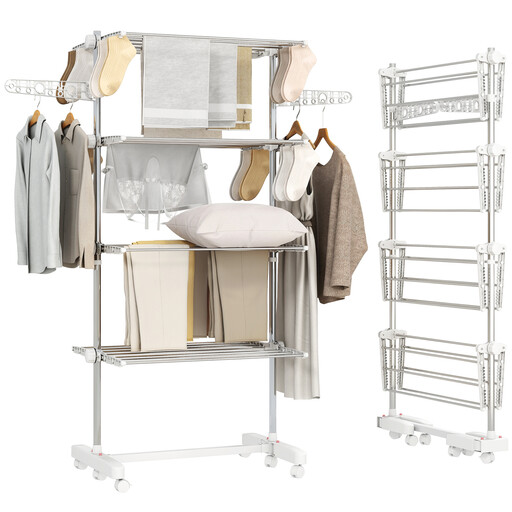 No image available
The different shelves and side arms offer hanging space for several small items of washing.
Four shelves and six wheels, two of which have brakes; the description lists a load capacity of up to 30 kg.
Lock the wheels during use and do not exceed the stated limit of 6 kg per shelf.
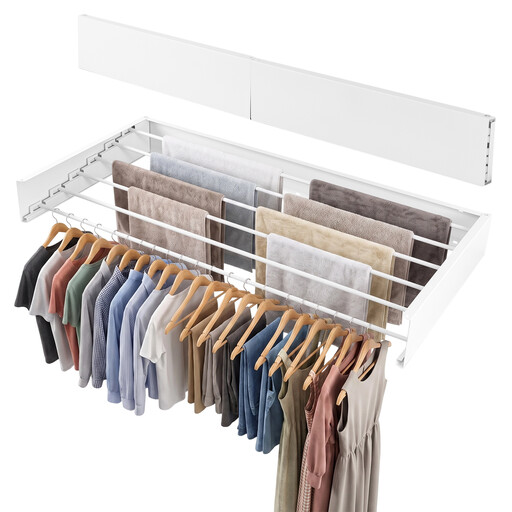 No image available
Suitable if you want to fit drying rails to the wall and don’t want a freestanding airer taking up floor space.
Six drying rails; stated load capacity of 15 kg and open dimensions of 100 × 50 cm. When folded, the airer has a profile of 3 cm, according to the description.
Wall mounting requires drilling; the description lists installation on concrete, brick or wood.
Not necessarily. If you can hang the cloths out separately in good time and ventilate the room, a standard airer uses no electricity. A reliable drying time for your load depends on factors including the fabric, how wet it is and the room.
Follow the instructions for the exact model on stable positioning, connection, clearance and cleaning. The instructions for the Joybuy airer with two side wings specify indoor use on a flat, stable surface with ventilation and clearance from walls; these do not automatically apply to other models. Also ventilate when drying washing indoors.
Multiply the power in kilowatts by the number of hours it is used to calculate energy use in kWh. Multiply this by your own tariff to estimate the cost; actual operating time and energy use may vary.
Applicable European requirements apply to electrical appliances. Ondernemersplein, a Dutch government website, explains that manufacturers must affix a CE mark and draw up an EU declaration of conformity when these requirements apply. A statement on a sales page does not, by itself, prove that a particular model meets the requirements.
If a product is faulty despite being used normally, the seller must put it right free of charge under ACM ConsuWijzer guidance, for example by repairing or replacing it, or refunding your money.