
Anyone who dries a few flannels every day
You regularly hang up small items and want to know whether a heated airer offers any benefit over hanging them out with no heat. Milieu Centraal lists hanging laundry up as an alternative to machine drying.


A heated airer isn’t automatically necessary for a few flannels: start by finding somewhere to hang them with space between each one, and a way to ventilate the damp air. An unheated airer uses no electricity; a compact heated model may be worth considering if you regularly want some extra warmth and have a suitable place and connection for it. Heating doesn’t replace ventilation, and the dimensions and instructions for the exact model will determine whether it’s suitable for your home.
You regularly hang up small items and want to know whether a heated airer offers any benefit over hanging them out with no heat. Milieu Centraal lists hanging laundry up as an alternative to machine drying.
You need to be able to use the airer at home and put it away afterwards. Compare its dimensions when open: a folding airer may take up more space than you expect when fully extended. DOMO also describes the DO7117DR as suitable for wall mounting.
You’re looking for a practical way to ventilate damp air. A heated airer dries textiles, but doesn’t remove the moisture from your home by itself; Milieu Centraal and GGD Leefomgeving highlight the importance of ventilation.
First, decide where you can dry flannels with enough ventilation. Then compare the floor space required and whether the extra heat is worth the electricity used for the way you plan to use it.
| Consideration | What should you look for? | Who is this important for? |
|---|---|---|
| Drying small loads | Compare how many items you can hang with space between them against the space available; a timer is only relevant if the model has one. | If I hang up a few flannels every day, I want to fit them on the airer without needing one that’s unnecessarily large. Around 25% of consumers make drying small daily loads their priority. |
| Space and storage | Check the dimensions when fully open, and whether the model is freestanding, foldable or designed for wall mounting. | If my floor space is limited, the airer needs to fit without blocking the way, and I want to know where I can store it afterwards. Around 25% of consumers prioritise the available space and where the airer will go. |
| Ventilating damp air | Consider ventilation options near the drying area and leave space between items; heating doesn’t remove moisture from your home. | If I dry laundry indoors, I want to be able to ventilate damp air before considering heating. Around 31% of consumers make controlling moisture their top priority. |
| Electricity use | Compare the stated power rating and how long you’ll use the airer; a timer only matters if the exact model has this feature. | If my main aim is to save electricity, I want to know whether hanging my flannels up without heat will be enough. Around 19% of consumers prioritise electricity use and purchase cost. |
A heated airer helps moisture evaporate from textiles, but doesn’t remove that moisture from your home by itself. So ventilation remains important when drying laundry indoors.
Start by choosing a drying spot where the air can be refreshed. If managing moisture is your main concern, look separately at how to ventilate damp air from indoors.
Choosing a different drying spot or arranging additional moisture control may mean taking extra steps.
An airer may be compact to store but still take up a lot of floor space when in use. This could block a walkway in an upper-floor flat.
Measure the space available and compare it with the airer’s dimensions when open. For wall-mounted models, make sure you also have a suitable place to install one.
The stated power rating won’t tell you when your flannels will be dry. The actual time they take depends on more than just the wattage.
Compare power ratings and usage times on the same basis. To get an estimate, multiply the power in kilowatts by the hours of use; this gives you energy consumption, not a guaranteed drying time.
According to DOMO, the DO7117DR is an electric airer for items including towels, and can be used freestanding or wall-mounted.
According to InnovaGoods, the Warmmat is a heated, foldable winged airer with space to spread out laundry.
Brabantia offers options for drying laundry without heat, including hanging airers and tower airers.
Leifheit lists holders for small items of laundry on certain versions of its Pegasus airers.
This selection of Joybuy products includes airers without heat and heated options for indoor use. In particular, compare the dimensions when in use and decide whether you need the extra heat for your flannels.
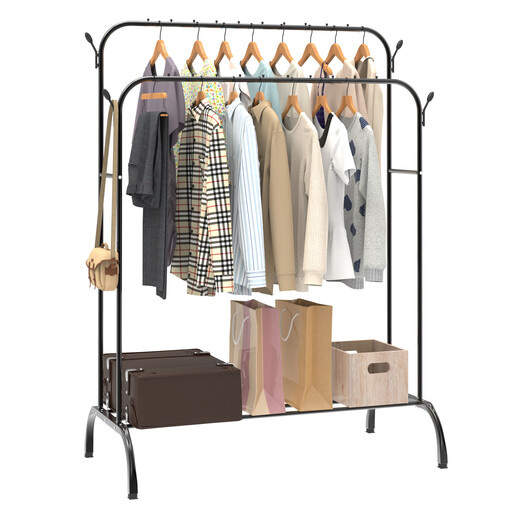 No image available
A freestanding option if you want to hang up flannels and other clothes indoors and have enough floor space.
The stated dimensions are approximately 110 × 55 × 150 cm. The airer has double rails and a storage shelf at the bottom.
 No image available
A wall-mounted heated option if you have a suitable place to install it and want extra warmth for towels or small items.
The product description lists touch controls, a digital temperature display, a top shelf and dimensions of 58,5 × 55 cm. Wall mounting is required.
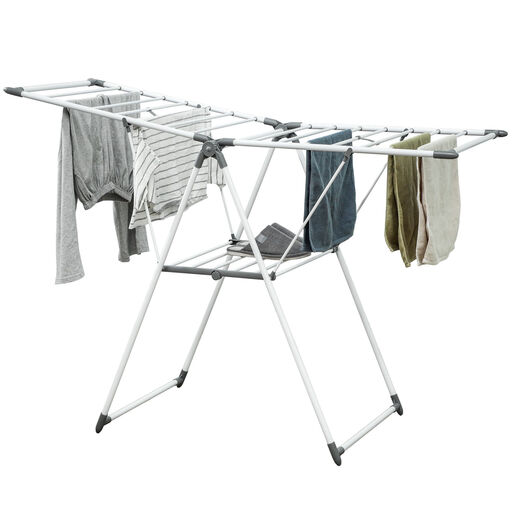 No image available
An unheated option if you want to hang up flannels and other laundry, then put the airer away after use.
The stated dimensions are 156,5 × 61,5 × 97 cm. According to the description, the wings adjust to four different heights and the airer folds down to a depth of 8 cm. The stated maximum load is 15 kg, evenly distributed.
 No image available
A heated option if you want to spread out several small items and have room for a winged airer.
The stated power rating is 230 W and the dimensions are 144 × 53 × 91 cm. The instructions say to use it on a stable, level surface with sufficient ventilation and at least 31 cm of clearance from walls; use a suitable earthed socket.
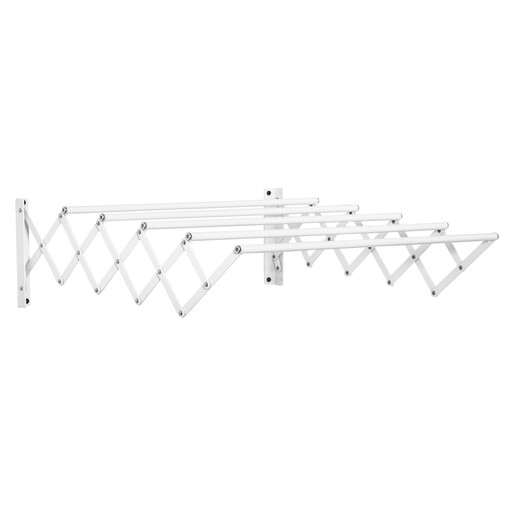 No image available
An unheated wall-mounted airer if you want to hang up small items and keep the floor clear when it’s not in use.
The description lists five rails, a maximum of 2 kg per rail and 10 kg in total. The airer is designed for wall mounting and folds flat against the wall.
No. Drying laundry indoors releases moisture into the air, so make sure the air can be refreshed and ventilated. A heated airer isn’t a dehumidifier.
Multiply the stated power rating in kilowatts by the number of hours you use it. Based on the stated power ratings, 150 W for 2 hours uses around 0,30 kWh, while 230 W for 2 hours uses around 0,46 kWh. This is a calculation, not a measurement of a drying cycle or a cost in money.
Use the airer according to the manual for the exact model, and check the product information and seller. Applicable European safety requirements and CE obligations apply to manufacturers of electrical appliances. The Netherlands Food and Consumer Product Safety Authority advises consumers to look for the CE marking; the CE mark alone isn’t an independent test report and doesn’t by itself prove that a specific item meets all requirements.
Keep shared escape routes clear. The Fire Service outlines rules on fire hazards in shared circulation areas; whether an airer is allowed in a particular spot depends on its location and the rules that apply.