
Renter with limited floor space
You want to hang up towels without an open airer taking up space you need to walk through. Measure both the spot where you’ll use the airer and the space where you’ll store it.


Choose a compact, portable heated towel rail if you mainly have a narrow space; a heated winged airer gives you more room to spread out your laundry, but takes up more space when open. An unheated airer is an alternative if you don’t want to use electricity for the airer. Heating doesn’t remove moisture from your home, so check the ventilation, the instructions for the intended location and the CE marking on an electric model.
You want to hang up towels without an open airer taking up space you need to walk through. Measure both the spot where you’ll use the airer and the space where you’ll store it.
You need drying space for regular use and want to weigh up whether a compact airer has enough rails or a larger winged airer would be a better fit.
You want to check where the moisture can go and whether the electric model can be used in the intended location according to its instructions.
Best for: a few towels and a narrow floor space; DOMO lists the DO7117DR as freestanding, with dimensions of 52,5 × 36,5 × 90 cm.
Bear in mind: there’s less room to spread out laundry than on a winged airer; heating uses electricity and doesn’t replace ventilation.
Best for: anyone who wants to spread out other laundry as well as towels and has enough space; InnovaGoods lists the Warmmat as having 20 rails and dimensions of approximately 148 × 112 × 54 cm when in use.
Bear in mind: it takes up more room when in use than when folded away.
Best for: anyone who wants to use an airer without it consuming electricity and has a suitable, well-ventilated place to dry clothes.
Bear in mind: moisture still needs to be removed from your home; a wall-mounted airer also needs to be fixed in place.
| What to consider | What to look for when buying | Who should pay particular attention? |
|---|---|---|
| Space for use and storage | Measure the full footprint when the airer is open, as well as its folded dimensions. Also allow for the space around the plug socket. | If you have limited room to move around, you’ll want to know whether the airer will fit when in use. Space is the main consideration for around 33% of consumers. |
| Drying space for towels | Compare the rail layout with your towels and check the stated load capacity. The number of rails alone doesn’t tell you how many towels will fit without overlapping. | If you use it every day, you’ll want enough rail space without the airer being too large. Around 27% of consumers focus mainly on towel capacity. |
| Ventilation and positioning | Follow the instructions for the specific model and location, and make sure ventilation can work properly. An IP rating alone doesn’t mean that every spot in the bathroom is suitable. Milieu Centraal recommends using additional extraction when drying laundry indoors if you have mechanical ventilation. | If the drying space is damp, you’ll want to know whether moisture can be removed and whether the airer can be placed there according to its instructions. Around 20% of consumers prioritise moisture and positioning. |
| Electricity use | Compare the stated power rating as well as how long you expect to use it. DOMO lists 150 W for the DO7117DR and InnovaGoods lists 230 W for the Warmmat; how long you use it also affects consumption. | If the airer will be switched on often, you’ll want to weigh up its electricity use against an unheated alternative. Around 20% of consumers focus mainly on electricity use. |
A winged airer may be compact when stored, but can take up much more floor space when in use. InnovaGoods gives the Warmmat’s dimensions when in use as approximately 148 × 112 × 54 cm.
Measure the space with the airer fully open and leave room to move around it.
An airer that doesn’t fit can block your way around the room while you’re drying clothes.
Heating doesn’t remove moisture from your home. Milieu Centraal warns that excess moisture can cause mould.
Choose a spot where your existing ventilation can keep working, and use it appropriately while clothes are drying.
Moisture can linger in your home if it isn’t extracted.
Eurom’s Sani-Towel 500 White is a wall-mounted radiator, not a portable airer. It’s a different option for a rented home because it needs to be installed.
Decide in advance whether you want a portable airer or a fixed installation. If you’re considering wall mounting, check whether the changes can be reversed.
DOMO describes the DO7117DR as a compact heated towel rail that can be used freestanding or wall-mounted.
InnovaGoods positions the Warmmat as a folding heated winged airer for anyone who wants to spread out more laundry and has enough floor space.
Eurom’s Sani-Towel 500 White is a fixed electric towel radiator for anyone considering bathroom heating too, not a freestanding airer.
Leifheit’s unheated Telegant 81 Protect Plus is a wall-mounted airer for anyone who can dry clothes without heating and has a suitable spot.
These products are options for drying towels in a small home, from freestanding stands to folding and heated airers. Measure the space where you’ll use the airer and, for electric models, check the CE marking and positioning instructions.
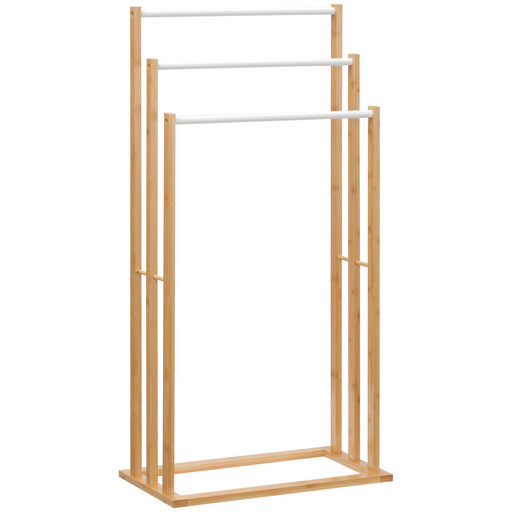 No image available
A freestanding stand for hanging towels on separate rails.
The product name lists bamboo, natural and white, and three rails.
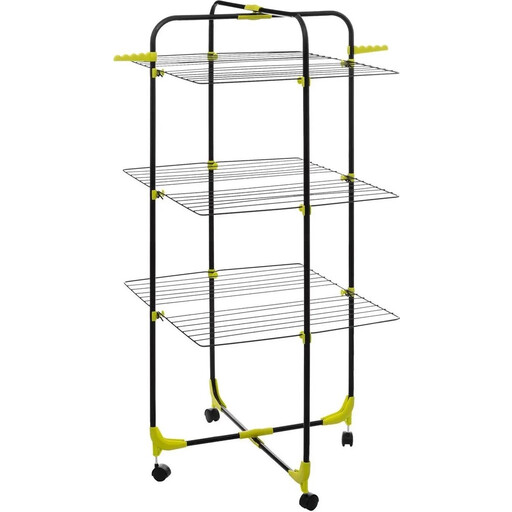 No image available
A folding airer for anyone who wants to dry other laundry as well as towels.
The product name lists 30 m of drying space and a folding design.
 No image available
A wall-mounted heated option if you want a fixed spot and the fittings are suitable for your rented home.
The product name lists touch controls, a digital temperature display and a top shelf. Check the CE marking, installation requirements and instructions for the intended location.
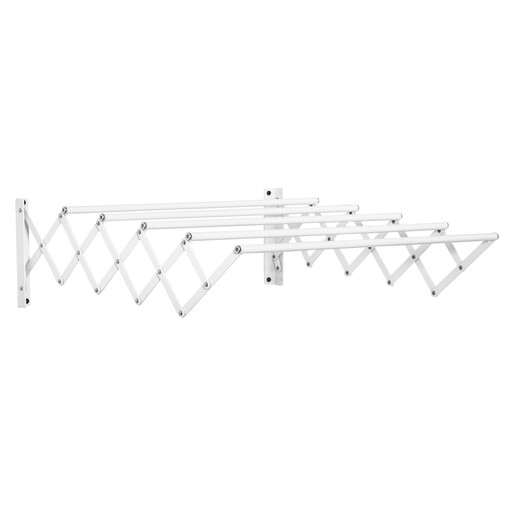 No image available
A wall-mounted airer can free up floor space if it’s possible to install it in the right place.
The product name lists five rails and dimensions of 63,5 × 60 × 20 cm. Check in advance whether the installation can be reversed in your rented home.
 No image available
A heated winged airer for anyone who wants to spread out laundry and has space for it when in use.
The product name lists 230 W and dimensions of 144 × 53 × 91 cm when in use. Follow the product-specific instructions on surfaces, ventilation, clearance from walls and connection; also check the CE marking.
Don’t assume it’s suitable just because it says ‘bathroom’ or has an IP code. DOMO lists IPX4 for the DO7117DR, but safe positioning and connection depend on the model-specific instructions and the electrical installation in your bathroom.
Yes, because heating doesn’t remove moisture from your home. Milieu Centraal warns that excess moisture can cause mould and recommends increasing mechanical extraction when drying laundry indoors if you have it.
According to the Dutch government, you don’t need your landlord’s permission for a minor alteration that can be reversed without excessive cost, but you do need permission for a renovation. Check what the installation involves and discuss any concerns with your landlord beforehand.
With normal use, the seller must put a faulty product right free of charge, for example by repairing or replacing it, or refunding you, according to ACM ConsuWijzer. A manufacturer’s guarantee doesn’t automatically limit this right.
No. The Netherlands Food and Consumer Product Safety Authority states that CE marking is required for electrical products covered by the applicable rules, while an inspection isn’t generally mandatory for this product group. Check the CE marking on the electric model you’re considering.
It depends on the actual power rating and how long the heating element is switched on. DOMO lists 150 W for the DO7117DR; as a calculation example, 150 W for four hours is 0,6 kWh. This isn’t a measured drying time or the airer’s actual electricity consumption.