
Drying sportswear with care
You regularly tumble dry sportswear that the care label says is suitable, and want to find the right programme rather than rely on a general claim about protecting clothes.


Start by checking the care label on each item and only choose a heat pump tumble dryer programme that the manual says is suitable for that fabric and load. Then compare the capacity with your usual laundry load, the programme duration and the current energy label. The Consumers’ Association notes that heat pump tumble dryers dry at lower temperatures, so they generally take longer than traditional condenser dryers. A programme name alone does not mean that a garment is suitable for tumble drying.
You regularly tumble dry sportswear that the care label says is suitable, and want to find the right programme rather than rely on a general claim about protecting clothes.
When changing your wardrobe for the season, you also dry other suitable laundry and want to weigh up capacity, drying time and condensation in your utility room.
You expect to use your tumble dryer often, so you compare energy use with the purchase price and programme duration.
| What to consider | What should you look for? | Who should prioritise this? |
|---|---|---|
| Programme and fabric care | Read the care label and check the manual to see which fabrics and loads are suitable for the sportswear, synthetics or outdoor programme. | I want to follow the care label for each item and choose a programme that suits the fabric; around 40% of consumers put fabric care first when buying. |
| Capacity and drying time | Compare the drum capacity with your usual load, and check the programme duration and maximum load for the programme. | When changing my wardrobe for the season, I want to know whether my usual laundry will fit in one load, without choosing more capacity than I need for smaller loads; around 20% of consumers prioritise load size and drying time. |
| Energy use and drying time | Compare the current EU energy labels and energy consumption figures for the exact models on the same measurement basis; do not treat old and current label classes as directly comparable. | If I use my tumble dryer often, I want to weigh up energy use against the purchase price and longer drying times; around 30% of consumers put energy and running costs first when buying. |
| Installation and maintenance | Measure the space and check access for the door and maintenance, condensation efficiency and whether a connection to the water drain is available. | I want to know in advance whether the appliance will fit practically and how much attention the utility room will need; around 10% of consumers name installation and maintenance as their main deciding factor. |
The permitted drying method can vary from one garment to another. A specialist programme does not override the care label.
Sort your laundry according to the care labels, then follow the programme instructions for the exact model.
EU rules for tumble dryers were updated from 1 July 2025. An older label class is not the same as a class on the current scale.
Compare the labels and energy figures for the exact models using the same current measurement basis. The European Commission outlined the application of the updated rules from 1 July 2025.
Load capacity, programme duration, dimensions and condensation efficiency are separate factors to consider. A large capacity alone does not tell you how long a small load of synthetics will take.
As well as load capacity, check the programme’s permitted load, the dimensions and the condensation efficiency.
The WQG133DBNL is an 8 kg heat pump tumble dryer with a sportswear programme.
The TR86CBC89 from the 8000 AbsoluteCare range is an option if you also need to dry suitable outdoor clothing.
The BM3T3824W is an 8 kg heat pump tumble dryer with a drying sensor.
According to Miele, the TWV780WP Passion has programmes for sportswear and HighTech fabrics.
This selection includes heat pump tumble dryers with listed programmes for sportswear, synthetics or delicate laundry, as well as models with a stated capacity for larger suitable loads.
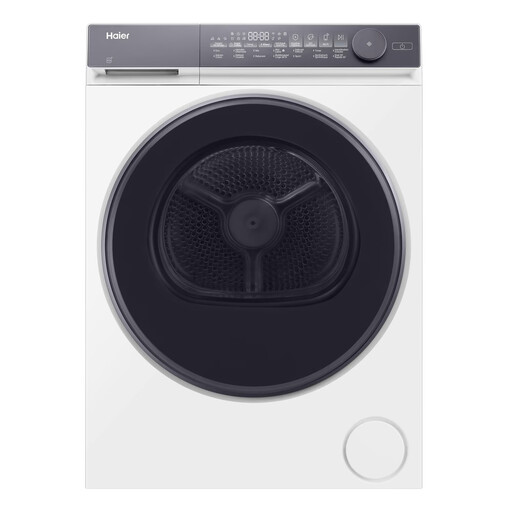 Image unavailable
The product description lists programmes for sportswear and synthetic fabrics.
The description states a capacity of 8 kg, 14 programmes and moisture sensing.
 Image unavailable
The product description lists programmes for sportswear and synthetic fabrics.
The description mentions Auto Dry with moisture sensing and a self-cleaning condenser.
The stated programme duration is 195 minutes for a full cotton load and 125 minutes for a partial load.
This version has an NL/FR control panel.
 Image unavailable
The product description lists a sportswear programme and Auto Dry with moisture sensing.
The description states a 40-minute quick programme and condensation efficiency class B.
This version has a German control panel.
 Image unavailable
The product description lists programmes for synthetic and delicate laundry, with a sensor drying system.
The description states 15 programmes, a display showing the time remaining and a filter indicator.
 Image unavailable
The product description lists programmes for synthetic and delicate laundry, Auto Dry with moisture sensing and a Gentle Dry mode.
The description states 20- and 40-minute programmes and a 3-in-1 filter.
No. Always check the garment’s care label first. The symbols show whether tumble drying is permitted; a sportswear or outdoor programme does not override a ban on tumble drying.
Compare the appliance’s dimensions and the access it needs with the space available. If ventilation is limited, check the condensation efficiency too. A drain connection is only practical if the model and location are suitable for it.
Follow the maintenance instructions for the exact model, including those for the filters and condenser. Check in advance how much maintenance is needed: for example, the Bosch WQG133DBNL does not have a self-cleaning condenser.
Compare the applicable EU energy labels for the exact models using the same current scale. The updated EU rules have applied since 1 July 2025; older classes such as A+++ are not directly comparable with the current A–G scale. The European Commission outlined when the updated rules came into force.
Report a problem to the seller. In the Netherlands, the government says there is no fixed statutory guarantee period; you are entitled to a product that meets what you could reasonably expect from it. A manufacturer’s guarantee is separate from this.