
If you mainly dry small loads
You want the capacity and programmes to suit smaller loads. Milieu Centraal says 6 or 7 kg is often enough if you live alone or don’t use your tumble dryer very often.


A shallower 7 kg tumble dryer is an obvious choice if you usually dry small loads and have limited space. Milieu Centraal says 6 or 7 kg is often enough if you live alone or do little drying. If you alternate between small and larger loads, you could also compare an 8kg model with a dedicated half-load option, provided you have enough depth. Beko lists the BM3T3722B as 54.5 cm deep, while Bosch lists the WQA23309NL as an 8 kg model with a half-load option. Always measure the full space available and check the installation requirements for your chosen model.
You want the capacity and programmes to suit smaller loads. Milieu Centraal says 6 or 7 kg is often enough if you live alone or don’t use your tumble dryer very often.
You need to fit your tumble dryer into a small alcove or above a washing machine. So measure more than just the appliance: check the clearance needed and the installation requirements too. The Consumentenbond highlights the need for space above, beside and behind the machine.
You want to take the current energy label into account when choosing, and consider moisture in a small laundry room. The Consumentenbond explains that the energy label for tumble dryers was updated on 1 July 2025.
A good fit if: you usually dry small loads and the available depth is the deciding factor.
Bear in mind: the rated capacity is smaller, and the appliance depth alone doesn’t tell you how much installation space you’ll need.
A good fit if: you alternate between small and larger loads and have enough depth for the appliance.
Bear in mind: a half-load option doesn’t tell you how much energy your individual load will use.
A good fit if: you don’t have a suitable place for one; drying your clothes on a washing line could be an alternative.
Bear in mind: a washer-dryer has a different drying capacity and programme duration from a separate heat pump tumble dryer.
| What to consider | What to look for when buying | Who is this important for? |
|---|---|---|
| Capacity and small loads | Compare the rated capacity and check whether the model specifically offers a small-load or half-load option. | If I usually dry small loads, I want a capacity and programmes that suit that amount of laundry. Around 34% of consumers say small loads are their top priority when buying. |
| Installation space | Measure the height, width and depth. Also check the door swing, the clearance specified in the manual and whether a stacking kit is suitable, if you need one. | If I have a tight alcove or want to stack the tumble dryer above the washing machine, I need to know the whole setup will fit. Around 33% of consumers put finding a suitable place for their appliance first. |
| Energy use | Check the current EU energy label and product information sheet for the exact model. Compare energy use and programme duration on the same basis. | If electricity use is my deciding factor, I want to compare models using the same current energy label. Around 20% of consumers put energy use at the top of their list. |
| Moisture and maintenance | Check condensation efficiency, where the condensate tank is located, whether there’s a water-drain connection and the model’s maintenance instructions. | In a small laundry room, I want to know how to manage moisture and day-to-day maintenance. Around 13% of consumers prioritise maintenance and moisture control. |
The stated depth isn’t the same as the installation space required. If you’re fitting the tumble dryer under a worktop, you may also need clearance above, beside and behind it, according to the Consumentenbond.
Measure the full space and check the installation requirements for the exact model before placing your order.
If the space doesn’t meet the installation requirements, you may not be able to put the tumble dryer there.
The European Commission and the Consumentenbond state that the energy label for tumble dryers was updated on 1 July 2025. The new ecodesign requirements apply to machines newly placed on the market from that date; they don’t apply retrospectively to machines that were already on the market.
Compare current product information sheets using the same energy label, and don’t treat an old A+++ label as a class on the new A-to-G scale.
A washer-dryer takes up less space than a separate washing machine and tumble dryer, but the Consumentenbond says standard washer-dryers have longer programmes and use more energy when drying.
Before choosing one to save space, compare the drying capacity, programme duration and energy use of that particular washer-dryer with those of a separate tumble dryer.
The BM3T3722B and BM3T3824W offer a useful comparison between a 7kg model and an 8kg model with different appliance depths.
The WQA23309NL is worth considering if you alternate between small and larger loads.
The RHX1008NWH is worth a look if you’re considering maintenance features in an 8kg model.
The TR728D4Z is a model to compare by capacity, dimensions and energy label details.
These Joybuy products are heat pump tumble dryers. Compare their stated capacities and programme features with the amount of laundry you usually dry and the space available.
 Image unavailable
The listed moisture-sensing Sensor Dry function and drying programmes may be useful if you’re comparing features for different load sizes.
The product name lists an 8 kg capacity, energy label E and a white finish. The product description mentions 15 drying programmes and Sensor Dry.
 Image unavailable
This model is worth comparing if you’re looking for an 8kg heat pump tumble dryer and want to consider its listed drying features.
The product name lists an 8 kg capacity, Eco Heat Pump and energy label E. The product description mentions Auto Dry and Quick Dry.
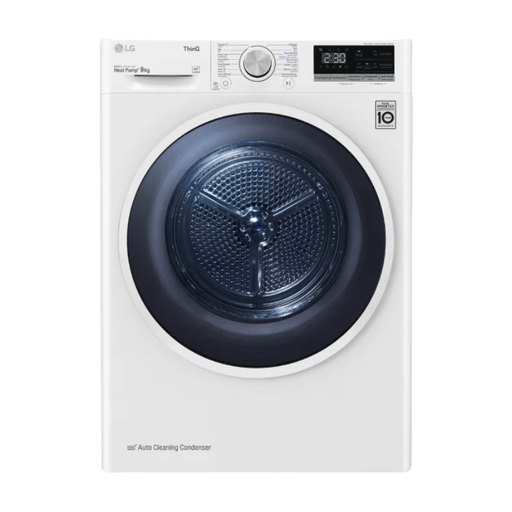 Image unavailable
The 9 kg capacity may suit you if you dry larger loads as well as small ones. Compare it with the space available and the amount of laundry you usually dry.
The product name lists a 9 kg capacity and a white finish. The product description mentions Sensor Dry, a self-cleaning condenser and Eco Hybrid, which lets you choose between faster or more energy-efficient drying.
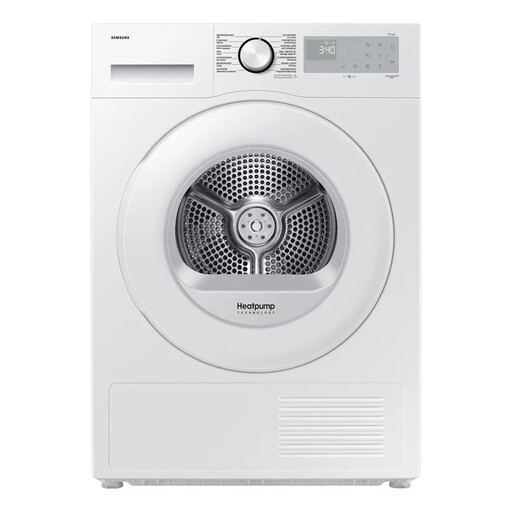 Image unavailable
A 9 kg capacity may suit you if you also dry larger loads. Check the appliance dimensions before considering this model for a limited space.
The product name lists a 9 kg capacity and heat pump technology. The product description mentions dimensions of 85 × 60 × 60 cm and the Optimal Dry system.
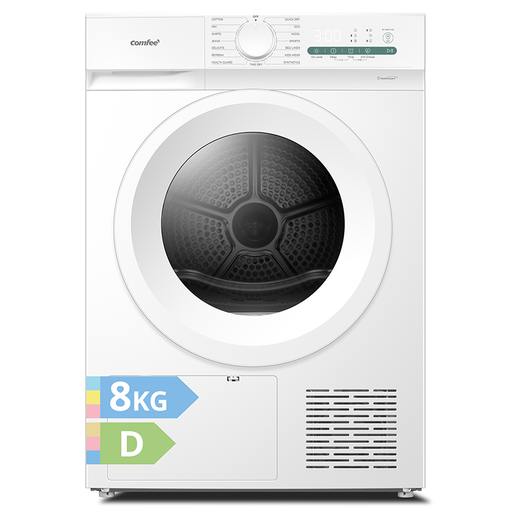 Image unavailable
This model is worth including when comparing 8kg tumble dryers. Check whether its capacity and programmes suit the small loads you usually dry.
The product name lists an 8 kg capacity and energy label D. The product description mentions three adjustable drying levels.
No. Milieu Centraal says 6 or 7 kg is often enough if you live alone or do little drying, but larger models with a dedicated small-load option are also available. Compare both options with the amount of laundry you usually dry and the space available.
Only if the combination and installation are suitable according to the requirements for the models in question. Check the dimensions and make sure you have a compatible stacking kit. The Consumentenbond recommends leaving enough clearance around the tumble dryer. Never put the washing machine on top of the tumble dryer.
Since 1 July 2025, tumble dryers have used the updated EU energy label, with an A-to-G scale. According to the European Commission, the new ecodesign requirements apply to machines newly placed on the market from that date. They don’t apply retrospectively to machines that were already on the market.
Clean the fluff filter according to the instructions and empty the condensate tank, unless the model is correctly connected to a water drain. Follow your tumble dryer’s manual for cleaning the condenser or heat exchanger; a self-cleaning function doesn’t replace the instructions for your specific model.