If you usually dry small loads, start by choosing a suitable capacity and compare it with a model that has a dedicated half-load function. That function alone doesn’t prove that your laundry will use less energy. Milieu Centraal says 6 or 7 kg is enough if you live alone or rarely use a tumble dryer. Then assess condensation efficiency, available space, ventilation and drainage in your utility room, and compare energy labels on the same basis.
Who should consider this choice?
If you usually dry small loads
You generally dry a small amount of laundry at a time and want to choose a drum capacity that suits how you use it. Milieu Centraal says 6 or 7 kg is enough if you live alone or rarely use a tumble dryer; also compare dedicated settings for small loads.
If you have a compact utility room
You want to know whether the tumble dryer will fit, without overlooking moisture and air circulation. The Consumentenbond points to the potential effects of damp air being released into a poorly ventilated room.
If you keep an eye on running costs
You want to weigh the purchase price against electricity use, drying time and maintenance. Check the current energy label and the features you’ll actually use.
What should you look for in a heat pump tumble dryer for small loads?
Start with the size of your usual load, then check the installation space, ventilation and drainage options you need. Next, compare current energy use and make sure the programmes suit your laundry and schedule.
| What to consider |
What to look for |
Who is this most relevant to? |
| Small loads |
Compare the capacity with your usual loads and the larger loads you occasionally dry. Check whether the exact model has a half-load function or a suitable programme. |
I usually dry small loads and want a drum capacity that suits how I use it. Around 33% of consumers say being able to dry small loads properly is their main concern when buying. |
| Positioning and moisture |
Measure the space, including the required clearance. Check the condensation efficiency class and whether the model can be connected to an existing drain. |
I want to know whether the tumble dryer will fit in my compact utility room and whether moisture can be managed. Around 27% of consumers say positioning and moisture are their main concerns when buying. |
| Energy use |
Compare energy labels on the same basis and check the consumption in kWh per 100 eco cycles. The label figure doesn’t automatically reflect the energy used for a small load or short programme. |
I want to weigh the purchase price against energy use and how often I’ll use the tumble dryer. Around 20% of consumers say running costs are their main concern when buying. |
| Programmes and fabrics |
Check the permitted load and fabric types for each programme, the programme duration and the care instructions on garment labels. |
If I dry different fabrics, I want to choose programmes that suit the load and my schedule. Around 20% of consumers say planning their drying and handling different fabrics are their main concerns when buying. |
Pitfalls to avoid when buying a heat pump tumble dryer
-
Assuming a half-load function halves energy use
A half-load function doesn’t tell you how much electricity your small load will use. Bosch lists this function for the WQG245D7NL, but that isn’t an independent measurement of energy use for small loads.
Compare the function with a suitably sized, smaller-capacity model, and consider both your usual loads and the larger ones you dry occasionally.
-
Checking only the tumble dryer’s external dimensions
Clearance, air circulation, moisture control and access to a drain all matter too. The Consumentenbond warns that damp air released into a poorly ventilated laundry room can contribute to mould growth.
Measure the installation space, follow the chosen model’s installation instructions, and check its condensation efficiency class and connection options.
-
Comparing an old A+++ label directly with a current label
Since 1 July 2025, tumble dryers have been labelled on an A–G scale. The European Commission and Energielabel.nl describe this current labelling scale; the old and current ratings aren’t directly interchangeable.
Check the latest model information and compare consumption in kWh per 100 eco cycles using the same labelling basis.
Brands and models to compare
Bosch
The WQG245D7NL is a 9kg model with a dedicated half-load function. This is a manufacturer specification, not an independent measurement for small loads.
- Bosch Netherlands lists Auto Dry and a self-cleaning condenser for this model.
- According to Bosch, the short cycle is limited to a small amount of thin or synthetic laundry. Check that the dimensions will fit.
Beko
The BM3T3722W is a 7kg heat pump tumble dryer that’s worth comparing if you usually dry small loads. A smaller drum doesn’t automatically guarantee lower energy use per small load.
- Beko Netherlands lists a drying sensor and a depth of 54,5 cm for this model.
- Beko lists energy class E on the current label and a noise level of 64 dBA. Consider each of these for this model separately.
AEG
AEG lists MixDry for the 8 kg TR7386T4B, a model to consider if you regularly dry different fabrics together.
- AEG lists energy class C for the TR7386T4B.
- AEG specifies condensation efficiency class C, 67 dB and a maximum depth of 663 mm. Consider noise, space and moisture control in your utility room.
Heat pump tumble dryers at Joybuy
These Joybuy product picks are heat pump tumble dryers to consider for small laundry loads and installation in a utility room. Capacity, programmes and connection options vary by model.
 Image unavailable
Candy BR 8N3BX-S heat pump tumble dryer, 8 kg
Worth considering if you’re looking for a sensor drying system and plenty of ventilation space; the product description identifies this as a freestanding model.
Capacity: 8 kg. Energy label: C. The product name mentions Wi-Fi (hOn).
Joybuy
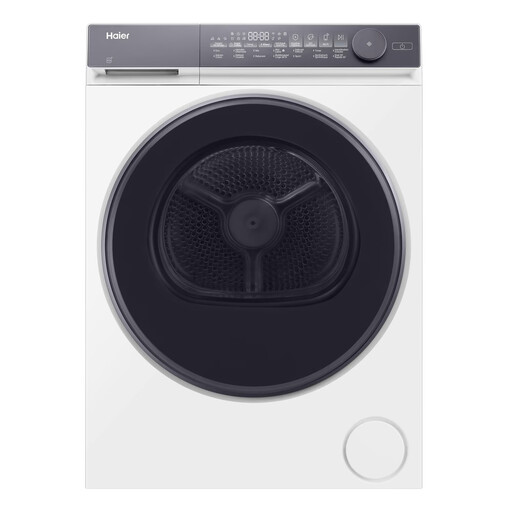 Image unavailable
Haier HD80-C367U1-DF heat pump tumble dryer, 8 kg
Worth considering if you alternate between small and larger loads and want to use a drain hose; check that the connection and included accessories suit your set-up.
Capacity: 8 kg. Energy label: C. The product description lists condensation efficiency class B and an included drain hose.
Joybuy
 Image unavailable
Bosch WQB245B40 Series 8 heat pump tumble dryer, 9 kg
An option if you alternate between small and larger loads and want continuous drainage; measure the available space and check the installation instructions.
Capacity: 9 kg. The product name lists energy class B (German label). The product description lists dimensions of 84,2 × 59,8 × 66,2 cm and an option for continuous drainage.
Joybuy
 Image unavailable
Midea MD205H80WB/W-NL heat pump tumble dryer, 8 kg
Worth considering if you’re looking for a short programme for a small, slightly damp load; the product description limits the 30-minute programme to this use.
Capacity: 8 kg. Energy label: C. The product name mentions SmartHome. Dimensions according to the product description: 850 × 595 × 600 mm.
Joybuy
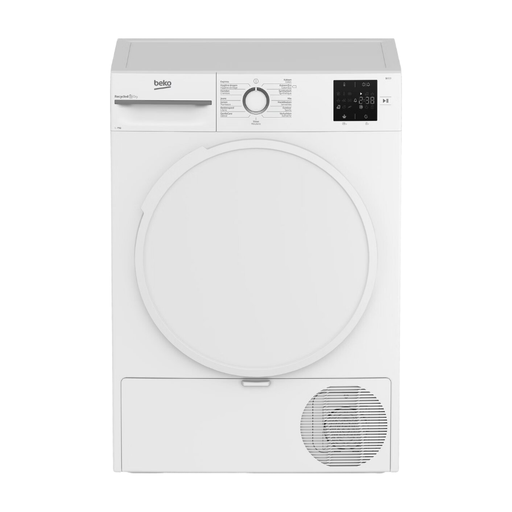 Image unavailable
Beko BM3T3722W heat pump tumble dryer, 7 kg
An option if you usually dry small loads and are looking for a 7kg model. Milieu Centraal says 6 or 7 kg is enough if you live alone or rarely use a tumble dryer.
Capacity: 7 kg. Energy label: E. The product description lists 15 programmes and a moisture sensor.
Joybuy
Frequently asked questions
Can a heat pump tumble dryer be installed in a utility room without an external air vent?
Yes. A heat pump tumble dryer doesn’t need an external air vent; condensation is collected in a tank or drained through a connection. The European Commission explains this for condenser dryers. Also check the ventilation, condensation efficiency, clearance and installation instructions for your chosen model.
Which energy label should I use to compare new tumble dryers?
Compare the current A–G label and the energy use in kWh per 100 eco cycles on the same basis. This scale has applied to tumble dryers since 1 July 2025, according to the European Commission and Energielabel.nl; old A+++ ratings aren’t directly comparable with current labels.
What maintenance does a heat pump tumble dryer need after each cycle?
Clean the fluff filter after every cycle and empty the condensation tank if no drain is connected. Follow the model’s manual for the heat exchanger: a self-cleaning condenser requires different maintenance. The Consumentenbond recommends tailoring maintenance to the type of tumble dryer.
Is a two-year manufacturer’s warranty in the Netherlands also the maximum period for the statutory guarantee?
No. ACM ConsuWijzer distinguishes between a manufacturer’s or seller’s warranty and the statutory guarantee. If a product breaks sooner than you could reasonably expect under normal use, the seller is responsible for providing an appropriate free solution; there isn’t one fixed statutory guarantee period for every tumble dryer.


