If you usually dry small loads, start by comparing drum capacity and the programmes or sensors available for partial loads; a larger drum isn’t automatically the most practical choice. In a shared utility room, also consider the stated noise level, condensation efficiency, how condensate is drained and the space needed for safe installation. Compare energy consumption using the current energy label, and weigh it against the purchase price and drying time.
Who is this choice relevant to?
If you mainly dry small loads
You usually dry partial loads and want to match the capacity to your typical washing, rather than to the occasional large load. Compare the capacity with how you use your dryer, and check whether the model has a moisture sensor or a programme for partial loads. Milieu Centraal says that 6 or 7 kg is enough if you live alone or don’t use the dryer often.
If you use a shared utility room
You’ll want to consider noise, moisture and emptying the condensate tank, so the room remains practical for everyone. The available space, ventilation and any drainage point may also affect which model is right for you.
If you keep an eye on running costs
You use the dryer often enough for energy consumption to matter, but you also want to compare the purchase price and drying time. Check energy consumption on the same labelling basis, and take your own usage and chosen programme into account.
What should you look for when buying?
Start with the load you usually dry, then check whether the noise level, condensate drainage and energy consumption are right for a shared space. The Consumers’ Association discusses noise levels and condensation efficiency as points to compare, while Milieu Centraal provides guidance on the capacity you need.
| What to consider |
What to look for when buying |
Who this matters to |
| Capacity for small loads |
Compare the capacity with your usual load. Check the exact model for a moisture sensor, a partial-load option and a programme suited to your fabrics. |
If you usually dry small amounts of washing, you won’t want to choose a drum based on an unusually large load. Around 33% of consumers prioritise suitable capacity and programmes for small loads. |
| Noise in shared spaces |
Compare the stated noise level in dB and consider when others use the room. |
If others use the utility room or adjoining rooms, you’ll want to know how noticeable a drying cycle may be. Around 27% of consumers give noise the highest priority when sharing a space. |
| Moisture and condensate |
Compare condensation efficiency. Check the ventilation, where the condensate tank is positioned, and whether a drain hose will fit the available drainage point. |
If the room has limited ventilation, you’ll want to consider moisture and emptying the water. Around 20% of consumers prioritise moisture control and condensate drainage. |
| Energy consumption and running costs |
Compare the current A–G label and the stated energy consumption on the same basis. Weigh this against the purchase price, how often you’ll use the dryer and drying time. |
If you use the dryer regularly, you’ll want to factor in electricity consumption without overlooking the purchase price or the time available. Around 20% of consumers give running costs the highest priority. |
Common buying mistakes
-
Comparing an old A+++ label directly with a new energy label
Since 1 July 2025, tumble dryers have used the revised A–G scale. The European Commission says this label must be displayed in shops and online from that date, so don’t compare old and new label classes as if they use the same scale.
Compare current product information using the A–G label and the same stated basis for energy consumption.
-
Assuming a larger drum means better performance for small loads
The capacity doesn’t tell you which sensors or partial-load programmes a model has. A larger capacity alone therefore won’t tell you how the dryer handles a small load.
Start with the load you usually dry and check the features and programmes available on the exact model.
-
Looking only at the drainage option and overlooking moisture in the room
Condensate drainage and condensation efficiency are two separate things to consider. Moisture may be a concern in a room with limited ventilation, while a drain connection also requires a suitable hose and drainage point.
Check the condensation efficiency, ventilation and condensate connection.
-
Assuming a model with a different suffix is the same version
A different model code may mean the energy label, features or other important details have changed.
Before comparing or buying, check the full model code and the specifications for that exact version.
Brands to consider
Beko
The BM3T3722W is a 7 kg heat pump tumble dryer worth comparing if you usually dry small loads.
- Beko lists a moisture sensor, energy class E on the new label and a noise level of 64 dBA for this model.
- Compare its label class and stated noise level with those of other specific models; on their own, they don’t say anything about Beko as a whole.
Bosch
The WQG235D2NL is an 8 kg option if you usually dry small loads but sometimes need more capacity.
- Bosch lists Auto Dry, a half-load option, a self-cleaning condenser and 61 dB(A) for this model.
- Check that its dimensions of 842 × 598 × 613 mm fit the space you have in mind and that the programme suits your fabrics. These are model-specific specifications.
AEG
The TR738AT4B is an 8 kg model to consider if you want to dry mixed loads of fabrics.
- AEG lists MixDry, energy class C and 97 kWh per 100 eco cycles for this model.
- The stated noise level is 67 dB. The claim about even drying comes from the manufacturer, so bear the noise level in mind when choosing a dryer for a shared space.
Miele
The TEA528WP 8kg Active is an alternative worth comparing if fabric-care features and condensate drainage matter to you.
- For this version, Miele lists features including PerfectDry and a maintenance-free heat exchanger.
- Treat claims about lifespan or drying quality as manufacturer claims, and check the label, noise level and overall costs for this version.
Samsung
The DV90DB8845GBU3 is a 9 kg model to consider if you want to dry larger loads as well as small ones.
- Samsung lists energy class A and smart drying features for this specific model.
- A larger capacity doesn’t automatically make it the best choice for mainly small loads. Performance claims come from Samsung.
Heat pump tumble dryers at Joybuy
These product picks suit small drying loads and use in a shared utility room. Check that the capacity, features and installation requirements of each version work for your needs.
 No image available
Bosch WQB245B40, Serie 8, 9 kg, heat pump tumble dryer, energy class B (German label)
The stated partial-load cycle may be useful for small cotton loads; check that it’s suitable for your fabrics.
View at Joybuy
 No image available
SHARP KDNHA8S6PWEBX heat pump tumble dryer, 8 kg, energy class E
If you dry small loads, check that the stated moisture sensor and programmes suit your washing and how you use the dryer.
View at Joybuy
 No image available
TCL DP4408WE1NL heat pump tumble dryer, 8 kg, energy class E
This 8 kg model may suit you if you alternate between small and larger loads; check which programmes are suitable for your fabrics.
View at Joybuy
 No image available
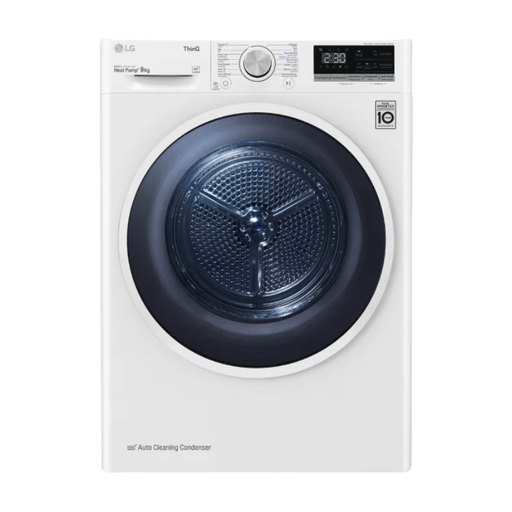
LG RH90V5AV6N heat pump tumble dryer, 9 kg
For a shared space, it’s worth checking the stated noise and condensation details, as well as how much room this model needs.
View at Joybuy
 No image available
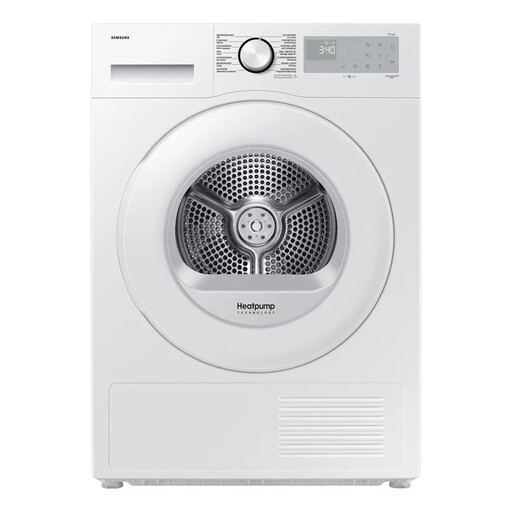
Samsung DV9UDG52A0THEN heat pump tumble dryer, 9 kg
If you’ll be using it in a shared space, check whether the stated noise levels, ventilation requirements and installation space are suitable for the utility room.
View at Joybuy
Frequently asked questions
Can you stack a tumble dryer on top of a washing machine in a shared utility room?
Only if the installation instructions for the specific models say they can be stacked together. Bosch recommends using a suitable stacking kit; also check that users can reach the filter, door and condensate tank.
Who cleans the dryer after a cycle?
Agree on who will clean the filter and, if the water isn’t drained away, who will empty the condensate tank. The Fire Service recommends following the manufacturer’s maintenance and cleaning instructions and keeping filters clean.
In the Netherlands, am I automatically entitled to just two years’ statutory guarantee?
No, there’s no fixed statutory guarantee period in the Netherlands. According to the Dutch government, you’re entitled to a product that works properly, and the retailer is your point of contact if something is wrong; any manufacturer’s or additional guarantee offered is separate.
Which energy label applies when buying a tumble dryer?
Since 1 July 2025, the revised A–G label must be displayed for household tumble dryers in shops and online. The European Commission gives this date, so don’t compare new product information as if A+++ were directly equivalent to the same class.


