Start with the space available and the amount of laundry you need to dry. Milieu Centraal considers 6 or 7 kg sufficient if you live alone or rarely use a tumble dryer, while a suitable 8 kg model with a moisture sensor or half-load option could also work. Measure the full installation space you’ll need, then compare the details on partial loads, noise, energy use and maintenance. A smaller casing or shorter programme doesn’t guarantee that the appliance will fit in your home or be the best choice for every load.
Who is this buying guide for?
If you often dry small loads
You regularly dry a small load and want to know whether a moisture sensor or half-load option is more useful than simply choosing a high stated capacity. Milieu Centraal considers 6 or 7 kg sufficient if you live alone or rarely use a tumble dryer.
If space is limited in your rented home
You’re looking for somewhere to put your tumble dryer and want to consider more than just its external dimensions, including the door opening, clearance and access for maintenance. Consumentenbond recommends placing the dryer on a stable, level surface to help reduce vibration and noise.
If you’re putting the dryer near a living space
You’re comparing the stated noise level and installation requirements, and thinking about where the condensed water will collect. Consumentenbond points out that a stable, level surface can help reduce vibration and noise.
What should you look for when drying small loads?
First, decide which constraint matters most to you: the space available, drying small loads, energy use, noise or maintenance.
| What to consider |
What should you check? |
Who should give this more weight? |
| Small loads |
Check whether the exact model has a moisture sensor or half-load option, and which programmes it works with. If available, also check the stated duration for a partial load. |
If I often dry just a few items, I want to know whether the settings are suited to that kind of load. Around 26% of consumers say drying small loads is their top priority. |
| Limited space |
Measure the height, width and depth, and allow for the required clearance. Also check the door, connections and maintenance access in the manual for the exact model. |
If the dryer has to go in a small space, I want to be sure I can still open the door and reach parts that need maintenance. Around 26% of consumers put available space first. |
| Energy use and drying time |
Compare current energy labels, kWh per 100 eco cycles and programme durations on the same basis. The duration and energy use for a small load may differ from the figures measured for the label. |
If I use the dryer regularly, I want to weigh up energy use against drying time and how often I usually run a cycle. Around 21% of consumers put energy use at the top of their list. |
| Noise and vibration |
Compare the stated noise levels and check whether you can place the appliance on a stable, level surface. The stated figure alone won’t tell you how disruptive it will be in your home. |
If the dryer is near my living or sleeping space, I want to factor noise and vibration into my choice. Around 16% of consumers say noise is their main concern. |
| Condensed water and maintenance |
Check whether you can reach a water tank or connect a drain hose. Also check which filters and other parts need maintenance according to the manual. |
If the dryer is going somewhere that’s hard to reach, I want to know how much maintenance I can realistically do there. Around 11% of consumers put ease of maintenance first. |
Common buying mistakes
-
Measuring only the stated depth
You may need more space than the casing alone takes up. The door, connections, clearance and access for maintenance all matter too.
Measure the full installation space and consult the installation manual for the exact model before you buy.
-
Assuming a quick cycle means every load will dry quickly
Bosch says its 40-minute programme is designed for a small load of synthetic and lightweight fabrics. Other fabrics and programmes may take a different amount of time.
Check which programmes suit the fabrics you usually dry, and compare the stated duration for a partial load if one is listed.
-
Assuming a self-cleaning condenser means no maintenance
Even a model with a self-cleaning condenser may still need other maintenance, such as cleaning the fluff filter.
Check which parts need to remain accessible and follow the maintenance instructions for the exact model.
Allow time for regular filter cleaning and, if no drain is connected, emptying the water tank.
-
Comparing old and new energy labels directly
Since 1 July 2025, the EU energy label for tumble dryers has run from A to G. An old A+++ rating cannot be directly compared with a letter on the new scale.
Compare current product information on the same basis, including energy use per eco cycle and the corresponding programme duration. The European Commission explains how the revised label scale is applied.
Brands to consider
Beko
Beko lists a casing depth of 54.5 cm for the BM3T3823WMM and 60.7 cm for the BM3T3824W. Both models have a stated capacity of 8 kg, according to Beko.
- Beko lists a drying sensor for both models.
- The manufacturer gives the BM3T3823WMM energy class D and the BM3T3824W class C on the EU 2025 scale. The casing depth isn’t the same as the full installation space required.
Siemens
The Siemens WQ33G1DANL is a heat pump tumble dryer with a stated capacity of 8 kg and an explicit half-load option.
- Siemens lists autoDry and a half-load function.
- The stated dimensions are 842 × 598 × 613 mm and the noise level is 63 dB(A). Check the space available and the maintenance required in the manual.
Bosch
The Bosch WQG133DBNL is an 8 kg heat pump tumble dryer with a half-load option and Auto Dry, according to Bosch.
- Bosch lists a 40-minute programme for a small load of synthetic and lightweight fabrics.
- The stated dimensions are 842 × 598 × 613 mm and the noise level is 63 dB(A). The short programme isn’t designed to dry every type of fabric.
LG
LG lists an 8 kg capacity, sensor drying and a self-cleaning condenser for the RHX1008NWH.
- The manufacturer also specifies a double-layer fluff filter.
- A self-cleaning condenser doesn’t mean the dryer is maintenance-free. Follow the model-specific instructions for the fluff filter and other parts.
AEG
The AEG TR738AT4B is an 8 kg model for which AEG lists eco programme durations for full and partial loads, among other details.
- AEG specifies energy class C, 67 dB and condensation efficiency class C. The stated eco programme durations are 2:55 for a full load and 1:45 for a partial load.
- These are model specifications, not a prediction of how long every programme or small load will take.
Joybuy product picks
These Joybuy picks focus on heat pump tumble dryers with moisture-controlled drying. Check each model’s capacity, dimensions and maintenance requirements against your small loads and the space available.
 Image unavailable
Bosch WQB245B40 Series 8, 9 kg
AutoDry and a stated programme duration for a partial cotton load make this model worth a closer look if you regularly dry smaller cotton loads.
The product name lists energy class B (German panel). The stated duration for a partial cotton load is 125 minutes. The listed external dimensions are 84,2 × 59,8 × 66,2 cm.
The product information lists a self-cleaning condenser, but the fluff filter still needs attention according to the maintenance instructions.
View at Joybuy
 Image unavailable
SHARP KDNHA8S6PWEBX, 8 kg
The listed sensor drying may be useful if you want the programme to respond to the moisture level in your laundry.
The product name lists energy class E. The product information specifies 15 programmes, a 90-litre drum and a noise level of 64 dB(A).
According to the product information, the water tank and filter should be emptied or cleaned after use, and the condenser should be cleaned regularly.
View at Joybuy
 Image unavailable
TCL DP4408WE1NL, 8 kg
Auto Dry is listed as a feature that detects moisture and stops when the laundry is dry, making it worth considering when comparing drying options for small loads.
The product name lists an Eco heat pump, 3D Drying™, a 3-in-1 filter and energy class E.
View at Joybuy
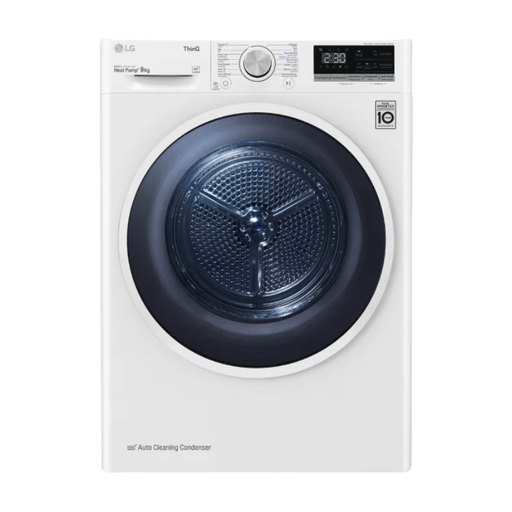 Image unavailable
LG RH90V5AV6N, 9 kg
Sensor Dry is described as a feature that measures moisture and adjusts the drying time. Compare the capacity and dimensions with your actual loads and the space available too.
The product information lists a noise level of 64 dB and a self-cleaning condenser. Follow the instructions for maintaining the other parts as well.
View at Joybuy
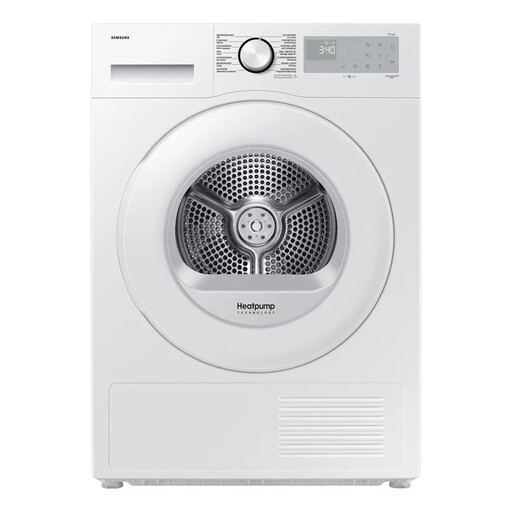 Image unavailable
Samsung DV9UDG52A0THEN, 9 kg
Optimal Dry is described as a feature that monitors the laundry, which may be worth considering when comparing moisture-controlled drying.
The product information lists 105 kWh per 100 cycles and a noise level of 64 dB. Check how the energy figure compares with the current product label and your own usage.
The maintenance information recommends cleaning the fluff filter after every drying cycle and regularly checking and cleaning the condenser.
View at Joybuy
Frequently asked questions
Do I need to install a drain for a heat pump tumble dryer in a rented home?
Not necessarily. A heat pump tumble dryer can collect condensed water in a tank, and many models also offer a drain hose. Check the connection options for the exact model. For a permanent alteration, the Dutch government says permission depends on the nature of the change and whether it can be reversed. Check the rules for your specific situation.
Can I install a permanent fitting for the dryer without my landlord’s permission?
It depends on the work involved. According to the Dutch government, the nature of the change and whether it can be reversed are relevant factors. Before making a permanent alteration, check how the rules and your tenancy agreement apply to your specific situation.
How do I compare the energy use of two tumble dryers?
Compare current models using the A-to-G label scale, stated energy use per 100 eco cycles and programme durations. The European Commission says the revised EU energy labels for tumble dryers have been in use since 1 July 2025; the old A+++ scale cannot be directly compared with the new classes. The energy used for your small load may differ from the figure measured for the label.
What should I clean or empty after a drying cycle?
Consumentenbond recommends cleaning the fluff filter after every drying cycle and emptying the water tank if no drain is connected. Follow the manual for cleaning the condenser; a self-cleaning condenser doesn’t automatically remove the need for other maintenance.


