
Families who often do small loads
If you dry individual items or small everyday loads, it’s worth checking the load adjustment and programme instructions. Bosch and AEG describe these features for specific models.


If your family often dries small loads but sometimes has a larger load, a suitable small-load function or load adjustment is important alongside drum capacity. Milieu Centraal recommends choosing a suitable size. Also compare energy use per 100 eco cycles on the energy label, and check the space available, drainage options and maintenance instructions. The label figure alone won’t predict how much energy your small loads will use.
If you dry individual items or small everyday loads, it’s worth checking the load adjustment and programme instructions. Bosch and AEG describe these features for specific models.
If you use your dryer regularly, the energy use stated on the label may help you decide. Milieu Centraal recommends choosing a drum capacity that suits your needs, while Energielabel.nl explains that the label shows energy use per 100 eco cycles.
The space available, drum capacity and drainage options all need to work together. For example, Beko lists the appliance depth for model BM3T3722B. Also check the installation instructions for the model you choose.
| What to consider | What should you check? | Who is this important for? |
|---|---|---|
| Small loads | Check whether the model has a small-load or half-load function, and which programmes it works with. | If I often dry small loads, I want to know whether the programme I choose is suitable. Around 36% of consumers say suitability for small loads is their top priority. |
| Energy use | Compare the stated number of kWh per 100 eco cycles on the same label basis. | If I dry clothes regularly, I want to factor in the stated energy use alongside my own usage habits. Around 29% of consumers put energy use first. |
| Capacity and installation | Measure the available space and check the capacity, installation requirements and drainage options. | If I dry both family laundry and small loads, the drum needs to suit my largest load as well as the space at home. Around 21% of consumers give capacity and installation top priority. |
| Fabrics and programme time | Check which fabrics are suitable, the maximum load and the duration of the programme you want to use. | If I’m drying mixed fabrics or need a small load in a hurry, I want to know which programmes are suitable. Around 14% of consumers put garment care and programme time first. |
According to Bosch, the 40-minute function on the Bosch WQG133DBNL is designed for a small load of synthetic or lightweight fabrics, not for every load.
Check the permitted load and fabrics for each model before making a quick programme your deciding factor.
The energy use shown on the label is based on 100 eco cycles. Energielabel.nl also lists other label information, including condensation efficiency and programme duration.
Compare label figures on the same basis, and also check which programmes suit your laundry.
The stated appliance dimensions don’t tell you how much space you’ll need for installation. The Consumentenbond notes that drainage may also require an extra hose and a nearby drain.
Measure the space and check the installation instructions, door clearance and drainage options for the exact model.
A manufacturer’s warranty or additional warranty scheme is separate from your statutory rights. The Dutch Government states that the Netherlands has no fixed statutory warranty period.
Speak to the retailer about any problem with a faulty product, and consider any additional cover separately.
The Bosch WQG133DBNL is an 8kg model to consider if you want to combine small loads with larger family loads.
The AEG TR738AT4B is an 8kg model to consider if you want to compare programmes for suitable mixed loads.
The Beko BM3T3722B is a 7kg alternative to consider alongside models with an 8 kg drum.
The Miele TEA528WP 8kg Active is an 8kg model to compare in terms of its programmes and maintenance requirements.
These Joybuy picks are heat pump tumble dryers with an 8 kg capacity, according to their product titles. For small loads, check the programme instructions for the exact model.
 No image available
The product title states an 8 kg capacity. Check which programmes are suitable for the small loads you dry.
Heat pump tumble dryer; 8 kg; energy rating C; Wi-Fi (hOn).
 No image available
The product title gives a capacity of 8 kg. Check the programmes for small loads and different fabrics.
Heat pump tumble dryer; 8 kg; energy rating E.
 No image available
The product title states an 8 kg capacity. For small loads, check which programmes and settings the model offers.
Heat pump tumble dryer; 8 kg; energy rating E; 3-in-1 filter.
 No image available
The product description lists a 30-minute programme for small, slightly damp items. Check whether those conditions suit your laundry.
Heat pump tumble dryer; 8 kg; energy rating C; 30-minute programme for small, slightly damp items.
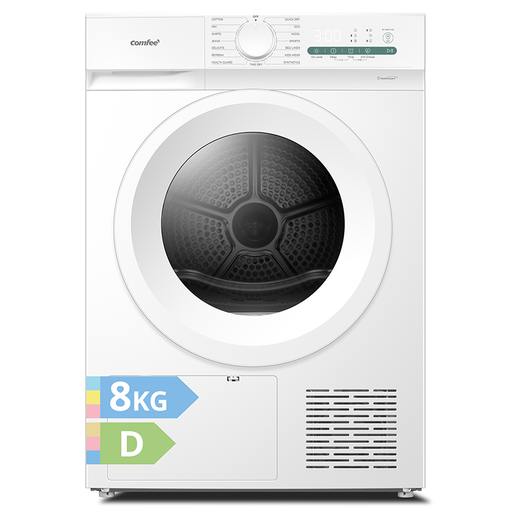 No image available
The product title states an 8 kg capacity. Check the programmes and drying levels for the fabrics you dry at home.
Heat pump tumble dryer; 8 kg; energy rating D.
That depends on the size of your largest loads. Milieu Centraal suggests 8 or 9 kg as an option for larger families or more frequent use, but recommends choosing a suitable size rather than automatically going for the largest drum. Also check the permitted load for individual programmes.
On the current A–G energy label, compare the stated number of kWh per 100 drying cycles using the eco programme. This gives you a common basis for comparison, but it doesn’t predict energy use for your small load or another programme.
No. According to the European Commission, a heat pump condenser dryer doesn’t need an air vent to the outside. Water is collected or channelled to a drain; check the manual for your chosen model to see whether you’ll need a drain hose or outlet.
Keep the filters clean and follow the manual for your exact model. The Fire Service recommends paying attention to cleaning and maintenance; the manufacturer provides the instructions for each model.
Since 1 July 2025, household tumble dryers have used the new A–G energy label scale. The European Commission states that this label must be displayed in shops and online. So don’t compare an older A+++ rating directly with a new energy rating letter.