
Parents who need to dry clothes in a hurry
You dry a few items on rainy days because you need them again soon. It’s important, then, that the load and fabric meet the conditions for the short programme.


If you often dry small loads, look for a heat pump tumble dryer with a programme that is demonstrably suitable for your clothes and load size. Check the care labels, permitted load weight and programme conditions. Then compare the energy label and available space, as the labelled energy consumption applies to the eco programme and not automatically to a quick programme.
You dry a few items on rainy days because you need them again soon. It’s important, then, that the load and fabric meet the conditions for the short programme.
You dry different fabrics together and want to choose a programme that suits the care labels and the level of dryness you need.
You use your tumble dryer regularly and consider energy use, dimensions, condensation water and maintenance as well as the programmes.
First check whether the clothes are suitable for tumble drying and which programme is right for the fabrics and load. Then compare the energy label and check that the dryer will fit practically in the available space.
| What to consider | What to look for when buying | Who should prioritise this |
|---|---|---|
| Drying a small load in time | Check the permitted load weight and fabrics for the specific programme; also see whether the model has a half-load option. | If I need a few items of clothing before the next school day, I want to know whether the short programme is intended for that particular load and fabric. Around 36% of consumers put drying a small load in time at the top of their list. |
| Suitable treatment for different fabrics | Read the care symbols and compare the programmes and sensor functions of the exact model for the fabrics in question. | When I’m drying different fabrics, I want to avoid choosing a programme that doesn’t suit the clothing care labels. Around 29% of consumers prioritise treating different fabrics correctly. |
| Electricity use when drying frequently | Compare the energy label rating and kWh per 100 eco cycles; this label figure is not a measurement for a small, urgent load. | If the dryer runs often, I want to compare models on the same basis and combine suitable laundry where possible. Around 21% of consumers give manageable electricity use top priority. |
| Installation and maintenance | Measure the space and check the condensation efficiency class, options for draining condensation water and the maintenance requirements of the exact model. | In a small laundry space, I want to know whether the dryer can be installed and maintained without impractical adjustments. Around 14% of consumers prioritise installation and maintenance. |
The Consumentenbond points out that heat pump tumble dryers generally take longer to dry than conventional condenser dryers. Energielabel.nl states energy use per 100 drying cycles based on the eco programme. Use this figure to compare models on the same basis, not to predict the duration or energy use of a short programme. According to the Consumentenbond, drying two half-full loads can use almost twice as much energy as one full load. Combining laundry can therefore help when the clothes and programme are suitable, but it isn’t always practical when you need to dry a small load in a hurry.
The quick programmes described by Bosch and AEG each have their own conditions for the load and fabric. A short cycle time doesn’t in itself mean a full drum or every school outfit will be dry in that time.
Compare the maximum load weight and permitted fabrics with the care labels and the amount of laundry you usually dry.
The kWh per 100 drying cycles shown on the energy label is based on the eco programme. This figure does not directly describe a small, timed cycle.
Use the label to compare models with each other. Don’t use it to calculate the exact cost of small, urgent loads without information about the programme selected and your electricity tariff.
If you often dry small loads, the need for clothes to be ready quickly may conflict with the benefits of combining laundry. The Consumentenbond says that two half-full loads can use almost twice as much energy as one full load.
Choose a capacity that suits the amount of laundry you usually dry. Combine suitable clothes when you can, but always follow the programme conditions.
Even with a self-cleaning condenser, the fluff filter still needs maintenance. The Consumentenbond recommends cleaning the filter after every drying cycle.
Check the instructions for the exact model to see how to maintain the filter, condensation water tank and any other components.
For the WQG143DANL, Bosch lists features including a half-load option, Auto Dry and a 40-minute programme for a small load of synthetic and lightweight fabrics.
AEG states that the TE7ONYX SpeedDry can dry up to 4 kg in 75 minutes and has MixDry. According to AEG, the TR86TRIER also has MixDry and programmes for specific fabrics.
Samsung describes the DV90DG6845LKU3 as a heat pump tumble dryer with an energy rating of A and sensor-controlled programme adjustment for different fabrics.
Beko describes the BM3T3824W as an 8 kg heat pump tumble dryer with an OptiSense drying sensor and an energy rating of C.
For the RHX5009TWB, LG lists Sensor Dry and Eco Hybrid, which LG says lets you choose between faster drying and greater energy savings.
This selection includes heat pump tumble dryers with sensor functions or short programmes, for anyone drying mixed or small loads of school clothes. Check the load, fabric and installation conditions for each model.
 No image available
AutoDry and the partial-load programme may be useful if your load sizes vary; check which fabrics and quantities are permitted for the programme.
The product description states 125 minutes for a partial cotton load. According to the product name, the stated energy rating of B is based on the German label.
 No image available
The product description mentions sensor drying and programmes for synthetic fabrics, delicates and shirts, among other items. Check that the programmes suit the care labels on your school clothes.
The product name states a capacity of 8 kg and an energy rating of E.
 No image available
According to the product description, Quick Dry takes up to 30 minutes; Auto Dry is also mentioned. Check the model information to see which loads and fabrics are suitable for Quick Dry.
The product name states a capacity of 8 kg and an energy rating of E.
 No image available
The product description states that Turbo Dry takes 30 minutes for small loads of lightly damp clothes. Check that it’s suitable for the size and dampness of your laundry.
According to the product information, the dryer must be installed in a room of at least 4 m² and the fluff filter must be cleaned after every cycle.
 No image available
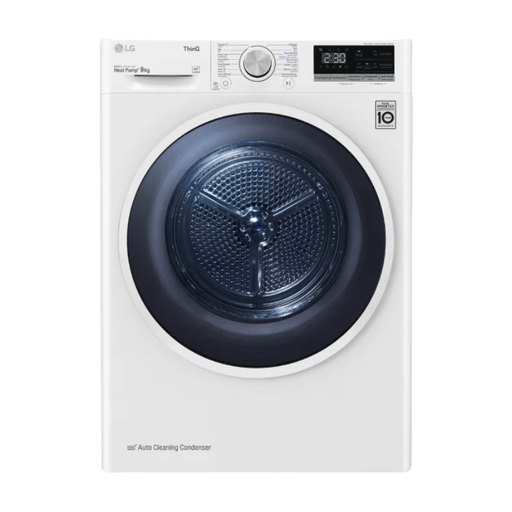
The product description mentions Sensor Dry, which adjusts the drying time according to the moisture level. LG describes Eco Hybrid as a choice between faster drying and greater energy savings; check the settings’ conditions for your load.
The product information states that it has a self-cleaning condenser and an energy rating of D. The fluff filter still needs maintenance.
No. Check the tumble-drying symbol on each item. A crossed-out circle inside a square means the item must not be tumble-dried. For other permitted symbols, follow the temperature and programme instructions on the care label.
No. Bosch describes the WQG143DANL’s 40-minute programme as suitable for a small load of synthetic and lightweight fabrics, not a full drum or every type of school clothing.
The label includes the electricity use per 100 drying cycles using the eco programme. This gives you a basis for comparing models, not a fixed figure for a small, urgent load; the programme you choose and the number of cycles also affect energy use.
Check the dimensions and installation requirements for the exact model, and make sure the dryer is stable and level. The Consumentenbond recommends cleaning the fluff filter after every drying cycle; follow the manual for the condensation water tank, condenser and any drain hose.
Not if you need the clothes soon or the different fabrics can’t be dried together in the same programme. The Consumentenbond says that two half-full drying cycles can use almost twice as much energy as one full cycle. So only combine laundry that can be dried together according to the care labels and programme conditions.