What should you consider when choosing?
For this situation, the key considerations are whether the dryer will fit, moisture management, cotton load capacity and electricity use. The Consumers’ Association (Consumentenbond), Milieu Centraal and Energielabel.nl provide guidance on the relevant checks.
| Consideration |
What to check before buying |
Who should pay extra attention? |
| Will the appliance fit? |
Measure the space and doorway; check the required clearance in the installation manual. |
If the alcove is tight, you’ll want to know whether the appliance will fit with the door open. Around 31% of consumers give fit the highest priority. |
| Moisture in the room |
Compare the condensation efficiency on the label and assess the ventilation. Check whether condensation is collected in a tank or can be drained through a suitable hose. |
If you dry clothes in a small or poorly ventilated room, you’ll want to prevent moisture building up. Around 25% of consumers prioritise moisture management. |
| Cotton load and drying time |
Compare the cotton capacity with your usual load, and check the eco programme duration for the stated load size. |
If you regularly dry cotton laundry, you’ll want to know whether the load will fit in the drum and when the cycle will finish. Around 25% of consumers give the most weight to cotton load capacity and drying time. |
| Energy use |
Compare kWh per 100 eco drying cycles using the same label basis; calculate your own costs using your number of drying cycles and electricity tariff. |
If you dry clothes frequently, you’ll want to weigh energy use against programme duration and purchase price. For around 19% of consumers, energy use is the main buying priority. |
Brands and models to compare
The features listed below apply to the specific models shown, not necessarily to every tumble dryer from the same brand.
Beko
For the 8kg BM3T3823WMM, Beko lists a depth of 54.5 cm and energy class D; for the 8kg BM3T3824B, the brand lists 67.2 cm and energy class B. These specifications relate to two separate models.
- The listed depth of the BM3T3823WMM may be useful if your available space is shallow.
- Measure the full installation space and check the exact model code; a shallower appliance is no guarantee that it will fit.
AEG
For the 8kg 7000 SensiDry TR738AT4B, AEG lists energy use of 97 kWh per 100 eco drying cycles and condensation efficiency of 86%. AEG states that the eco programme takes 2 hours and 55 minutes at full load.
- The manufacturer’s specifications provide energy use, condensation efficiency and programme duration for this model.
- Alongside the listed external dimensions of 85 × 59.6 × 66.3 cm, allow for the clearance required for installation.
Siemens
For the 8kg iQ300 WT45H20MNL, Siemens lists dimensions of 84.2 × 59.8 × 61.3 cm and moisture sensing via autoDry.
- The listed external dimensions help you assess the available space.
- According to Siemens, this model has an easyClean filter but no self-cleaning condenser, so bear the required maintenance in mind.
Bosch
The Serie 6 WQH245B5NL is a 9kg model for which Bosch lists a self-cleaning condenser and dimensions of 84.2 × 59.8 × 61.3 cm.
- The listed capacity and dimensions can be useful points of comparison.
- Bosch lists this specific model as no longer available; its features do not indicate whether other Bosch models are currently available.
Midea
For the 8kg MD205H80WB/W-NL, Midea lists energy class C and 102 kWh per 100 eco drying cycles.
- The model specifications give you concrete points for comparing capacity and energy use on the label.
- Midea Netherlands lists a depth of 680 mm for this model code; the English-language Midea product page lists 600 mm. Check the dimensions for the exact version before assessing whether it will fit.
Heat pump tumble dryers at Joybuy
This selection includes 8 and 9 kg heat pump tumble dryers. Compare the capacity with your usual cotton load, and check the dimensions, condensation specifications and energy use on the label for each model.
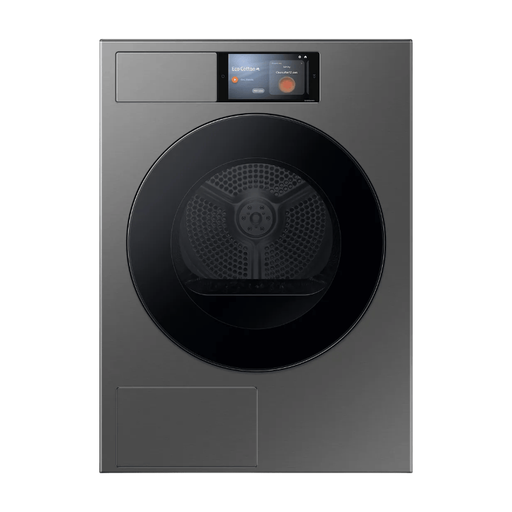 Image unavailable
Samsung DV90F09F4SU3 heat pump tumble dryer, 9 kg, energy class A
A 9kg model to compare if you regularly dry larger cotton loads.
Listed energy use: 79 kWh per 100 drying cycles. Condensation class B. Dimensions: 85 × 60 × 60 cm. Condensation is collected in a tank.
View at Joybuy
 Image unavailable
Haier HD80-C367U1-DF heat pump tumble dryer, 8 kg, energy class C
An 8kg model with a cotton programme to compare with your usual cotton load.
Listed condensation efficiency: 91%. Energy use: 1.01 kWh per cycle. Dimensions: 595 × 586 × 850 mm.
View at Joybuy
 Image unavailable
Midea MD205H80WB/W-NL heat pump tumble dryer, 8 kg, class C
An 8kg model with a cotton programme and sensor drying, to compare with your usual laundry load.
Check the depth of the exact version before assessing whether it will fit.
View at Joybuy
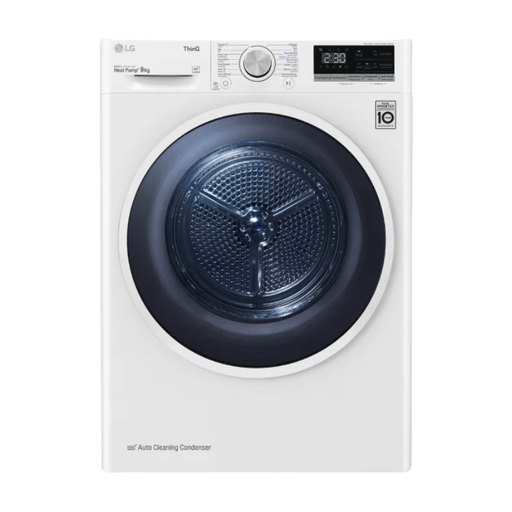 Image unavailable
LG RH90V5AV6N heat pump tumble dryer, 9 kg, energy class D
A 9kg model with sensor drying, for anyone looking to match the capacity to a larger cotton load.
The product specifications list a self-cleaning condenser. Energy class D.
View at Joybuy
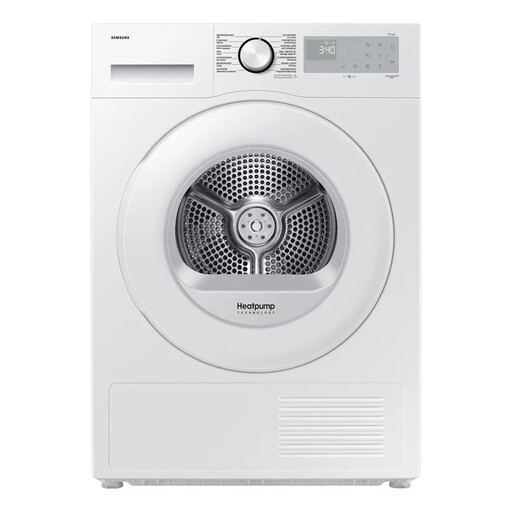 Image unavailable
Samsung DV9UDG52A0THEN heat pump tumble dryer, 9 kg, energy class C
A 9kg model with Optimal Dry to compare if you dry larger cotton loads.
Listed energy use: 105 kWh per 100 cycles. Condensation class B. The product specifications state that installation requires a level surface and adequate ventilation.
View at Joybuy
Frequently asked questions
Can I use a heat pump tumble dryer without a drain?
Yes, if the model has a water tank. You can then empty the collected water from the tank; a drain hose is an alternative if there is a suitable drain. Check the manual to see whether a hose is supplied with the model.
Where can I put a tumble dryer in a small rented home?
Choose a spot that meets the installation requirements for the exact model. Measure not just the appliance, but also the doorway and the required clearance. Allow for ventilation and check that the door can open.
What maintenance does a heat pump tumble dryer need?
Clean the lint filter after every drying cycle and follow the model manual for condenser care. If you do not use a drain, you will also need to empty the water tank. The Consumers’ Association (Consumentenbond) recommends cleaning the lint filter after every drying cycle.
Do I need my landlord’s permission to install a tumble dryer?
The information from the Dutch government (Rijksoverheid) does not indicate that general permission is automatically required to place a freestanding tumble dryer. Different rules may apply to permanent alterations to the property; discuss any necessary changes with your landlord in advance.
Which energy label should I compare for a tumble dryer?
Compare the current A-to-G scale, which has been used for tumble dryers since 1 July 2025, and also check kWh per 100 eco drying cycles. An old A+++ label is not directly equivalent to a letter on the new scale; the European Commission explains this energy label scale.


