If you often dry small amounts of cotton, look for a cotton programme, moisture sensing and, if available, a half-load option. A quick programme for synthetic fabrics doesn’t prove that cotton will dry just as quickly. Also compare the current energy label on a like-for-like basis, and check that the drainage, maintenance and installation requirements suit your utility room.
Who is this advice relevant for?
If you often dry small cotton loads
You regularly dry a few cotton garments or towels and want to know how the cotton programme handles a small load. Bosch, Siemens and AEG describe functions for small or partial loads on specific models, but the conditions vary by model.
If you use your tumble dryer often and keep an eye on energy use
You want to factor in the energy label and consumption when using your dryer regularly in winter, without treating a label figure as a prediction of your own energy use. Milieu Centraal recommends choosing a suitable capacity, while the European Commission explains the current A-to-G label for tumble dryers.
If you need to consider your utility room
You need to think about available space, water drainage, room humidity and regular maintenance. The Consumers’ Association highlights drainage as something to consider, while the Fire Service advises following the manual and keeping filters clean.
What should you look for when buying?
Start with the cotton programme and how the model handles a small load. Then compare energy use and check that installation, drainage and maintenance are practical for your utility room.
| What to consider |
What should you check? |
Who is this important for? |
| Small cotton loads |
For the exact model, check the cotton programme, moisture sensing and the conditions for any half-load option. |
If I often dry a small cotton load, I want to know whether the programme is designed for it; around 36% of consumers give suitable drying for small cotton loads their top priority. |
| Energy use when drying frequently |
Compare the current A-to-G label and consumption figures for models on a like-for-like basis. These figures don’t predict the energy use of every small load. |
If you use your tumble dryer often in winter, you’ll want to factor in energy use without assuming a fixed saving; around 29% of consumers put energy use at the top of their list. |
| Drying results for cotton |
Check the cotton programme and, where available, results for dryness and evenness. Compare stated programme times only under the same conditions. |
If I want cotton items to come out of the drum dry enough to use, I look at the results rather than just the time; around 21% of consumers make cotton drying results their first consideration. |
| Space, drainage and maintenance |
Check the dimensions, permitted installation options and whether water can be drained away. Remember that the filter still needs maintenance, even with direct drainage. |
If your utility room is awkward, you’ll want to be able to position the dryer properly and carry out maintenance easily; around 14% of consumers give these points top priority. |
Since 1 July 2025, tumble dryers have used the A-to-G energy label, according to the European Commission. An older A+++ label is not directly equivalent to a class on the new label.
Common buying mistakes
-
Assuming a 40-minute programme is the drying time for cotton
On the Bosch WQA23305NL, the 40-minute programme specified by Bosch is intended for a small load of synthetic fabrics and lightweight textiles. It is not a stated drying time for cotton.
For each model, check which fabric type and load size the quick programme is intended for, and assess cotton drying using the cotton programme.
-
Looking only at the energy rating
A label figure is based on a prescribed measurement method and doesn’t, by itself, tell you how long a small cotton load will take or how much energy it will use. What’s more, old and new label scales are not directly equivalent.
Compare the current product information for models on a like-for-like basis, and factor the cotton programme and drying results into your decision.
-
Leaving drainage and filter maintenance until after installation
Direct water drainage can reduce how often you need to empty a tank, but you’ll need a suitable drain point and sometimes an extra hose. Filters still need maintenance.
Before buying, check the drainage options, any parts required, available space and access to the filter. The Consumers’ Association notes that you may need an additional drainage hose; the Fire Service advises following the manual and maintenance instructions.
You may need an additional drainage hose or installation. Check which parts and installation requirements apply to each model.
Brands to consider
Bosch
For the WQA23305NL, Bosch lists a cotton programme, Auto Dry and a half-load option.
- According to Bosch, the half-load option adjusts the settings and programme time for smaller loads.
- According to Bosch, the 40-minute programme is intended for a small load of synthetic fabrics and lightweight textiles, not cotton.
AEG
According to AEG, the AEG T73DR8P4O is an 8 kg heat pump tumble dryer with PreciseDry and stated eco programme times for different load sizes.
- AEG lists the eco programme as taking 2:49 for a full load and 1:40 for a partial load.
- These are stated programme conditions, not independent measurements or a guarantee for every small cotton load.
Siemens
For the WQ43G1DANL, Siemens lists autoDry and a half-load option.
- According to Siemens, the half-load option shortens the programme for smaller loads.
- The brand’s mention of speedPack does not, by itself, demonstrate a time saving for small cotton loads compared with other models.
Beko
According to Beko, the Beko BM3T3823WMM is an 8 kg heat pump tumble dryer with a drying sensor.
- For this model, Beko lists a depth of 54,5 cm, a noise level of 64 dBA and a D energy label under the EU-2025 label.
- Don’t assume that a separate half-load option is available just because the model has a sensor.
Miele
According to Miele, the Miele TEA528WP 8kg Active is a T1 heat pump tumble dryer with a stated capacity of 8 kg and PerfectDry.
- Miele lists an integrated condensate drainage system.
- Installation is offered as a separate service. Brand claims about fabric care are not an independent comparison of drying results for small cotton loads.
Heat pump tumble dryers at Joybuy
These products offer heat pump drying with features such as cotton programmes and moisture sensing, as well as practical drainage or maintenance options. Check the product specifications for details of the exact model.
 No image available
Bosch WQH246DPFG Series 6, 9 kg
According to the product description, this model has a cotton programme and Auto Dry with continuous moisture sensing.
The description mentions a self-cleaning condenser and a condensate drain hose as an accessory. Check which parts are included with the product.
View at Joybuy
 No image available
Bosch WQB245B40 Series 8, 9 kg
The product description lists a cotton programme time of 125 minutes for a partial load, giving you a specific programme figure to compare for that load size.
The description also mentions AutoDry and a self-cleaning condenser. The product name lists energy label B (German panel).
View at Joybuy
 No image available
SHARP KDNHA8S6PWEBX, 8 kg
The product description lists the Cotton Extra Dry and Eco Cotton programmes, as well as a sensor drying system.
The product name lists energy label E. A label class alone can’t predict the results for your small cotton load.
View at Joybuy
 No image available
TCL DP4408WE1NL, 8 kg
The product description mentions Auto Dry with moisture sensing to adjust the drying process.
The product name lists Eco Heat Pump and energy label E. The stated quick-programme time is not a confirmed drying time for cotton.
View at Joybuy
 No image available
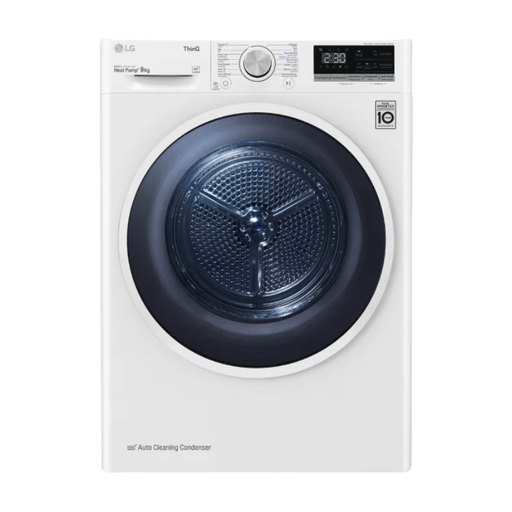
LG RH90V5AV6N, 9 kg
The product description lists Sensor Dry, which measures moisture levels and adjusts the drying time.
The description mentions a self-cleaning condenser and energy label D. Check that the available programmes suit your cotton laundry.
View at Joybuy
Frequently asked questions
Can I use a 40-minute programme as a guide for a small cotton load?
Not without checking the programme conditions. Bosch describes the 40-minute programme on the WQA23305NL as suitable for a small load of synthetic fabrics and lightweight textiles. For cotton, compare the cotton programme and its drying results.
What can I do before putting cotton in the tumble dryer?
First check that the care label allows tumble drying. Milieu Centraal recommends spinning laundry thoroughly so the tumble dryer has less moisture to remove. Then choose a suitable programme and the dryness level you want.
Should I clean the fluff filter after every drying cycle?
Yes. Remove the fluff from the filter after every drying cycle, and follow your model’s manual for further maintenance. The Fire Service and Siemens stress the importance of keeping filters clean.
What should I consider if the tumble dryer is in a cool utility room?
Before buying, check the installation instructions and the permitted ambient temperature for the exact model. Also consider ventilation and condensation in the room; permitted conditions can vary by model.
Which energy label should I compare when buying a new tumble dryer?
Compare the current A-to-G label and the product information sheet. According to the European Commission, this label has applied since 1 July 2025; an older A+++ label is not directly equivalent to a class on the new scale.


