
Family with school laundry in a hurry
You regularly dry a small load that’s needed the next morning. Compare the fabric and load limits for a quick programme, not just its stated duration.


First, choose a heat pump tumble dryer that fits in your utility room, and check its condensation efficiency and ventilation requirements. Then compare energy use per 100 eco cycles and programmes suited to your school laundry. A quick programme may be useful for a small, suitable load, but the programme time doesn’t tell you how quickly a full drum will dry. Before buying, check the care labels, the permitted load for each programme and the model’s installation instructions.
You regularly dry a small load that’s needed the next morning. Compare the fabric and load limits for a quick programme, not just its stated duration.
You want to stop the drying area from becoming damp. Condensation efficiency, ventilation and the installation instructions are all important points to check.
As well as school clothes, you dry larger loads and different fabrics. Match the capacity and programmes to your usual laundry, and check the care labels.
First, check that the dryer and its installation requirements are suitable for your utility room. Then compare energy use and programmes based on your usual load and the clothing care labels.
| Buying concern | What should you check? | Who is this important to? |
|---|---|---|
| School clothes dry in time | Check the programme duration, suitable fabrics and maximum programme load; follow the care label and spin the laundry before drying. | If I need a few items of clothing for the next school day, I want to know whether a short programme is suitable for that fabric and load. Around 28% of consumers prioritise small, time-critical loads. |
| Damp and installation in the utility room | Check the condensation data, required clearance, ventilation and temperature requirements in the manual for the exact model. | If my utility room has limited ventilation or is cold, I want to know the installation requirements in advance. Around 22% of consumers prioritise damp and installation. |
| Electricity use with regular drying | Compare the current energy label class and consumption in kWh per 100 eco cycles; use your own electricity tariff to estimate your personal costs. | If I dry clothes often, I want to be able to compare energy use on a consistent label basis. Around 22% of consumers focus mainly on running costs. |
| Suitable load and different fabrics | Compare the capacity with the weight of your dry laundry, and check the load limit and permitted fabrics for each programme. | If I also dry larger loads or different fabrics, I want the capacity and programmes to suit my usual laundry. Around 17% of consumers prioritise load size and fabric care. |
| Maintenance and service | Check how to maintain the fluff filter and condenser, and what service and warranty conditions apply. | If I use the dryer often, I want to know what maintenance is needed after each cycle and who to contact if there’s a problem. Around 11% of consumers focus mainly on maintenance and service. |
A short programme time doesn’t necessarily apply to every fabric or a full drum. AEG warns that a faster programme may use more energy and make more noise.
Check the programme table for permitted fabrics and load size, and compare drying times for your usual laundry.
A faster programme may use more energy.
The amount of moisture the dryer collects and the room’s ventilation also matter. The Consumers’ Association warns that damp air in a poorly ventilated laundry room can cause problems.
Compare the condensation data on the energy label, ensure there’s adequate ventilation and check whether a drain hose for the condensed water will work in your room.
The European Commission says that, since 1 July 2025, the A–G energy label for tumble dryers must be displayed in shops and online. An old label rating therefore can’t be compared directly with the current scale.
Check the current EU product information sheet and compare consumption in kWh per 100 eco cycles on the same basis.
A self-cleaning condenser doesn’t mean that no other maintenance is needed. The Netherlands Fire Service recommends cleaning the fluff filter after every cycle.
Follow the maintenance instructions for the exact model and clean the filter after every cycle.
The Serie 4 and Serie 6 models mentioned offer a choice between 8 kg without a self-cleaning condenser and 9 kg with one.
The TR968V4C is an 8 kg model whose stated energy and condensation figures can be compared with those of other models.
The BM3T3924WMM is a 9 kg model you can compare for capacity and stated energy label class.
The RH90V5AV6N is a 9 kg model with moisture-sensing features and, according to LG, a choice between faster or more energy-efficient drying.
The WQ46B2CENL is a 9 kg model you can compare for its condensed-water drainage feature and shorter programmes.
These Joybuy products include heat pump tumble dryers for small, time-critical loads and regular family laundry. Before buying, check that the capacity, programmes and installation requirements suit your needs.
 No image available
The product description lists a 30-minute programme for small, slightly damp loads. Check that your school clothes and load size are suitable for it.
The listing mentions six quick programmes and a moisture sensor. Leave at least 5 cm of clearance around the appliance for air circulation, and clean the fluff filter after every cycle.
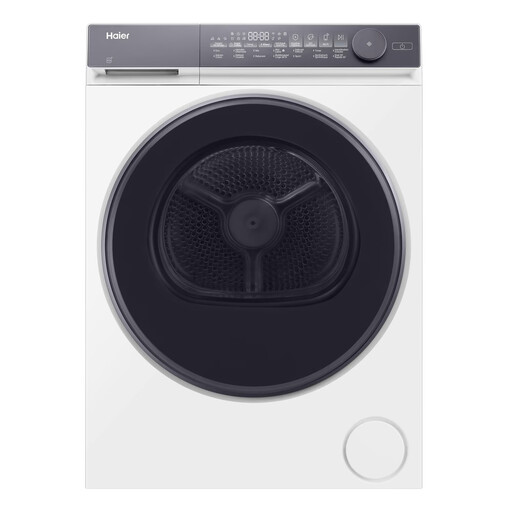 No image available
For mixed loads, the listed moisture sensor and wool basket may be useful. Choose a programme based on the care labels.
The product information mentions six quick programmes and highlights the need for adequate ventilation. Clean the fluff filter after every cycle.
 No image available
The listed Extra Quick 40 feature may be useful for a small, time-critical load. Check the programme limit and suitable fabrics, as 40 minutes isn’t necessarily enough to dry a full drum.
The product information lists moisture sensing, condensation class B and a self-cleaning condenser. Sort clothes according to the care label and clean the fluff filter after use.
 No image available
With its 9 kg capacity, this model is worth comparing if you regularly dry larger loads. Match the programme and load to the types of fabric.
The product information lists AutoDry moisture sensing, a self-cleaning condenser and programmes for delicates, shirts, sportswear and wool, among other items. The control panel is in German.
 No image available
The product information lists Express 34 and Shirts 20 programmes if you’re comparing programmes for different types of laundry. Check the permitted fabric and load for each programme.
The listing mentions 15 programmes and sensor drying. Don’t exceed the maximum 8 kg load, ensure there’s adequate ventilation and clean the filter after every use.
No. First check the drying symbol and choose a suitable programme. Bosch recommends sorting clothes by care label and fabric type; Milieu Centraal advises against tumble-drying fleece.
Check the manual for the exact model, along with the ventilation, filters and condensate tank. AEG Support recommends a room temperature above +5 °C and below +35 °C for its dryers when troubleshooting drying problems. Don’t treat this brand-specific advice as a general limit for all models.
Since 1 July 2025, the new A–G energy label must be displayed for household tumble dryers in shops and online, according to the European Commission. Also compare consumption in kWh per 100 eco cycles, and don’t treat an old A++ rating as directly comparable.
Clean the fluff filter after every cycle, as advised by the Netherlands Fire Service. For other cleaning and any condensed-water drainage, follow the manual for your model.
No. According to the Dutch government, the Netherlands has no fixed statutory warranty period. You’re entitled to a product that works properly, and if there’s a fault, the seller must provide a solution. A manufacturer’s warranty or extended warranty is separate from this.