What should you look for when buying?
First compare energy use and capacity with the laundry you usually wash; then check that the space, programme duration and maintenance routine suit shared use.
| Concern |
What to look for when buying |
Who is this important to? |
| Electricity consumption with regular use |
Compare energy use in kWh per 100 eco cycles on the same label basis. Energielabel.nl lists this consumption alongside the energy class as a point of comparison. |
If we use the tumble dryer often, we want to weigh up its energy use against using the washing line. Around 29% of consumers prioritise low electricity costs. |
| Capacity for shared cotton laundry |
Compare the cotton capacity with the loads you usually dry together. Also check which load size is suitable for smaller washes. |
If we want to dry shared cotton loads without running lots of unnecessary small cycles, we need a drum capacity that suits our needs. Around 23% of consumers focus on capacity for shared loads. |
| Installation in a cold or small laundry room |
Measure the space and check the installation instructions for the exact model. Also look at its condensation efficiency and whether condensation is collected in a tank or can be drained away. |
If our laundry room is short on space or gets cold in winter, we want to know in advance whether the model is suitable for the location. Around 18% of consumers prioritise a suitable installation space. |
| Drying time and noise when shared |
Compare the eco programme duration and the stated noise level. Check which fabric and load size a short programme is designed for. |
If several housemates want to use the tumble dryer one after another, or it is close to a living space, time and noise matter. Around 18% of consumers focus on faster or quieter cycles. |
| Purchase and shared maintenance |
Check how to clean the lint filter and which maintenance tasks are listed in the manual. Also check which drainage components are included. |
If we share the cost of buying the appliance and the cleaning tasks, we want to agree on a routine everyone can follow. Around 12% of consumers prioritise purchase and shared maintenance. |
Heat pump tumble dryers at Joybuy
This selection includes heat pump tumble dryers suited to shared cotton laundry in winter. Compare each model’s capacity, programmes, maintenance instructions and the space available for installation.
 No image available
Candy BR 8N3BX-S, 8 kg
The stated 8 kg capacity and moisture sensor may be useful for varying shared loads.
The product details list 15 programmes, including cotton, and 6 quick cycles. Stated energy consumption is 142 kWh per year, with a noise level of 62 dB(A).
According to the product details, the lint filter should be cleaned after every cycle.
Joybuy
 No image available
Bosch WQB245B40 Series 8, 9 kg
The 9 kg capacity and listed cotton settings are worth considering if you regularly dry larger cotton loads.
The product name gives an energy rating of B on the German label. The product details list 1,6 kWh for a cotton cycle, 195 minutes for a full cotton cycle, AutoDry, a self-cleaning condenser and 61 dB.
According to the product details, the lint filter should be cleaned after every cycle; also check the instructions for the condenser.
Joybuy
 No image available
SHARP KDNHA8S6PWEBX, 8 kg
The 8 kg capacity and listed cotton and eco-cotton programmes make this model relevant when comparing options for shared cotton laundry.
The product details list 15 programmes, a moisture sensor and a noise level of 64 dB(A).
According to the product details, the water tank should be emptied and the filter cleaned after use; the condenser needs regular maintenance.
Joybuy
 No image available
Midea MD205H80WB/W-NL, 8 kg
The 8 kg capacity and listed cotton programme make this model worth comparing with the cotton loads you usually wash.
The product details list 14 programmes and a sensor that detects temperature and humidity. According to the details, the 30-minute programme is intended for small amounts of slightly damp clothing, not as a confirmed drying time for a full cotton load.
The product details recommend keeping the ventilation openings clear and cleaning the filter and condenser after every cycle.
Joybuy
 No image available
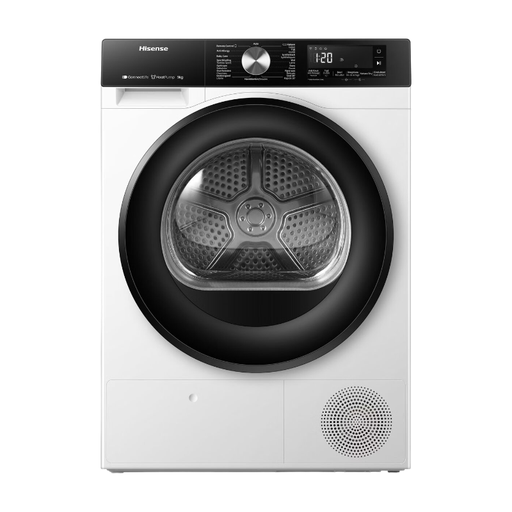
Hisense DH3S902BW3, 9 kg
The stated 9 kg capacity can be compared with the amount of shared laundry you usually dry.
The product details list 110 kWh per 100 cycles, a humidity sensor and dimensions of 84,5 × 59,5 × 64 cm.
According to the product details, the lint filter should be cleaned after every cycle and the ventilation openings kept clear.
Joybuy
Frequently asked questions
How do you compare the electricity consumption of two tumble dryers?
For both models, compare the label energy use in kWh per 100 eco cycles on the same label basis. Divide the figure by 100 to calculate the label energy use per cycle, then multiply it by your own electricity rate per kWh. A different load or programme may result in different actual consumption.
Can a heat pump tumble dryer be installed in an unheated room?
Check the installation instructions for the exact model and the room’s winter temperature. For the tumble dryers covered by its support advice, AEG recommends a room temperature above +5 °C and below +35 °C; this is not a universal specification for every model.
What should housemates do after every drying cycle?
Agree who will remove lint from the filter after use and who will empty the condensation tank if no drain is connected. Follow the manual for any other cleaning. The Dutch Fire Service recommends removing lint from the filter after every use.
Is there a fixed statutory two-year guarantee period for tumble dryers in the Netherlands?
No. According to the Dutch government, Dutch statutory guarantee law does not set a fixed period: you are entitled to a product that meets what you can reasonably expect of it. If a product is faulty, the retailer is your point of contact. Compare any paid-for extended guarantee with the rights you already have.
Which energy label should you use when comparing models?
Since 1 July 2025, tumble dryers sold in shops and online have used the A–G label, according to the European Commission. So do not compare an old A+++-label directly with a rating on the current scale; also check energy use in kWh per 100 eco cycles.


