Which households is it for?

Family short on time to dry school clothes

Often needs to get a few wet items dry for the next school day. So check the programme duration and drying performance for a suitable small load, rather than relying on a function name such as ‘quick’. The Consumers’ Association describes drying time as part of its testing approach; Samsung lists a Quick Dry function for a specific model.

Family with large laundry loads

Wants to dry school clothes with the rest of the laundry, so compares the stated capacity with its usual load. Also check the programme duration and whether the appliance will fit in the space available. Bosch, Beko, LG, AEG and Samsung list models with an 8 or 9 kg capacity.

Family that wants to dry fabrics with care

Has clothes made from different fabrics and checks the care labels first. Only then choose a suitable programme or drying setting; the Consumers’ Association includes drying performance for different fabrics in its testing approach.

What should you look for when buying?

Small loads needed urgently

Choose this if: you mainly need a few items dry before the next school day.

Trade-off: a quick programme doesn’t tell you how long a full family load will take; check the duration for a similar small load and fabric.

Larger family loads

Choose this if: you usually dry several items at once and the stated capacity suits that load.

Trade-off: extra capacity isn’t necessarily useful if you usually only dry a few items; check the external dimensions and drying time too.

Delicate or varied fabrics

Choose this if: you often dry different fabrics and want to compare programmes that are suitable for your clothes.

Trade-off: a specialist programme doesn’t make clothes marked as unsuitable for tumble drying safe to put in the dryer; follow the care label.

Buying factor What should you check? Who is this more important for?
School clothes dry in time Compare the programme duration and drying performance for the small load and fabric you want to dry; don’t use the name of a quick programme to estimate how long a full drum will take. If I only need a few wet items for the next school day, I look at the duration for that specific load. Around 29% of consumers give top priority to having school clothes dry in time.
Capacity for family laundry Compare the stated maximum capacity with your usual load and check that the programme you want is suitable for it. If I want to dry school clothes with the rest of the family laundry, I focus on finding a suitable capacity. Around 23% of consumers prioritise drying a full family load at once.
Energy use when drying regularly Compare the current EU label and energy use figures on a like-for-like basis; the energy use for an eco programme doesn’t automatically apply to every programme. If I use the dryer regularly, I want to be able to compare its energy use on a like-for-like basis. Around 18% of consumers give energy use top priority.
Different clothing fabrics Read the care label first, then compare only programmes and drying settings that are suitable for clothes that can be tumble dried. If I dry clothes made from different fabrics, I check the care label for each item. Around 18% of consumers prioritise suitability for a range of clothing over other buying factors.
Positioning, drainage and maintenance Measure the space and delivery route, check whether water is collected in a tank or can be drained away, and find out what filter maintenance is needed. If my laundry room has limited space or I want to plan for drainage and maintenance in advance, I check these points before buying. Around 12% of consumers give positioning and maintenance top priority.

Common buying mistakes

  • Assuming a quick programme takes as long as a full family load

    Duration and drying performance depend on the fabric and load you choose. So a programme name alone won’t tell you when a full drum will be dry.

    Compare the duration and permitted load for the programme you actually want to use.

  • Comparing an old A+++ label directly with the current label

    The European Commission says that, since 1 July 2025, tumble dryers must display the revised A-to-G energy labels. This means old and current labels aren’t directly comparable on the same scale.

    For a current comparison, use the latest EU label and compare energy use figures on a like-for-like basis.

  • Checking the space and connections only after buying

    The stated capacity won’t help if the dryer doesn’t fit in the space available or the chosen drainage option won’t work at home. You may need an extra drain hose or a suitable stacking kit.

    Measure the installation space and delivery route, check the drainage and, if stacking, make sure the appliances and stacking kit are compatible.

  • Assuming ‘self-cleaning condenser’ means ‘maintenance-free’

    For the RHX1009NWK, LG lists both a self-cleaning condenser and a dual lint filter. The Fire Service advises removing lint from the filter after every use.

    Check the manual to see what maintenance is still needed for the exact model.

Brands to compare

Bosch

Bosch describes the WQG133DANL from the Serie 6 range as an 8 kg heat pump tumble dryer.

  • The stated capacity gives you a useful point of comparison if you’re looking for an 8 kg model. Source: Bosch Netherlands.
  • Capacity alone doesn’t tell you how quickly a full load will dry.

Beko

Beko lists the BM3T3824W as a heat pump tumble dryer with a drying sensor and energy class C on the current scale.

  • Beko Netherlands lists an 8 kg capacity and dimensions of 84.6 × 59.8 × 60.7 cm; check whether the appliance will fit in the space available.
  • The stated specifications aren’t an independent comparison of drying performance or lifespan.

LG

For the RHX1009NWK, LG lists a 9 kg capacity, Sensor Dry, a self-cleaning condenser and a dual lint filter.

  • You can compare the stated capacity and sensor-controlled drying with your usual load and preferred programme.
  • The manufacturer’s description doesn’t confirm that the lint filter needs no maintenance or that the model dries clothes faster.

Samsung

For the DV90DG52A0ABEN, Samsung lists a 9 kg capacity and features called Optimal Dry and Quick Dry.

  • These features give you a starting point for comparing programmes for small loads.
  • The feature name doesn’t tell you the drying time for every family load; check the duration for your load.

AEG

For the TR869T4C from the 8000 AbsoluteCare range, AEG lists a 9 kg capacity and programmes for different fabrics.

  • AEG lists energy class B, 92 kWh per 100 eco cycles and a noise level of 61 dB.
  • A fabric care programme doesn’t make clothes marked as unsuitable for tumble drying safe to put in the dryer.

Heat pump tumble dryers at Joybuy

These models cater for different family needs, from small loads needed quickly to larger laundry loads and clothes made from a range of fabrics. Check the conditions and limitations of the programme you want to use for each model.

Candy BR 8N3BX-S heat pump tumble dryer, 8 kg, energy class C

Candy BR 8N3BX-S heat pump tumble dryer, 8 kg, energy class C

If you’re looking to compare an 8 kg model with a moisture sensor and a range of programmes.

The product description lists 15 programmes, six quick programmes and a wool basket. The lint filter needs to be cleaned after every cycle.

View at Joybuy
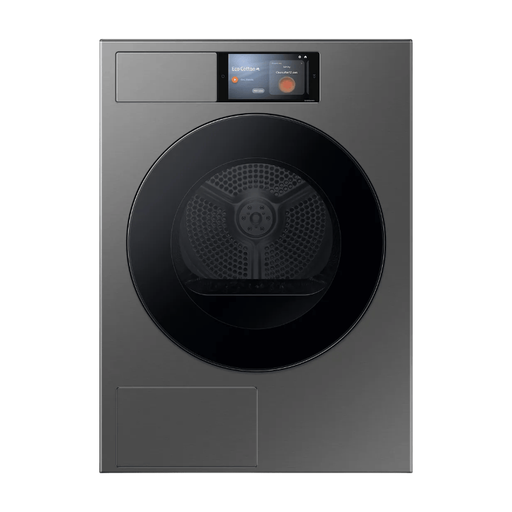
Samsung DV90F09F4SU3 heat pump tumble dryer, 9 kg, energy class A

Samsung DV90F09F4SU3 heat pump tumble dryer, 9 kg, energy class A

If you’re looking to compare a 9 kg model with a programme that the product description says is designed for small loads.

Samsung lists a 35-minute Super Speed programme for small loads and AI Dry+. According to the product information, the filter needs cleaning after every cycle and the water tank needs emptying regularly.

View at Joybuy

Bosch WQB245B40 Serie 8 heat pump tumble dryer, 9 kg, energy class B on German label

Bosch WQB245B40 Serie 8 heat pump tumble dryer, 9 kg

If you’re looking to compare a 9 kg model with listed programmes for different fabrics.

The product name lists AutoDry, Sensitive Drying and energy class B on a German label. The product description lists programmes for shirts and delicate fabrics, among others; the lint filter needs to be cleaned after every cycle.

View at Joybuy

SHARP heat pump tumble dryer, 8 kg, energy class E, model KDNHA8S6PWEBX

SHARP KDNHA8S6PWEBX heat pump tumble dryer, 8 kg, energy class E

If you’re looking to compare an 8 kg model with programmes for different fabrics.

The product description lists 15 programmes and a moisture sensor, with programmes for delicate fabrics and synthetics, among others. The filter needs cleaning after every use and the condenser regularly.

View at Joybuy

Midea MD205H80WB/W-NL heat pump tumble dryer, 8 kg, energy class C

Midea MD205H80WB/W-NL heat pump tumble dryer, 8 kg, energy class C

If you’re looking to compare an 8 kg model with a short programme for a small, slightly damp load.

The product information lists a 30-minute Turbo Dry programme for small amounts of slightly damp clothing and sensor-controlled drying. According to the instructions, the filter and condenser need cleaning after every drying cycle.

View at Joybuy

Frequently asked questions

Can I put any school clothes in a heat pump tumble dryer?

No. Check the care label first, then choose only a programme that’s suitable for the fabric. A specialist programme or claim about gentle drying doesn’t override a label saying the item must not be tumble dried.

Does a heat pump tumble dryer need to be connected to a drain?

Not necessarily: the condensed water can be collected in a tank or, if the model is designed for it, drained away. Before buying, check which connection and any hose are compatible with your chosen model.

What maintenance is important if the dryer is used often?

The Fire Service advises removing lint from the filter after every use. Also follow the manual for the exact model; a self-cleaning condenser doesn’t mean the lint filter never needs cleaning.

Can I compare an old A+++ label with the current A label?

No, those ratings are on different scales. According to the European Commission, since 1 July 2025 tumble dryers must display energy labels on the A-to-G scale. So when comparing dryers now, use the current label and the energy use figures that go with it.

Who should I contact if there’s a fault, and is extra cover compulsory?

According to the Dutch government, you should contact the seller if there’s a problem. In the Netherlands, there’s no fixed statutory guarantee period; what you can expect from a product depends, among other things, on the product and normal use. Extra cover is optional; check what additional rights it provides.
