Who is this relevant to?

People with a cold utility room

If you want to dry cotton in winter in a room that can get cold, compare its usual lowest temperature with the manual for your chosen model. AEG recommends an installation temperature above +5 °C and below +35 °C for its dryers.

People looking to reduce moisture in the utility room

If the room is small or has limited ventilation, check the condensation efficiency, ventilation and whether there’s an option to drain away the condensed water. The Consumers’ Association also covers the drain requirements and any hose needed.

People who regularly dry cotton laundry

If you dry laundry often or do larger loads, weigh up the capacity and programme duration against energy consumption. Milieu Centraal recommends a capacity of 8 or 9 kg for larger households or more frequent drying.

What should you look for when buying?

What to consider What should you check? Who should pay particular attention?
Room temperature Find out the usual lowest winter temperature and check the manual for the exact model. AEG recommends a temperature above +5 °C and below +35 °C for its dryers. If I want to put the dryer in a cold utility room, I first need to know whether the space meets the stated requirements. Around 33% of consumers put the suitability of the installation space first.
Moisture in the utility room Check the condensation efficiency on the current energy label, and look at the ventilation, drainage options and whether a hose is needed or supplied. If ventilation is limited, I want to know how to reduce moisture in the room and whether the condensed water can be drained away easily. Around 27% of consumers prioritise moisture control.
Cotton load and drying time Compare the capacity in kg and the duration of the cotton or eco programme for the exact model. A short cycle for a small synthetic load is not the same as the drying time for a full drum of cotton. If I often dry cotton, I want a drum and programme that suit my usual load and schedule. Around 20% of consumers focus mainly on capacity and drying time.
Energy consumption Compare models using the same A–G label, and check their consumption in kWh per 100 eco drying cycles. The energy-label figure is not an exact measure of every cotton load in a cold room. If I dry laundry regularly, I want to take energy consumption into account, while also considering the purchase price and how I use the dryer. An estimated 13% of consumers put energy costs first.
Maintenance and water drainage Check the manual to see which filters need cleaning, how to maintain the condenser and how condensed water is drained away. A self-cleaning condenser does not automatically mean that no filter maintenance is needed. If I want to spend as little time as possible on maintenance, I check what cleaning and drainage the model still requires. Around 7% of consumers put ease of maintenance first.

Avoiding common buying mistakes

  • Assuming a short cycle is the drying time for a full drum of cotton

    A short cycle may be intended for a small amount of synthetic laundry or lightweight fabrics, so it tells you little about a full cotton load. Drying can also take longer when the ambient temperature is low.

    Compare the duration of the cotton or eco programme, and take the temperature in your utility room into account. AEG warns that a low ambient temperature can extend drying time.

  • Looking only at the energy rating

    The letter doesn’t tell you everything that matters for your utility room. Capacity, consumption per 100 eco drying cycles, condensation efficiency and programme duration may also be relevant.

    Compare the current energy labels of models with a capacity that suits your usual cotton load. Energielabel.nl explains the consumption figures shown on the label.

  • Assuming a self-cleaning condenser means maintenance-free

    Cleaning the filter and draining condensed water may still be separate tasks; the exact instructions vary by model.

    Before buying, read the maintenance and drainage instructions for the model you’ve chosen. Bosch recommends cleaning the fluff filter after every use on dryers without Auto Clean.

Brands to compare

AEG

The TR968V4C is an 8kg heat pump tumble dryer worth comparing if energy and condensation figures matter to you.

  • AEG lists the TR968V4C as energy class A, with 73 kWh per 100 eco programme cycles and condensation class A with 94% condensation efficiency.
  • AEG recommends an installation temperature above +5 °C and below +35 °C for its dryers. Check the manual for the model you choose; these figures are not the result of an independent winter test.

Bosch

The Serie 6 WQG235D9NL is an 8kg model worth comparing if you want moisture sensing and a self-cleaning condenser.

  • Bosch lists moisture sensing, a self-cleaning condenser and a noise level of 61 dB for this model.
  • A self-cleaning condenser does not automatically remove the need to clean the filter. Check the maintenance instructions for the model you choose.

Beko

The BM3T3824B is an 8kg heat pump tumble dryer to compare with other capacities and models.

  • Beko lists this model as energy class B, with a noise level of 64 dBA.
  • The stated depth is 67,2 cm. Measure the available space and allow for the necessary installation clearance; the specifications don’t show how the model performs in winter cold.

Siemens

The iQ500 WQ46H2CLNL is a 9kg model worth comparing if you often dry larger cotton loads.

  • Siemens lists a noise level of 59 dB, moisture sensing and a self-cleaning condenser for this model.
  • Check whether 9 kg suits the loads you actually dry. The stated capacity alone doesn’t prove that drying will be quicker in a cold utility room.

LG

The RH90V9AV3N is a 9kg heat pump tumble dryer worth comparing if you want to weigh its stated drying options against its capacity.

  • LG says this model has an automatically cleaning condenser and an Eco Hybrid option to choose between faster and more energy-efficient drying.
  • These are LG’s claims for this model. Compare the current energy label and cotton programme duration before expecting to save energy or time.

Heat pump tumble dryers at Joybuy

These Joybuy products are heat pump tumble dryers with a stated capacity of 8 or 9 kg, making them worth comparing for larger cotton loads. Check that each model’s installation requirements, energy label and maintenance suit your utility room and how you use it.

Candy BR 8N3BX-S heat pump tumble dryer, 8 kg, energy class C

Candy BR 8N3BX-S, 8 kg, energy class C

An option to compare if you’re looking for a heat pump tumble dryer with a stated capacity of 8 kg.

Capacity: 8 kg. Energy class: C.

View at Joybuy
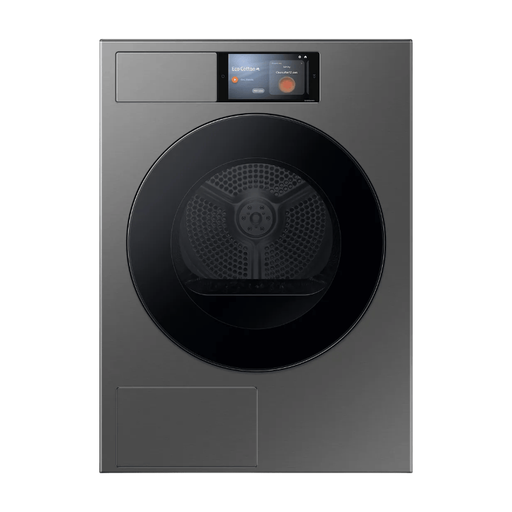
Samsung DV90F09F4SU3 heat pump tumble dryer, 9 kg, energy class A

Samsung DV90F09F4SU3, 9 kg, energy class A

An option to compare if you’re looking for a heat pump tumble dryer with a stated capacity of 9 kg.

Capacity: 9 kg. Energy class: A.

View at Joybuy

Bosch WQH246DPFG Serie 6 heat pump tumble dryer, 9 kg, energy class B, NL/FR control panel

Bosch WQH246DPFG Serie 6, 9 kg, energy class B, NL/FR control panel

An option to compare if you’re looking for a heat pump tumble dryer with a stated capacity of 9 kg.

Capacity: 9 kg. Energy class: B. Control panel: NL/FR.

View at Joybuy

Bosch WQB245B40 Serie 8 heat pump tumble dryer, 9 kg, energy class B, German control panel

Bosch WQB245B40 Serie 8, 9 kg, energy class B, German control panel

An option to compare if you’re looking for a heat pump tumble dryer with a stated capacity of 9 kg.

Capacity: 9 kg. Energy class: B. Control panel: German.

View at Joybuy

TCL DP4408WE1NL heat pump tumble dryer, 8 kg, energy class E

TCL DP4408WE1NL, 8 kg, energy class E

An option to compare if you’re looking for a heat pump tumble dryer with a stated capacity of 8 kg.

Capacity: 8 kg. Energy class: E.

View at Joybuy

Frequently asked questions

Can you put a heat pump tumble dryer in an unheated utility room?

It depends on the winter temperature and the manual for the exact model. AEG specifies an installation temperature above +5 °C and below +35 °C for its dryers, and warns that cold can extend drying time. Check the manuals for other brands for their own requirements.

Is a drain for condensed water essential?

Not always: a tumble dryer can collect condensed water in a tank. Connecting it to a drain can be convenient if there’s a suitable outlet; check whether your model needs a hose and whether one is supplied. Ventilation is a separate consideration.

What can I do if cotton takes longer to dry in winter?

Check that the room stays within the temperature requirements in the manual, that the load is suitable for the programme and that the filters are clean as instructed for your model. AEG lists a low ambient temperature and dirty filters as possible causes of poorer drying results. Bosch recommends cleaning the fluff filter after every use on dryers without Auto Clean.

Which energy label applies to tumble dryers in the Netherlands?

Since 1 July 2025, tumble dryers have used the A–G label. The European Commission states that this label must be displayed in shops and online. Alongside the letter, compare consumption in kWh per 100 eco drying cycles. The older A+++ rating uses a different scale.

Am I always entitled to exactly two years’ statutory warranty in the Netherlands?

No. According to the Dutch government, the Netherlands has no fixed statutory warranty period. What you can expect from a product depends, among other things, on the product and the circumstances; if a product is faulty, the seller is your point of contact. A manufacturer’s warranty is in addition to your statutory rights.
