
A guest room and a deadline
You want to know how long the selected bedding programme will take for your load, and leave enough time to check the laundry or run another drying cycle if needed.


Start by checking the care label to make sure the bedding is suitable for tumble drying on your chosen programme and fits within its load limit. Then compare how evenly the dryer handles bedding and how long that specific load is likely to take. A short programme time for a small load won’t tell you how long a full duvet cover will need.
You want to know how long the selected bedding programme will take for your load, and leave enough time to check the laundry or run another drying cycle if needed.
You dry large duvet covers, sheets or a duvet that the care label says is suitable for tumble drying. You’ll want to consider the programme, room to move and how evenly items dry.
You’ll keep using the tumble dryer after your family visit and want to take energy use and everyday convenience into account when choosing a model.
First, check that the care label allows tumble drying and tells you which temperature to use. GINETEX explains the meaning of textile care symbols. The Consumentenbond points out that laundry doesn’t always dry evenly in a tumble dryer.
| What to consider | What should you check? | Who is this important for? |
|---|---|---|
| Getting bedding dry in time | Check the time and maximum load for the programme suited to your bedding, and leave time to check the result. | If the bedding needs to be ready before your family arrives, plan around the right load. For around 36% of consumers, getting it done on time is the priority. |
| Drying large items evenly | Check the care label, programme and programme load limit; you could also see whether the model has a reversing drum. | With large sheets, duvet covers or a tumble-dryer-safe duvet, there needs to be enough room for items to move around. Around 29% of consumers pay particular attention to large items and even drying. |
| Energy use with regular drying | Compare the current energy labels and consumption per 100 cycles on the same label basis. | If you’ll continue using the tumble dryer regularly, consider its energy use as well as its suitability for bedding. For around 21% of consumers, ongoing electricity use is the main concern. |
| Positioning and maintenance | Measure the available space and check drainage options, filter access, and the installation and maintenance instructions. | If your utility room is cramped, you’ll want to know in advance whether the dryer will fit and whether you can reach the filter. Around 14% of consumers focus mainly on positioning and maintenance. |
A 40-minute programme isn’t automatically designed for large bedding items. Bosch describes its SuperKort programme as being for a small amount of synthetic material and thin fabrics.
Plan around the instructions and permitted load for the programme that suits your bedding. Before making the bed, check that thicker sections are dry too.
If the bedding is still damp, you may need to run an extra drying cycle, which will take more time.
An 8 or 9 kg capacity doesn’t prove that a large duvet will fit in a particular programme or have enough room to move around.
Before choosing a dryer based on capacity, check the care label, programme instructions and maximum load for that programme.
The European Commission states that the A–G scale has been used for tumble dryer labels in shops and online since 1 July 2025. An old A+++ label and a new label are therefore not necessarily based on the same scale.
Compare current labels and kWh figures on the same programme basis.
A condenser feature doesn’t replace the instructions for cleaning the fluff filter and the rest of the appliance.
Before buying, check that the filter is easy to reach and follow the manual for the exact model when installing and maintaining it.
AEG presents the TR9HAMBURG as a 9 kg heat-pump tumble dryer with 3DScan and a programme for duvets.
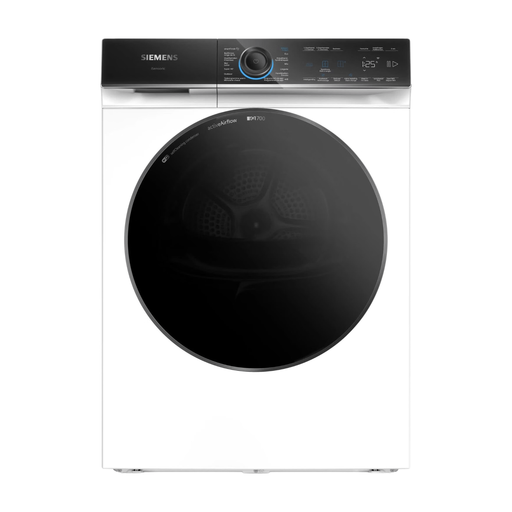
Siemens lists a 9 kg capacity, a bedding programme and a reversing drum for the WR47B2C0FG.
Bosch lists a 9 kg capacity, Auto Dry and a self-cleaning condenser for the WQG245D9NL.
Beko lists the BM3T3823B as an 8 kg heat-pump tumble dryer with a drying sensor.
Miele lists the TEH788WP as a 9 kg T1 heat-pump tumble dryer with an intelligent reversing drum.
Here you’ll find heat-pump tumble dryers with a stated capacity of 8 or 9 kg. Check whether your bedding is suitable for each model and its chosen programme; capacity alone doesn’t confirm this.
 No image available
The stated capacity can help you narrow down your options, but it doesn’t confirm that your bedding will fit in the chosen programme.
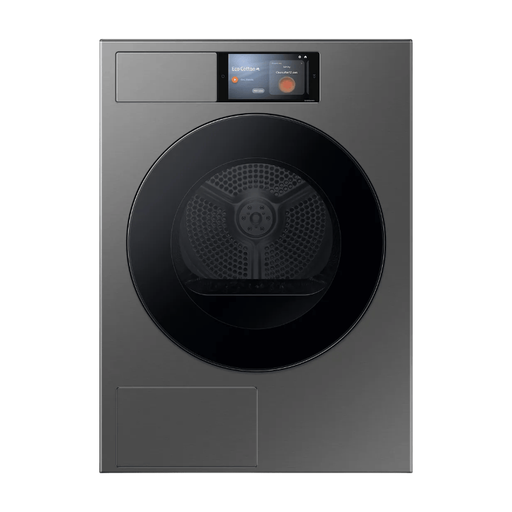
The product name lists AI Home, AI Dry+, Wi-Fi (SmartThings) and energy class A.
 No image available
The stated capacity can help you narrow down your options, but it doesn’t confirm that your bedding will fit in the chosen programme.
The product name lists energy class A and an NL/FR control panel.
 No image available
The stated capacity can help you narrow down your options, but it doesn’t confirm that your bedding will fit in the chosen programme.
The product name lists energy class B and an NL/FR control panel.
 No image available
The stated capacity can help you narrow down your options, but it doesn’t confirm that your bedding will fit in the chosen programme.
The product name lists AutoDry, Sensitive Drying, energy class B and a German control panel.
 No image available
The stated capacity can help you narrow down your options, but it doesn’t confirm that your bedding will fit in the chosen programme.
The product name lists energy class E.
No. First check the care label, including the permitted drying temperature, then check the programme instructions and maximum load. A programme name doesn’t override a do-not-tumble-dry symbol on the care label.
No, not necessarily. Bosch describes its SuperKort programme as being for a small amount of synthetic material and thin fabrics. For a large bedding load, check the information for the programme designed for it and see how dry the items are afterwards.
Check the model manual for installation, ventilation clearance and any drainage requirements. The Consumentenbond recommends cleaning the fluff filter after every drying cycle. Follow the instructions for your exact appliance when cleaning the condenser, and don’t leave the tumble dryer running when nobody is at home, as a safety precaution.
Compare the kWh per 100 cycles for the same eco programme, as shown on the energy label. To estimate your own costs, divide the label figure by 100 and multiply it by your tariff per kWh. This won’t automatically tell you how much energy a bedding programme uses.
According to the European Commission, the A–G scale has been used for tumble dryer labels in shops and online since 1 July 2025. Don’t compare a new label directly with an old A+++ label. There is a transitional exemption for machines that were already placed on the market before that date.