What should you look for when buying?
First check whether the bedding programme is suitable for your fabrics and load. Then compare moisture collection, noise, energy use and programme duration.
| What to consider |
What should you check? |
Who is this important for? |
| Bedding programme |
Check the fabric care label and the specific programme’s permitted fabric types and load; the nominal capacity is not necessarily the programme load. |
I want a large, tumble-dryer-safe item of bedding to fit within the permitted load and dry evenly. Around 34% of consumers give even drying of bedding top priority. |
| Noise and moisture |
Compare the noise level and condensation efficiency on the same label basis. Also check ventilation, drainage and the space available for installation. The Dutch Consumers’ Association explains that condensation efficiency measures how much moisture the tumble dryer collects. |
In a shared or poorly ventilated room, I want to minimise disruption to others and moisture in the room. Around 33% of consumers prioritise noise and moisture in the shared space. |
| Energy use |
Compare current A–G labels and energy use in kWh per 100 eco cycles; don’t compare old and new labels as if their letters were equivalent. Energielabel.nl and Milieu Centraal explain the scale that has applied since 1 July 2025. |
If I use the tumble dryer often, I want to take its standardised energy use into account when choosing. Around 20% of consumers say energy use is their most important consideration. |
| Programme duration and use |
Check the duration and permitted load of the programme you actually want to use; eco programme figures don’t automatically apply to other cycles. |
When several people need to use the tumble dryer, I want to know how long my bedding programme takes and when the appliance will be available again. Around 13% of consumers prioritise a short turnaround time. |
Brands to compare
The examples below refer to specific models and model-specific features; they are not an overall assessment of the brands.
AEG
The TR969PB4C is worth considering if capacity and moisture collection are priorities. AEG lists a 9 kg capacity, condensation class A and 94% condensation efficiency.
- AEG says that 3DScan helps dry items such as duvets evenly in this model.
- That is an AEG claim, not a guarantee for every duvet. The specifications list 61 dB(A) and 92 kWh per 100 eco cycles. Check separately what load is permitted for the programme you want to use.
Siemens
The iQ500 WQ46N2D0NL is worth comparing if noise in the shared space is a consideration. Siemens lists a capacity of 9 kg and a noise level of 59 dB(A).
- Siemens lists a self-cleaning condenser and moisture sensing.
- A self-cleaning condenser doesn’t remove the need to clean the lint filter. The noise level alone tells you nothing about how well your bedding will dry.
Bosch
According to Bosch, the Serie 6 WQG143DANL combines a nominal capacity of 9 kg with alternating drum rotation and Auto Dry.
- The alternating drum rotation is a model feature worth considering if you dry large items.
- Bosch doesn’t claim that this guarantees a particular result for every duvet. Bosch lists no self-cleaning condenser for this model and gives a noise level of 63 dB(A).
Samsung
According to Samsung, the DV9UDG52A0THEN has a capacity of 9 kg and a reversible door, which is worth considering if your layout restricts the way the door can open.
- Samsung lists an energy rating of C for this model.
- Check that the door’s opening direction suits your space, and check the load limit for the specific programme when drying bedding.
LG
According to LG, the RH90V9AV3N is a 9 kg heat pump tumble dryer with a self-cleaning condenser and a choice of faster or more energy-efficient drying.
- These model features may be relevant if you’re weighing up maintenance and programme duration.
- These features don’t amount to an independent performance comparison. Check the current A–G product information sheet for the exact model to find its energy rating, rather than relying on an old A+++ rating.
Heat pump tumble dryers at Joybuy
Compare these heat pump tumble dryers for tumble-dryer-safe bedding and use in a shared laundry room. Check the permitted programme load and installation requirements for each model.
 No image available
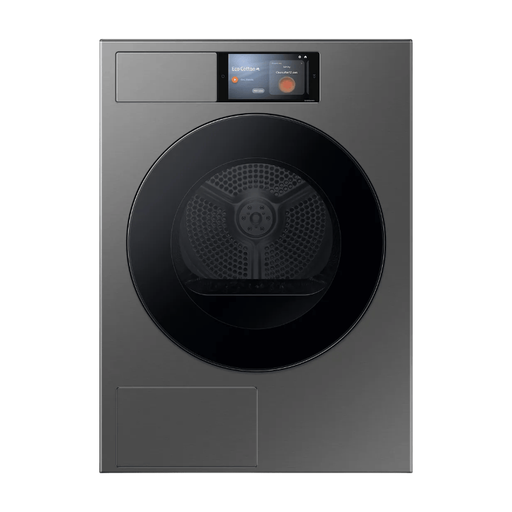
Samsung DV90F09F4SU3, 9 kg
The listed capacity and moisture sensing are features to compare for bedding; check the permitted load for the programme you intend to use.
The product information lists energy class A, 60 dB, condensation class B and AI Dry+ with moisture sensing. AI Home and Wi-Fi are also included in the product name.
View at Joybuy
 No image available
Bosch WQH246DPFG Serie 6, 9 kg
The listed Bed Linen programme makes this model worth considering for bedding; check the programme load and permitted fabric types.
The product information lists energy class B, a Bed Linen programme, Auto Dry with moisture sensing, 91% condensation efficiency, 59 dB(A) and a self-cleaning condenser. The control panel is in Dutch and French.
View at Joybuy
 No image available
Bosch WQB245B40 Serie 8, 9 kg
The product information lists a Bed Linen programme; check whether its permitted load is suitable for your bedding.
The product name lists energy class B and a German-language control panel. The description mentions a self-cleaning condenser, 61 dB, AutoDry with moisture sensing and a Bed Linen programme.
View at Joybuy
 No image available
SHARP KDNHA8S6PWEBX, 8 kg
The listed capacity and drum movement are features to weigh against the load permitted for the bedding programme.
The product name lists energy class E. The description mentions moisture sensing, drum rotation in two directions, 15 programmes and 64 dB(A).
View at Joybuy
 No image available
TCL DP4408WE1NL, 8 kg
The listed Auto Dry function is worth considering if you’re looking at moisture-sensing drying; also check the programme load for your bedding.
The product name lists energy class E, an Eco Heat Pump and a 3-in-1 filter. The description mentions 3D Drying and Auto Dry.
View at Joybuy
Frequently asked questions
Can I put every item of bedding with a tumble-dryer symbol through the same programme?
No. The tumble-dryer symbol alone doesn’t tell you which programme or load is suitable. Follow the temperature and programme instructions on the fabric care label too, and check the manual to see which fabric types and quantities the specific programme allows.
What should I check before putting a tumble dryer in a shared laundry room?
Measure the installation space, access route and doorway, and check the model’s installation instructions, ventilation requirements and any water drainage options. Also agree who will empty the condensate tank and clean the filter after use.
Who should clean the lint filter in a shared space?
The Netherlands Fire Service recommends removing lint from the filter after every use. Agree that each user will do this after their drying cycle, and follow the model’s manual for other maintenance.
How can I compare energy use without guessing the cost per cycle?
Use the kWh per 100 eco cycles shown on the label, then multiply that figure by your own rate per kWh on the same basis. Actual energy use may vary with a different programme, load or amount of residual moisture.
Can I compare an old A+++ label directly with a new A–G label?
No. Don’t treat those letter ratings as equivalent classes. Energielabel.nl and Milieu Centraal explain that the A–G scale for tumble dryers has applied since 1 July 2025. Compare the current label and energy use in kWh per 100 eco cycles for the exact models.


