
Drying sportswear with care
You want to tumble dry sportswear only if the care label allows it, and you’re looking for a setting that suits the fabric. GINETEX explains the symbols for tumble drying and drying at a lower temperature.


Choose a heat pump tumble dryer with a programme or setting that suits both the care label and the amount of laundry you usually dry. Then check the programme’s stated maximum load. The energy label is based on the eco programme, so it won’t predict how much energy a small sportswear load will use.
You want to tumble dry sportswear only if the care label allows it, and you’re looking for a setting that suits the fabric. GINETEX explains the symbols for tumble drying and drying at a lower temperature.
You regularly dry a small load and want to know which setting and programme limit apply. The drum’s rated capacity alone won’t tell you this.
You use your tumble dryer regularly and want to compare energy consumption without treating the eco programme’s label figures as a guide to what a sportswear programme will use.
First, check whether your clothes can go in the tumble dryer and what temperature conditions apply. Then compare the programme load and duration, and consider the energy label as a separate measure.
| Buying concern | What to check | Who should pay extra attention? |
|---|---|---|
| Fabric care | Check each garment’s drying symbol and temperature conditions. GINETEX explains what the symbols mean; also follow the programme instructions for your model. | When I dry sportswear, I first want to know whether the care label allows tumble drying and what temperature to use. Around 31% of consumers put appropriate fabric care first. |
| Small loads | Check the maximum load for the specific programme. Bosch lists a half-load option for the WQG235D2NL; Samsung lists a 1 kg load for Quick Dry 35' on the DV90DG52A0ABEN. | If I often dry small loads, I want to know whether the setting suits the amount I usually wash. Around 31% of consumers give small loads top priority. |
| Energy consumption | Compare the energy label and consumption per 100 eco cycles on the same basis. The Consumers’ Association explains that programmes are measured differently from the label. | If the tumble dryer is used often, I want to take energy consumption into account without treating the label as a prediction for my sportswear programme. Around 25% of consumers put energy consumption first. |
| Installation and maintenance | Measure the available space and check the connection options. Consult the model-specific manual to see how to maintain the filters and condenser. | If I use the tumble dryer regularly, I want to know whether it will fit and what maintenance it needs. Around 13% of consumers put installation and maintenance at the top of their list. |
The care label tells you whether tumble drying is allowed and what temperature conditions apply. A programme called ‘sportswear’ doesn’t change those instructions.
Check the care label on every garment before choosing a programme.
Manufacturers state programme times for specific loads. Bosch lists a 40-minute programme for a small load of synthetic or lightweight fabrics; Samsung lists Quick Dry 35' for 1 kg. These aren’t results from a like-for-like comparison.
For the exact model, compare both the programme time and its maximum load.
The energy label shows consumption for the eco programme. The Consumers’ Association explains that other programmes are measured on a separate basis.
Use label figures to compare models on the same basis, not as a guarantee of how much energy your chosen programme will use.
Even with automatic condenser cleaning, the fluff filter needs attention. The Consumers’ Association recommends cleaning it after every drying cycle.
Check the manual to see which parts need cleaning after use.
The WQG235D2NL is worth considering if you’re looking for a specific setting for small loads.
The DV90DG52A0ABEN is worth comparing if you’re looking for a short programme for a small load.
The TR7E86BB4 is worth comparing if you also dry mixed loads.
The VDW9030W is worth considering if you want to compare a clearly named sportswear programme.
These product picks are heat pump tumble dryers to consider for drying sportswear and small loads. Check the programme settings for each model and always follow the garment care label.
 No image available
For sportswear, check whether a setting on this exact model is suitable according to the care label.
The product name lists AutoDry, Sensitive Drying and a B energy rating (German panel).
 No image available
For sportswear, check whether a setting on this exact model is suitable according to the care label.
The product name lists an E energy rating and Anti-Crease Plus.
 No image available
For sportswear, check whether a setting on this exact model is suitable according to the care label.
The product name lists an Eco heat pump, 3D Drying, a 3-in-1 filter and an E energy rating.
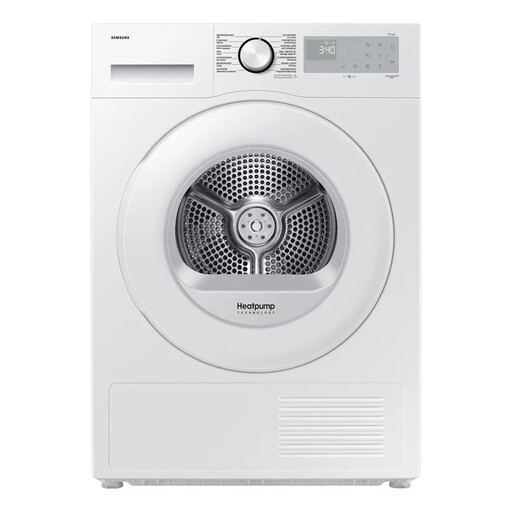 No image available
For sportswear, check whether a setting on this exact model is suitable according to the care label.
The product name lists heat pump technology and the Optimal Dry system.
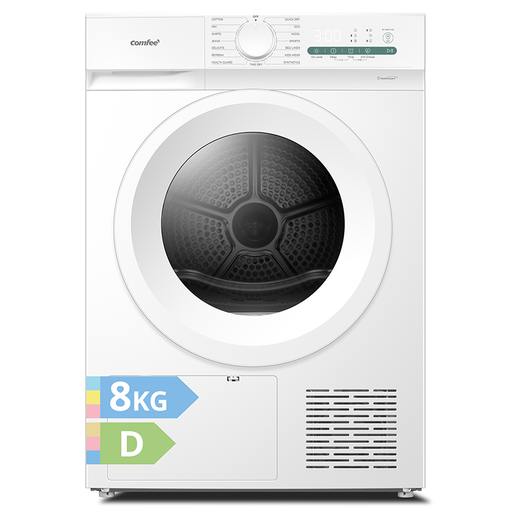 No image available
For sportswear, check whether a setting on this exact model is suitable according to the care label.
The product name lists a D energy rating and heat pump technology.
No, not automatically. GINETEX distinguishes between tumble drying at a normal or lower temperature and the symbol for do not tumble dry. Follow both the garment’s care label and the limits of the programme you choose.
Clean the fluff filter after every drying cycle, as recommended by the Consumers’ Association. Follow the manual for your model when cleaning the condenser and emptying or draining the condensed water.
A heat pump tumble dryer doesn’t vent moist air outside. However, check how the model collects or drains condensed water, and make sure the available space and connections are suitable.
No. According to the Authority for Consumers & Markets, statutory rights apply alongside the manufacturer’s warranty, and the retailer is responsible for the statutory warranty. In the Netherlands, there’s no fixed two-year period for this; what you can expect with normal use depends on factors including the product.
Compare the A–G label and the stated consumption per 100 eco cycles on the same basis. According to the European Commission, the new ecodesign requirements have applied to appliances newly placed on the market since 1 July 2025; existing shop stock isn’t automatically covered from the same date. The label figure doesn’t measure your sportswear programme.