What should you look out for?
Choose based on the loads that will actually go through the machine: drying only your own washing calls for a different approach from sharing a dryer that will also handle larger loads.
The percentages show which factors are the top priority for consumers in this student-house scenario.
| What to consider |
What should you check? |
Who is this important to? |
| Small loads |
Check the capacity in kg and the permitted load for the programme you want to use. See whether the model has a half-load function. |
If I mainly dry my own small loads, I want the capacity and programmes to suit. Around 31% of consumers say small loads are their top buying priority. |
| Placement and shared use |
Measure the space in line with the installation instructions. If stacking the appliances, check that both machines and the stacking kit are suitable for that combination. |
In a shared laundry room, I want to know the machine will fit safely and that we can agree on filter cleaning. Around 25% of consumers say placement and safe shared use are their top priority. |
| Purchase price and energy consumption |
Compare the purchase price separately from consumption in kWh per 100 eco cycles on the current energy label. |
If we’re sharing the costs, I want to weigh up the purchase price and energy consumption side by side. Around 25% of consumers put the overall cost first. |
| Noise and moisture |
Check the noise level and condensation efficiency on the energy label. Also consider where the dryer will go and how well the room is ventilated. |
If the dryer is close to a living or sleeping area, I want to consider noise and moisture in the shared space. Around 19% of consumers say a quiet dryer and a dry laundry room are their top priority. |
Since 1 July 2025, tumble dryer energy labels have used the A–G scale. Compare the current label information, and don’t treat the stated energy consumption as an exact prediction for a small load.
Joybuy products for small and shared loads
These heat pump tumble dryers are options to compare for small loads and shared use. Check the capacity, programmes and maintenance requirements for each model.
 No image available
Bosch WQB245B40 Series 8, 9 kg
The 9 kg capacity is worth comparing if the shared dryer also needs to handle larger loads. Check which programme is suitable for small loads.
The product information lists a partial-load programme. The title mentions AutoDry and Sensitive Drying.
View at Joybuy
 No image available
Midea MD205H80WB/W-NL, 8 kg
The product information lists a 30-minute Turbo Dry programme for small loads of lightly damp clothes. Check whether it’s suitable for the fabric and how dry you want your washing to be.
The title lists energy rating C, sensor drying and SmartHome. According to the product information, the filter and condenser need cleaning after every drying cycle.
View at Joybuy
 No image available
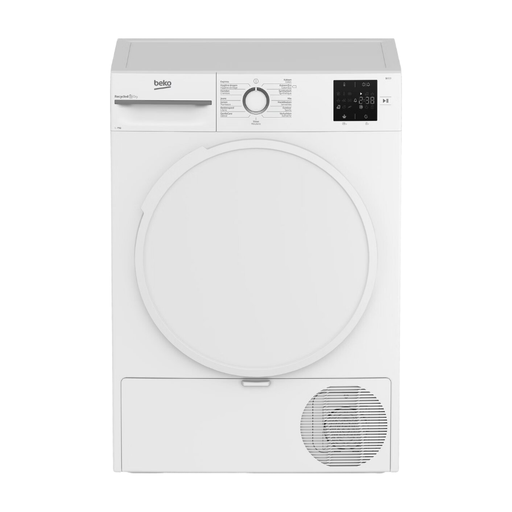
Beko BM3T3722W, 7 kg
The 7 kg capacity is worth comparing if you mainly dry your own washing. Milieu Centraal says 6 or 7 kg is enough if you live alone or use the dryer infrequently.
The product title lists energy rating E. Compare the current label and consumption per 100 eco cycles with how much you expect to use the dryer.
View at Joybuy
 No image available
Candy BR 8N3BX-S, 8 kg
With an 8 kg capacity, this model is worth comparing if the shared machine also needs to handle larger loads. Check the requirements for small loads for each programme.
The product title lists energy rating C, Wi-Fi and hOn.
View at Joybuy
 No image available
Haier HD80-C367U1-DF, 8 kg
The 8 kg capacity is worth comparing for shared use. Check how well the programmes suit small loads.
The product title lists energy rating C, Wi-Fi and Bluetooth. According to the product information, the lint filter needs cleaning after every cycle.
View at Joybuy
Frequently asked questions
How do you compare energy consumption if you mainly dry small loads?
Use the consumption figure in kWh per 100 eco cycles on the current energy label to compare models on the same labelling basis. This figure isn’t a measurement of your small load or of a different programme.
Can you put the dryer on top of the washing machine?
Only if the installation instructions confirm that the chosen machines are suitable for stacking, and you use a compatible stacking kit. Put the dryer on top of the washing machine, not the other way round, and check that the exact models are compatible.
What maintenance does a shared dryer need?
Read the model’s manual and agree with your housemates on who will clean the filters. The Dutch Fire Service stresses the importance of keeping tumble dryer filters clean as a fire-safety measure.
Which energy label applies to tumble dryers in the Netherlands?
Since 1 July 2025, the current scale for tumble dryers has run from A to G; A+++ isn’t a class on this scale. The European Commission says the new ecodesign rules apply to new machines and don’t apply retroactively to appliances that were already placed on the market before that date.
Are you automatically entitled to only a two-year legal guarantee in the Netherlands?
No. According to the Dutch government, there’s no fixed statutory guarantee period: you’re entitled to a product that works properly, and the retailer is your point of contact if there’s a problem. A manufacturer’s guarantee or an extended guarantee you’ve bought is separate from this.


