If you usually dry small weekend loads, a 7 kg tumble dryer is a sensible capacity to consider first: Milieu Centraal says 6 or 7 kg is enough if you live alone or don’t use the dryer often. An 8kg model may suit you if you also dry larger loads, but check that its programmes are suitable for smaller loads too. For example, Bosch limits its 40-minute programme to small loads of synthetic and lightweight fabrics. Compare the energy label as well, and measure the space available.
Who is this advice relevant for?
A tumble dryer for small weekend loads
You usually dry a small amount at a time and want to know whether the capacity, moisture sensor and programmes are suitable for your load. Milieu Centraal, Beko and Bosch provide information about these choices and their model specifications.
An energy-conscious user
You expect to use the dryer during the week as well as at weekends, and want to compare energy consumption on a like-for-like basis. Milieu Centraal, Energielabel.nl and the Consumentenbond outline key points to consider when using dryers and comparing energy labels.
A user in a hurry or short on space
You need your clothes again quickly or have to fit the dryer into a small utility room. Bosch and the Consumentenbond explain which programme and installation requirements to check in advance.
What should you look for when drying small weekend loads?
First, work out how much laundry you usually dry. Then check that the programmes, energy consumption and installation requirements fit your routine.
7kg heat pump tumble dryer
A good fit if: you usually dry small loads and don’t need a larger drum.
Trade-off: you’ll have less capacity for larger loads.
8kg heat pump tumble dryer with a small-load setting
A good fit if: you sometimes want to dry more than your weekend laundry, and the model has a suitable half-load function or moisture sensor.
Trade-off: a larger drum alone doesn’t tell you how the dryer will handle a small load.
Air-drying or using a tumble dryer you already own
A good fit if: you only dry a small load occasionally and have enough space to air-dry it, or already own a suitable tumble dryer.
Trade-off: air-drying takes time and space.
| What to consider |
What to look for |
Who it matters most to |
| Drying small loads effectively |
Check the permitted load for each programme and whether the model has a moisture sensor or half-load function. |
If I usually dry only a small amount of laundry, I want a programme that suits it. Around 36% of consumers prioritise suitability for small loads. |
| Energy consumption |
Compare the current A–G label and consumption in kWh per 100 eco cycles. |
If I use the dryer during the week as well as at weekends, I want to compare energy consumption on a consistent basis. Around 29% of consumers consider energy consumption their main priority. |
| Drying time |
Check which fabrics and load sizes are allowed in the quick programme; look at the eco programme’s duration separately. |
If I need my clothes again soon after getting home, I want to know whether the quick programme is suitable for that fabric and load. Around 21% of consumers prioritise drying time. |
| Installation and maintenance |
Measure the available space and check the water outlet, filter access and whether you need a hose. |
If my utility room is cramped, I want to know whether the dryer will fit and whether I can carry out the maintenance. Around 14% of consumers start by considering installation and maintenance. |
Common pitfalls
-
Assuming a 40-minute programme works for every load
Bosch describes its 40-minute programme as suitable for small loads of synthetic and lightweight fabrics. That doesn’t mean it’s suitable for every mixed load or thick towels.
Before using it, check the permitted load size and fabrics for the specific programme.
-
Comparing only the energy rating letter
The energy label also shows consumption per 100 eco cycles. The Consumentenbond says that two drying cycles with a half-full drum can cost almost twice as much as one full cycle.
Compare current A–G labels and kWh per 100 eco cycles. Bear in mind that the label figure applies to the eco programme, not every programme.
-
Assuming a water outlet or self-cleaning condenser means no maintenance
You’ll still need to maintain the filter even if the dryer has a water outlet. The Consumentenbond recommends cleaning the fluff filter after every drying cycle.
Check the model’s maintenance instructions and which parts you’ll need for the outlet.
Brands to consider
Beko
The BM3T3722B is a 7kg heat pump tumble dryer worth considering if you usually dry small loads.
- Beko lists a drying sensor, a depth of 54,5 cm and an E energy label for this model.
- Compare its programmes and labelled energy consumption with the needs of your own loads.
Bosch
The WQA23305NL is an 8kg model with features for smaller loads.
- Bosch lists Auto Dry, a half-load option and a 40-minute programme for small loads of synthetic and lightweight fabrics.
- A self-cleaning condenser isn’t listed for this model; don’t assume a feature name means proven savings.
Siemens
The WQ33G1DANL is an 8kg model with a feature for smaller loads.
- Siemens lists autoDry, half load, an extra-quick programme and a noise level of 63 dB(A).
- A selfCleaning Condenser isn’t listed for this model.
AEG
The TR738D4B is an 8kg heat pump tumble dryer with features for mixed loads.
- AEG lists MixDry, moisture sensors, a D energy label and 119 kWh per 100 eco cycles.
- AEG’s claims about even drying and optimisation are manufacturer claims.
Miele
The TWC640WP is an 8kg heat pump model with control and fabric-protection features.
- Miele lists app control and DryProtect for this model.
- If you dry small loads, consider whether these extra features meet your needs.
Heat pump tumble dryers at Joybuy
This selection features freestanding heat pump tumble dryers with capacities from 8 to 10 kg. For small loads, focus on the programmes listed and check the installation requirements for the exact model.
 No image available
SHARP KDNHA8S6PWEBX, 8 kg
A good option if you want moisture detection: the product description mentions a sensor that stops the programme when the laundry is dry.
Heat pump tumble dryer; energy label E.
View at Joybuy
 No image available
Midea MD205H80WB/W-NL, 8 kg
The product description mentions a 30-minute Turbo Dry programme for small loads of lightly damp clothes; check whether it’s suitable for your laundry.
Heat pump tumble dryer; energy label C.
View at Joybuy
 No image available
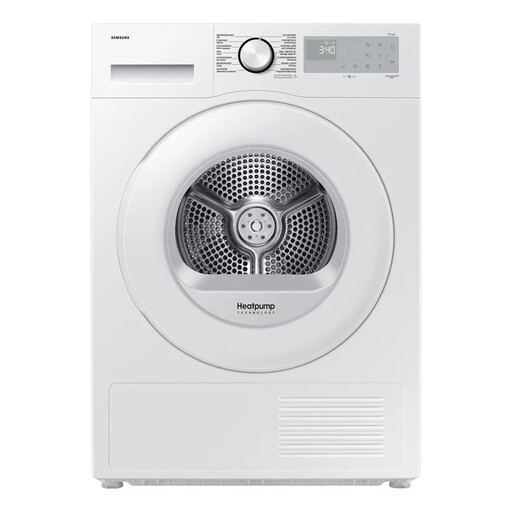
Samsung DV9UDG52A0THEN, 9 kg
If you want sensor control, the product information describes Optimal Dry as a system that monitors the laundry to prevent overdrying.
Freestanding heat pump tumble dryer; 9 kg.
View at Joybuy
 No image available
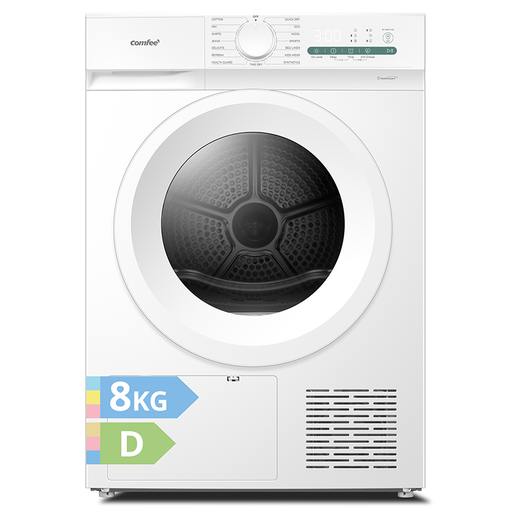
Comfee CD08EHP05W-HR, 8 kg
If a quick drying option matters to you, the product information lists a 30-minute programme; check whether it’s suitable for your load.
Heat pump tumble dryer; energy label D.
View at Joybuy
 No image available
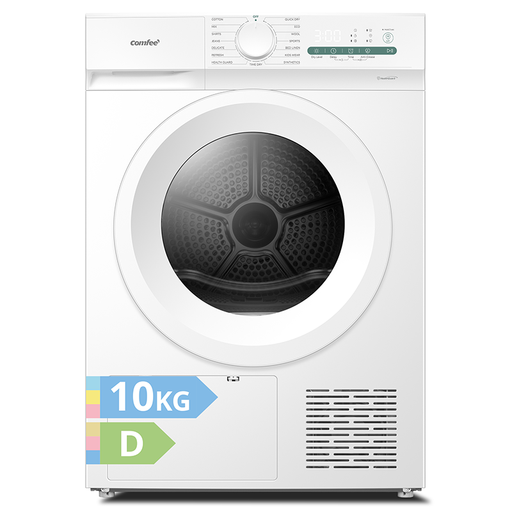
Comfee CD10EHP05W-HR, 10 kg
The larger capacity may suit you if you dry bigger loads as well as weekend laundry. The product information specifies at least 4 m² of well-ventilated space and an earthed 220–240 V socket.
Heat pump tumble dryer; energy label D. According to the product information, the cooling circuit must be serviced by qualified technicians.
View at Joybuy
Frequently asked questions
Does 7 kg mean a small weekend load won’t fit in an 8kg dryer?
No. An 8kg model may also have features for smaller loads, such as a moisture sensor or half-load function. Check the permitted load size and fabrics for each programme; the maximum drum capacity alone doesn’t determine which programme is right for your laundry.
Is a 40-minute programme suitable for every small load?
No, it depends on the fabric and load size. Bosch describes its 40-minute programme as suitable for small loads of synthetic and lightweight fabrics; check the instructions for the specific programme.
How do I maintain the dryer after a drying cycle?
Clean the fluff filter after every drying cycle and empty the water tank if no water outlet is connected. Follow the manual’s instructions for the condenser and any additional filters; a self-cleaning condenser doesn’t automatically mean you can skip all other maintenance.
Which connections and measurements should I check in advance?
Measure the available space and check the installation requirements for the specific model. If you want to drain the condensed water, check that there’s a suitable outlet and whether you need an extra hose; the Consumentenbond points out that you sometimes have to buy one separately.
How do I compare the energy consumption of tumble dryers?
Compare the current A–G label and consumption in kWh per 100 eco cycles. This figure applies to the eco programme and won’t predict the exact consumption of a shorter or half-full programme; the Consumentenbond also recommends considering how you fill the drum.


