What should you look for when buying?
First, check whether a programme is suitable for the school clothes that need to be dry on time. Then measure the space in your next room and, if you’ll use the dryer regularly, compare energy consumption on the same programme basis.
| What to consider |
What should you check? |
Who is this important for? |
| School clothes dry on time |
Check the care label and the load size and fabric types allowed for the short programme. |
If I need a small load of school clothes quickly on a rainy day, I want to know whether those particular clothes can go in the short programme. Around 33% of consumers say that drying clothes on time is their top buying priority. |
| Space after moving |
Measure the space and check the required clearance, doorway and water drainage requirements in the installation manual. |
Anyone moving to another room soon will want to know in advance whether the tumble dryer will fit and how the condensate can be drained. For around 27% of consumers, where the appliance will go comes first. |
| Energy consumption with regular use |
Compare the current energy label and consumption per 100 eco cycles on the same basis. Since 1 July 2025, the European Commission has used the A-to-G scale for tumble dryers in shops and online. |
If you often have larger loads as well as school clothes, energy consumption with repeated use will factor into your choice. Around 20% of consumers name this as their top priority. |
| Drying clothes with care |
Check the drying symbol on each item and choose only a programme suitable for the fabric type allowed. |
If you want to dry clothes in line with their care instructions, check the labels first. For around 20% of consumers, caring for their clothes comes first. |
Heat pump tumble dryers at Joybuy
This selection includes heat pump tumble dryers with a stated short programme and a capacity of 8 or 9 kg. Load size and fabric requirements vary by programme, so check they’re suitable for the clothes you want to dry.
 No image available
Bosch WQH246DPFG Serie 6 heat pump tumble dryer, 9 kg, energy class B, NL/FR panel
The 9kg capacity and stated short cycle may be worth considering if you regularly dry larger loads and need to keep an eye on drying time too.
The product description lists Extra Quick 40' and Auto Dry with moisture sensing. For school clothes, check which load sizes and fabrics are allowed in the short programme.
View at Joybuy
 No image available
SHARP KDNHA8S6PWEBX heat pump tumble dryer, 8 kg, energy class E
With an 8 kg capacity and stated short programmes, this model is worth comparing for regular loads when time is tight.
The product description lists sensor drying, Express 34' and Shirts 20'. Check the programme requirements for the specific items of clothing.
View at Joybuy
 No image available
Midea MD205H80WB/W-NL heat pump tumble dryer, 8 kg, energy class C
According to the product description, the Turbo Dry cycle is designed for small, slightly damp items of clothing that are needed quickly.
The title lists an 8 kg capacity and energy class C. The product description states that the short cycle takes 30 minutes; this time applies to the small, slightly damp load described.
View at Joybuy
 No image available
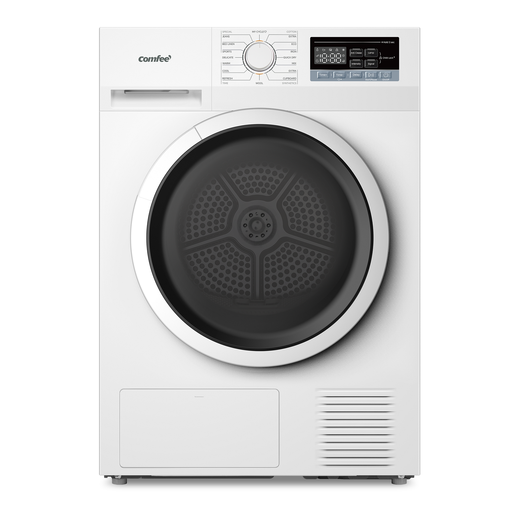
Comfee CFP01EH80W-JD heat pump tumble dryer, 8 kg, energy class D
The product description lists a 30-minute Quick Dry programme for small loads of slightly damp clothing.
The product information lists R290 as a flammable refrigerant and requires a well-ventilated room of at least 4 m², an earthed 220–240 V socket and no extension lead. Check the installation requirements before placing the appliance.
View at Joybuy
 No image available
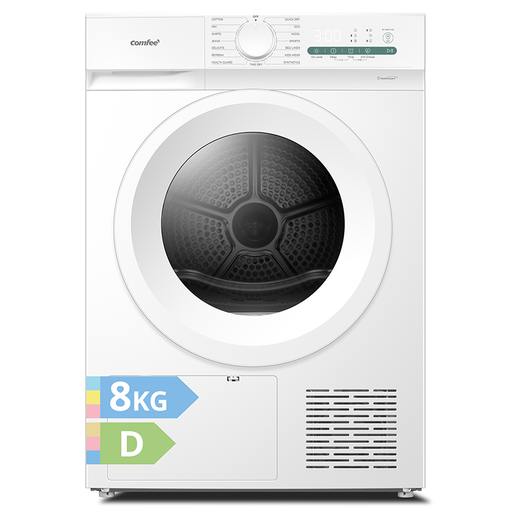
Comfee CD08EHP05W-HR heat pump tumble dryer, 8 kg, energy class D
The stated Quick Dry function may be worth considering if you want to compare a short cycle with the model’s other programmes.
The product title lists an 8 kg capacity and energy class D; the product description lists a 30-minute Quick Dry programme.
View at Joybuy
Frequently asked questions
Can all school clothes go in a heat pump tumble dryer?
No. Check the drying symbol on each item; a crossed-out drying symbol means it must not go in the tumble dryer. Then choose a programme suitable for the fabric type and temperature allowed.
Do you need a water drain in your next room?
Not necessarily. A heat pump tumble dryer can collect condensate in a tank that you empty by hand. Some suitable models can drain water directly if there’s an appropriate outlet; check the manual for your chosen model.
What maintenance is still needed with a self-cleaning condenser?
Clean the lint filter after every drying cycle. According to Consumentenbond’s maintenance advice, a self-cleaning condenser removes the need to clean that component by hand, but it doesn’t mean you can skip cleaning the lint filter. Empty the condensate tank too if no drain is connected.
Does a two-year manufacturer’s guarantee mean your statutory rights in the Netherlands end after that?
No. According to ACM ConsuWijzer, your statutory guarantee depends on what you could reasonably expect from the product. If there’s a problem, the seller must offer an appropriate solution; an additional manufacturer’s guarantee doesn’t replace those rights.
Which energy label applies to new tumble dryers in Dutch shops now?
Since 1 July 2025, the EU A-to-G scale has applied to tumble dryers in shops and online, according to the European Commission. Don’t compare an older A+++ label as if it were on the same scale. The new design rules for machines placed on the EU market from that date don’t mean that an appliance already placed on the market before then is automatically banned.


