
The only remote speaker
You’re joining on your own and want to be able to mute your voice and make yourself clearly heard.


If you’re the only person speaking via a computer, choose a headset with a microphone, mute control and connection that suit your meeting setup. If several colleagues need to join from the same room, consider shared-room audio rather than assuming one personal headset will pick up everyone. A headset won’t improve a dark camera image: deal with audio and video separately.
You’re joining on your own and want to be able to mute your voice and make yourself clearly heard.
You’re sitting with colleagues around one device and need to decide whether their voices also need to reach the people joining remotely.
You want to move around, or you’re on camera in a dimly lit room. Wireless audio and good lighting for your video are separate needs.
Choose this if: you’re the main speaker and will be staying at your computer. Check the USB port, cable length and mute button.
Bear in mind: there’s no headset battery to charge, but the cable limits how far you can move. A personal microphone isn’t designed to pick up voices from around an entire table.
Choose this if: you want to move around during the meeting and your device supports the required wireless connection.
Bear in mind: you’ll need to charge it and configure the connection. Check the pairing and battery level before the meeting.
Choose this if: several people in the room need to speak to remote participants using the same meeting device. Choose a solution that suits the room and the number of participants.
Bear in mind: this is different from listening privately with a headset; people in the room will be able to hear the conversation too.
Choose this if: your camera is on and your face isn’t clearly visible in the dimly lit room. Check the lighting, camera image and settings in your meeting app.
Bear in mind: a better microphone won’t improve the camera image. Microsoft describes a video brightness setting in Teams; this doesn’t apply to other apps.
| What to consider | What to look for when buying | Who is this important for? |
|---|---|---|
| Your voice and muting | Check the position of the microphone boom and how the mute control works; test the headset in your meeting app. | When I’m speaking, I want to position the microphone close to my mouth and mute it quickly. Around 29% of consumers prioritise making their own voice clear and being able to mute it. |
| Several people speaking in the room | Decide who needs to speak using the same device and whether shared-room audio is needed. | If several colleagues are sitting around the table, I want their voices to reach the remote participants. Around 18% of consumers prioritise audio for several speakers in one room. |
| Connection and meeting app | Compare your computer’s ports with the exact USB variant; check that the right microphone and speaker are selected in the app. | I want to use the headset with my meeting device without connection problems. Around 23% of consumers prioritise compatibility and working with their meeting app. |
| Fit and freedom to move | Consider the fit, mono or stereo design, cable length and Bluetooth support. | If I’m in a long meeting or want to get up during it, the fit or freedom to move matters. Around 18% of consumers put this first. |
| Video in low light | Check the camera preview and lighting, and, if you use Teams, the video brightness setting. | When my camera is on, I want to be clearly visible in a dimly lit room; this means checking the lighting and image separately. Around 12% of consumers prioritise being visible on video. |
A personal speaking setup and audio for a shared room serve different purposes.
Before buying, decide who needs to speak using the same device. If several people will be joining, compare speakerphones or other suitable room-audio options.
Additional room audio may be needed for several speakers.
A microphone feature won’t change the lighting on your camera.
Assess audio and video separately. If you use Teams, also check the camera preview and brightness setting.
Variants can differ in USB connection, fit or platform version. For example, the Jabra Evolve2 40 SE is available with different USB connections, and the HP Poly Blackwire 3200 series also has variants.
Before buying, compare the full model name, port, fit and any platform version.
You may need a suitable adapter or a different version.
A manufacturer’s or seller’s warranty doesn’t replace your statutory rights.
Check your statutory rights, then consider separately what any additional warranty offers. According to ACM ConsuWijzer, the seller must remedy a faulty product free of charge under the applicable conditions.
The H390 is a personal wired headset with in-line controls; the Zone 300 is a separate wireless Bluetooth range.
The Ayda USB-ENC is a personal wired on-ear headset with muting via the microphone boom. Trust also offers a separate wireless Ayda ENC.
The Blackwire 3200 series includes wired business headsets with different connection and wearing options.
The Evolve2 40 SE is a wired headset range with mono, stereo and USB variants for personal conversations.
The IMPACT SC 60 USB ML is a dual-sided wired USB headset for personal PC or softphone calls.
These Joybuy products are designed for personal participation in online meetings, either wired or wirelessly.
 No image available
A wired option for joining online meetings on your own.
USB-A connection with USB-C adapter; two integrated microphones and controls for muting and calls.
The cable limits how far you can move.
 No image available
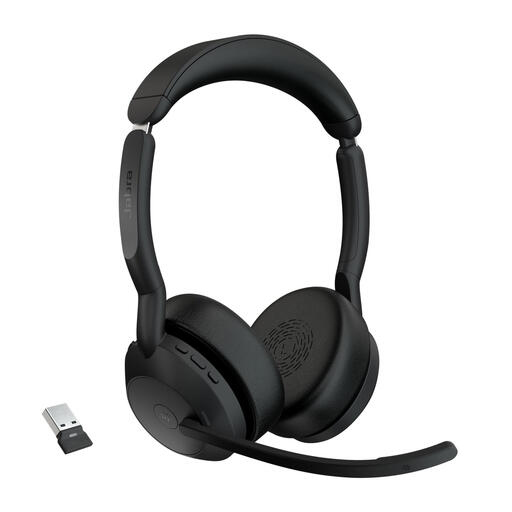
A wireless option if you want more freedom to move during online meetings.
Bluetooth 5.2, connection to two devices, and controls for muting and calls.
Wireless use requires charging and a compatible Bluetooth connection.
 No image available
A wireless mono option for joining meetings on your own.
Bluetooth 5.0, a USB-A Bluetooth adapter and Teams certification; the product description lists three microphones.
Wireless use requires charging and a compatible Bluetooth connection.
 No image available
A wired in-ear option for calls with a device that has a USB-C connection.
USB-C, built-in microphone and in-line controls, including microphone mute.
The cable limits how far you can move.
 No image available
A wired option for online meetings, with controls on the microphone boom.
The product information lists USB Type-A and USB-C connections, volume control and muting by flipping up the microphone.
The cable limits how far you can move.
No, that’s a separate video issue. Check the lighting and camera preview; Microsoft describes a video brightness setting in Teams for poor lighting.
Check that the connection is compatible with your computer, select the right microphone and speaker in your meeting app, and test the mute control. With a Jabra Evolve2 40 SE, the USB port you can use depends on the variant you bought.
Don’t assume it can. If several people are speaking through one device, compare shared audio options that suit the number of participants and the room. Microsoft describes speakerphones for shared spaces.
Not to get statutory rights: these are separate from any manufacturer’s or seller’s warranty. According to ACM ConsuWijzer, the seller must remedy a faulty product free of charge under the applicable conditions. Check separately whether an additional warranty offers more.
According to ACM ConsuWijzer, online purchases generally come with a statutory cooling-off period of up to 14 days after delivery. Check the applicable exceptions and returns terms for your purchase; the statutory guarantee and cooling-off period are separate rights.