What should you consider when choosing?
Wired USB headset
A good fit if: you mainly practise at a computer and want to record and listen back using one compact set-up.
Bear in mind: the cable and the differences between USB-A and USB-C versions; a noise-cancellation claim for calls doesn’t tell you whether it will record vowels accurately.
Headset with a 3.5mm plug
A good fit if: your device has a suitable combined headset socket and you don’t want to use a USB port.
Bear in mind: a headphone output on its own isn’t a microphone input; separate sockets may require a suitable adapter.
Wireless headset
A good fit if: being able to move around freely matters more to you than having the simplest possible permanent practice set-up.
Bear in mind: how the headset connects to your device and how often you’ll need to charge it.
Before you choose, check the connection, then set both the headset microphone and headphones in your recording software. For this type of practice, the main things to consider are recording, connectivity, listening back and background noise.
| What to consider |
What to look for when buying |
Who is this important for? |
| Recording vowels |
Check that you can select the microphone and view the recording level in your software. |
If I want to compare vowel pairs, I need to be able to listen back to my voice clearly, without the signal being too quiet or distorted. Around 36% of consumers prioritise a usable recording. |
| Connection and space |
Check the exact USB-A, USB-C or 3.5mm version against the ports on your device. |
If I’m short on space, I want a headset that works with my device and doesn’t need a separate desk microphone. Around 29% of consumers prioritise connectivity and a compact set-up. |
| Listening back and fit |
Check the headphone design and consider whether it will be comfortable for your practice sessions. |
If I want to listen to examples and my own recordings repeatedly, I need a headset I’m happy to wear. Around 21% of consumers prioritise listening back and wearing comfort. |
| Background noise |
Check how to position the microphone and monitor the input level; test the recording in your own space. |
If my practice space isn’t completely quiet, I want to be able to assess how much of my voice and the background is recorded. Around 14% of consumers focus mainly on background noise. |
Headsets at Joybuy
This selection includes wired USB headsets and a headset with a 3.5mm plug for a compact practice set-up. Check the connection of your chosen version and test whether you can set up recording and playback as you want.
 No image available
Jabra Evolve2 30 SE
A wired USB headset to consider for a permanent practice spot; check that this version’s connection is compatible with your device.
Compare the product version with your computer’s ports and recording settings.
View at Joybuy
 No image available
Logitech H540 Wired
A wired USB headset for anyone who wants to practise and listen back using one set-up.
Check the exact connection and set the headset as both the input and playback device.
View at Joybuy
 No image available
Logitech PC 960 USB
This wired USB headset is an option to compare for recording and listening back at a permanent computer workstation.
Before buying, check that the connection is compatible and make a test recording with your own software.
View at Joybuy
 No image available
Logitech H340 USB Headset Black, Wired
A wired USB headset to consider for a simple, permanent practice set-up at a computer.
Check that your device’s connection and settings are suitable for the way you plan to record.
View at Joybuy
 No image available
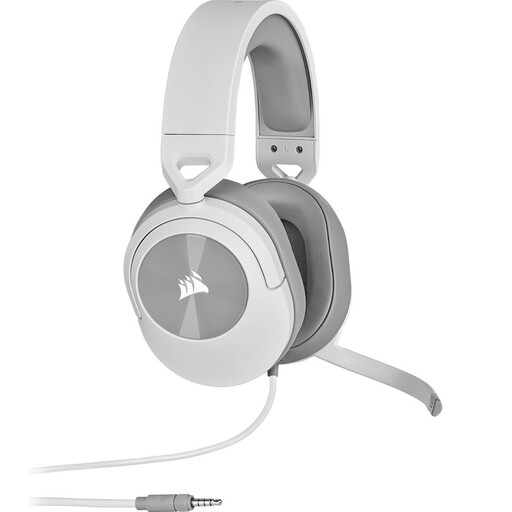
Corsair HS55 Stereo Gaming Headset, White, 3.5mm
A wired headset with a 3.5mm plug to consider if your device has a suitable headset socket.
If your device has separate headphone and microphone inputs, you’ll need to use the supplied Y-splitter.
View at Joybuy
Frequently asked questions
How can I test whether my vowels are being recorded clearly?
Select the headset microphone and headphones in your recording software, then make a short recording at a normal speaking volume. Watch the input meter as you say the vowels. Audacity recommends peaks between −18 and −6 dB for normal speech; if the signal reaches 0 dB, clipping occurs. This is recording advice for Audacity, not a product specification.
Why do my headphones work, but the microphone doesn’t record?
First, check that you’ve selected the headset as the input device. For a 3.5mm connection, the plug must also be connected to a suitable microphone or combined headset socket; a headphone output on its own isn’t a microphone input.
Should I buy an extended warranty for a headset?
You don’t need an extended warranty product to have a legal guarantee. According to ACM ConsuWijzer, the legal guarantee applies alongside any manufacturer’s or seller’s guarantee. If a product breaks too soon despite normal use, or doesn’t do what you could reasonably expect, the seller must offer an appropriate solution at no cost. Assess any additional service product separately by checking its terms and conditions.
What is the cooling-off period for online purchases in the Netherlands?
According to ACM ConsuWijzer, online purchases often come with a cooling-off period of up to 14 days after the product has been delivered. Before ordering, check which terms or exceptions apply to your purchase.
Can I record my own pronunciation exercises under the GDPR?
According to the Dutch Data Protection Authority, the GDPR doesn’t apply to processing carried out purely for personal or household use. However, a recording in which someone else can be identified may contain personal data. So think separately about what you do with recordings like this, especially if you share them outside your private circle.


