Choose a complete headset if you want to listen through the same set while recording; choose a standalone headworn microphone if you already have headphones or prefer to use them separately. Then check the microphone position, the acoustics in your room and the exact connections: USB, XLR and 3.5 mm may require different equipment or power.
Who is this choice relevant to?
Expressive voice-over artist
You want to remain easy to understand when you emphasise words, vary your volume or move your head. Compare how adjustable the microphone boom is, and make a test recording with both a quiet and a loud passage. Shure recommends positioning the microphone at the corner of your mouth for its SM35 to reduce plosives; this advice is specific to that model.
Home recorder dealing with room noise
You record in a space where background noise may be picked up. Consider the microphone’s polar pattern and positioning, and assess the result with a test recording in your own room. A specification does not guarantee a noise-free recording.
Creator with their own recording equipment
Your choice depends on the connections and equipment you already have, such as a computer port, audio interface, mixer or microphone input with plug-in power. Also consider how you want to monitor the sound while recording.
What should you look for when buying?
Start with your recording setup and how you plan to record the synopsis. This will help you compare the right connections and microphone configurations.
| What to consider |
What should you check? |
Who is this important for? |
| Clarity when emphasising words |
Check how adjustable the microphone boom is, and listen to both a quiet and a loud passage for breath noise and plosives. |
If I vary my volume and emphasis while speaking, I want the microphone to stay in the right position. Around 28% of consumers prioritise clarity during expressive delivery. |
| Room acoustics |
Compare the polar patterns and listen to a test recording made in your own recording space. |
When I record at home, I want to know how much background noise will end up in the recording. Around 22% of consumers prioritise the effect of room noise. |
| Connection and power |
Check the exact headset version, available ports and whether you need an audio interface, mixer or plug-in power. |
I want to connect to equipment I already own without overlooking the power supply or extra equipment I may need. Around 22% of consumers prioritise finding a compatible connection. |
| Monitoring |
Decide whether you need a complete headset and check where the headphones connect to your device. |
If I want to hear my voice or the film audio while recording, my monitoring solution needs to work with the rest of my recording setup. Around 17% of consumers give monitoring top priority. |
| Fit and freedom of movement |
Check the fit and make sure the cable, connection or transmitter suits the way you record. |
For longer takes or when I move around, I want a style that suits the way I work. Around 11% of consumers prioritise wearing comfort and freedom of movement. |
Common buying mistakes
-
Confusing closed-back headphones with a microphone that blocks room noise
Closed-back headphones and a directional microphone serve different purposes. A headset reducing background noise for the wearer does not prove that the same noise will be kept out of the recording.
Assess a test recording made in your own room, paying attention to the microphone position and the sound you want to capture.
-
Assuming all versions of a model are interchangeable
Connections can vary between versions. For example, Audio-Technica lists different connections for the ATH-M50xSTS and ATH-M50xSTS-USB. The BPCB1 cable for the BPHS1 is also different from the intercom cable for the BPHS1-XF4.
Before buying, check the full model name, the cable included and the ports on your recording device.
-
Assuming a 3.5 mm plug also provides the power the microphone needs
RØDE specifies that the HS2 needs a microphone input with plug-in power. So, a plug that fits does not confirm that your recording device supplies the power required.
Check whether your input provides plug-in power and how you want to monitor the sound while recording. For using the HS2 via XLR, RØDE describes a suitable adapter, such as the VXLR+.
Brands to compare
Audio-Technica
The ATH-M20xSTS and ATH-M50xSTS are streaming headsets, while the BPHS1 is a broadcast headset. The versions differ in their connections and design.
- Audio-Technica lists a TRRS cable with USB-C and USB-A adapters included for the ATH-M20xSTS.
- The BPHS1 with BPCB1 cable uses separate XLR and headphone connections. Manufacturer claims about recording clarity are not an independent comparison.
Shure
The WH20 is a standalone dynamic headworn microphone for anyone who already has headphones or another monitoring solution.
- Shure specifies separate WH20-XLR, WH20-QTR and WH20-TQG versions.
- The WH20 does not include headphones, so choose the connection that suits your existing equipment.
RØDE
The HS2 is a standalone headworn microphone for a suitable 3.5 mm input with plug-in power or a compatible transmitter.
- RØDE specifies the HS2 as an omnidirectional condenser microphone and lists a windscreen and pop filter.
- A suitable adapter may be needed in a setup that uses XLR only. An omnidirectional microphone will not necessarily suit a room with background noise.
beyerdynamic
The MMX 300 PRO is an analogue headset that the manufacturer targets at gaming.
- beyerdynamic describes a closed-back headset and a cardioid condenser microphone.
- These specifications do not show that the headset records a film synopsis better than a broadcast or streaming headset. Check that the connections are compatible with your device.
Headsets at Joybuy
These product picks are complete headsets with microphones for anyone who also wants to listen while recording. Before you record, check that the connection, microphone position and controls suit your equipment and the way you work.
 No image available
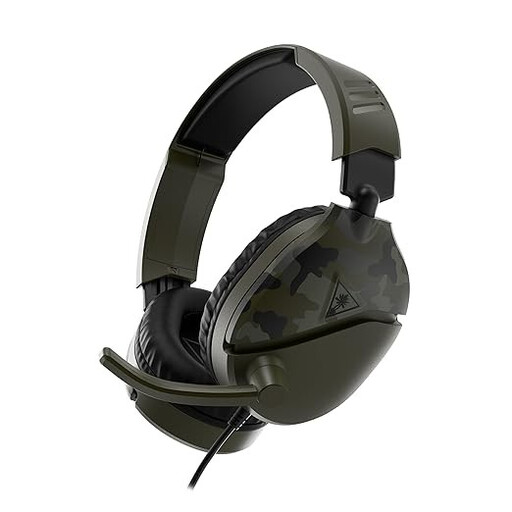
Turtle Beach Recon 70, Green Camo
A wired headset option if you’re looking for a 3.5 mm connection for recording and listening.
The product name lists a 3.5 mm connection and a flip-up, muteable microphone. The product description mentions an adjustable microphone boom.
View at Joybuy
 No image available
Logitech USB Headset H540 Wired
A complete headset option if your recording device has a compatible USB Type-A connection.
The product description lists USB Type-A, on-earcup controls and an adjustable headband.
View at Joybuy
 No image available
Jabra Evolve2 75, USB-A MS Teams, black
A wireless headset option if you want to listen while recording and its listed connections are compatible with your equipment.
The product name lists USB-A. The product description mentions Bluetooth, connection to two devices and a microphone array for calls; this is not a performance comparison for voice-over recording.
View at Joybuy
 No image available
HyperX Cloud III S Wireless, black
A wireless headset option with a detachable microphone boom, if its connection type and fit suit your recording setup.
The product description lists 2.4 GHz and Bluetooth connections, as well as a detachable boom microphone.
View at Joybuy
 No image available
Jabra Evolve 30 II MS Stereo
A wired headset option if you want to use a microphone and headphones with a compatible 3.5 mm or USB connection.
The product description lists a 3.5 mm connection and an included LINK MS controller for USB.
View at Joybuy
Frequently asked questions
How should I position the microphone for emphatic lines without plosives?
Adjust the boom and test a loud line in a test recording. In the SM35 manual, Shure recommends positioning the microphone at the corner of your mouth, rather than directly in front of it, to reduce plosives. This advice does not guarantee the same result with every model.
Can I connect a RØDE HS2 directly to any XLR input?
No. According to RØDE, the RØDE HS2 requires a 3.5 mm microphone input with plug-in power. For use via XLR, RØDE describes the VXLR+ as an adapter that converts phantom power to plug-in power; check that this connection route is suitable for your recording device.
What do warranty and repairs mean when buying in the Netherlands?
According to the Dutch government, you are entitled to a product that works properly, and the retailer is your point of contact if something is faulty. The Dutch government states that there is no fixed statutory warranty period in the Netherlands; a manufacturer’s warranty is in addition to your statutory rights. Also check which parts can be replaced on the version you’re considering.
Can I add film audio or music when I publish my synopsis?
Don’t assume you can use protected film audio or music without permission. The Dutch government states that permission is generally required. Auteursrechtnl describes a limited exception for quotations subject to conditions, including relevance to the content, using only a small amount where necessary, and crediting the source. Whether a particular excerpt qualifies depends on the excerpt and how you intend to use it.


