
Storytellers with a small desk
A headset microphone boom keeps the mic close to your mouth without needing a separate stand on your desk. Models from Logitech, Audio-Technica and RØDE show that connections vary between headsets.


Start by checking the connections on your recording device. A wired USB headset will suit a computer with the right USB port, while an analogue or broadcast headset may need different inputs. Then make a short test recording to check that your voice is clear and the microphone boom stays in place. A headset saves desk space, but fit and equipment requirements vary by model.
A headset microphone boom keeps the mic close to your mouth without needing a separate stand on your desk. Models from Logitech, Audio-Technica and RØDE show that connections vary between headsets.
Check both the microphone input and headphone output on your equipment. The Audio-Technica BPHS1, for example, has separate XLR and 6,3mm plugs, while the analogue RØDE NTH-100M comes with a splitter for devices with separate 3,5mm ports.
Adjustability, the headband and the ear cushions all matter if you record for extended periods. Manufacturer information can help you compare models, but it cannot predict how a headset will fit your head.
Suitable if: you record using a computer with the right USB port and do not want a separate desk microphone. The Logitech H390 is one example, with a microphone boom and in-line controls.
Keep in mind: the exact USB type and where the cable sits. A claim about call quality is not an independent assessment of storytelling recordings.
Suitable if: your device has a compatible combined headset socket, or separate 3,5mm inputs that work with the supplied splitter. The RØDE NTH-100M is one example, with a detachable microphone.
Keep in mind: check that you can connect both the microphone and headphones to your device. Manufacturer claims about recording quality are not an independent comparison with USB headsets.
Suitable if: your recording equipment has compatible separate connections and you want a headset with a directional microphone and closed ear cups. The standard Audio-Technica BPHS1 is one example.
Keep in mind: the standard BPHS1 has a 3-pin XLR plug for the microphone and a 6,3mm plug for the headphones. It is not a direct USB headset; the BPHS1-XF4 has a different connection.
| What to consider | What should you check? | Who is this important to? |
|---|---|---|
| Clear voice recordings | Check that you can adjust the microphone boom, then make a short test recording on your own device at your normal storytelling volume. | When I record stories, I want to be able to hear my voice clearly afterwards and position the microphone close to my mouth. Around 31% of consumers put clarity first. |
| Clear desk space | Check where the cable will run and whether the stated cable length suits the distance between your chair and computer. | If you have limited desk space, you may not want a separate microphone stand on the desk, but you will need to allow for a cable across your workspace. Around 25% of consumers give clear desk space top priority. |
| Compatible connection | Make a note of the available ports and check both the microphone input and headphone output for the exact model. | If I want to use my existing equipment, the headset needs to connect for both recording and playback. Around 25% of consumers put device compatibility first. |
| Comfort during practice | Look at the adjustability and type of ear cushions. Assess the fit for yourself, and do not treat manufacturer claims as a guarantee of personal comfort. | If you plan longer practice sessions, you will want a headset that stays comfortable and has a microphone boom you can adjust easily. Around 19% of consumers make comfort their top priority. |
The standard Audio-Technica BPHS1 uses an XLR microphone plug and a separate 6,3mm headphone plug. This is different from a USB connection.
Compare both plugs with the inputs and outputs on your own recording equipment.
A headset with separate connections may require compatible additional audio equipment.
The Jabra Evolve2 30 SE comes in mono and stereo versions, with different USB options. The stated 3,5mm compatibility for certain Poly Blackwire models does not necessarily apply to the Blackwire 3320.
Check the full model name and connection of the version you want to buy.
Logitech describes the H390 as suitable for calls, among other uses. That does not prove how natural a Dutch-language story recording will sound with your voice and set-up.
Make a short test recording and listen back before recording a longer story.
The Dutch government states that there is no fixed statutory guarantee period for all products in the Netherlands.
Distinguish between your statutory rights and any separate manufacturer’s guarantee. If a product is faulty, contact the seller.
The H340 and H390 are examples of wired computer headsets. Check which USB connection is compatible with your device.
The NTH-100M is an analogue over-ear headset with a detachable microphone, which RØDE also presents for podcasting.
The standard BPHS1 is a broadcast headset for use with compatible recording connections.
The Evolve2 30 SE series includes wired on-ear versions for computer use. Check whether you need the mono or stereo version and which USB connection it has.
The Blackwire 3320 is a wired on-ear computer headset. The version with product number 8X220AA has USB-C with a USB-C/A adapter.
This selection includes wired USB headsets and analogue headsets with microphones, for practising without a separate microphone stand on your desk. Check that each model’s connection is compatible with your recording device.
 No image available
A wired headset option if you do not want to use a separate microphone stand on your desk while practising.
The product description lists a USB connection, adjustable microphone boom and in-line volume and mute controls. Check that your computer has a compatible USB port.
 No image available
This wired headset is an option if you want to use a headset microphone for recording instead of a separate desk stand.
Logitech lists a USB-A connection, adjustable microphone and plug-and-play set-up. Check that the USB version is compatible with your computer.
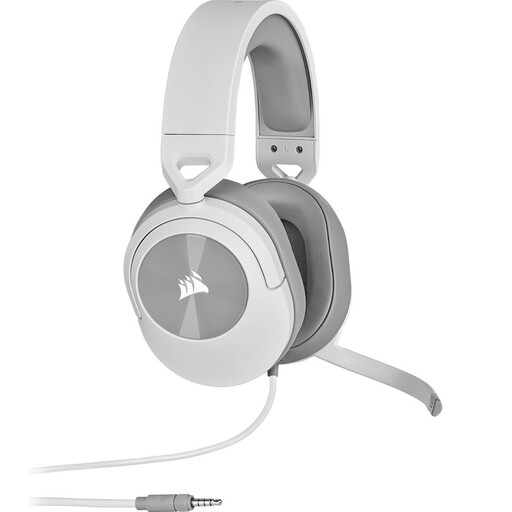 No image available
An analogue headset option if you want to use the microphone and headphones with compatible 3,5mm connections.
The product description lists an omnidirectional microphone, a flip-up mute function and a supplied Y-splitter. Check whether your device has one combined socket or separate ports.
 No image available
This headset may suit you if you want an adjustable microphone boom and an analogue connection for practising stories.
The product description lists a swivelling microphone and a wired 3,5mm connection. Devices with separate microphone and headphone ports need a splitter, which is not included.
 No image available
A wired headset option for recording without a separate microphone stand, provided the 3,5mm connection is compatible with your equipment.
The product description lists a flexible cardioid microphone and a 3,5mm connection. For computers with separate ports, it mentions a splitter.
Connect the headset, select it as the input device in your recording software and record a few sentences with the microphone boom close to your mouth. Listen back before recording a whole story; Logitech recommends positioning the boom near your mouth for a better voice recording.
Yes. According to RØDE, the supplied splitter is designed for a separate 3,5mm microphone input and headphone output. Check that your device has both ports.
For a distance sale from a business, you will often have a 14-day cooling-off period, according to the Dutch government. If the product is faulty, contact the seller about your statutory guarantee. The Dutch government states that there is no fixed statutory guarantee period for all products in the Netherlands.
First, consider which privacy rules apply. According to the Dutch Data Protection Authority, a recording in which someone is recognisable may be personal data. Under the GDPR, consent is required in most cases to publish it publicly online. The exception for purely personal or household use does not automatically apply to public sharing.
You do not need permission from another speaker to make a private practice recording of your own voice. The position may be different if you record other identifiable people or make the recording public; the exception for personal or household use only applies in certain circumstances.