What should you look for when choosing?
Start by checking the connections on your recording device. Then make a test recording to see how your voice, microphone position and wearing comfort work for your practice sessions.
Wired USB computer headset
A good fit if: you practise on a computer with the right USB port and want to record and listen back without a separate audio interface.
Things to consider: the cable limits your movement. Logitech positions the H390 mainly for calls, which doesn’t show how well it records expressive performances.
Over-ear headset with a TRRS microphone
A good fit if: you want to use one headset for recording and listening, and your device has a suitable headset microphone connection.
Things to consider: RØDE specifies the supplied TRRS cable for the NTH-100M. The XLR connection described requires an adapter with a suitable power supply.
Broadcast headset with separate connections
A good fit if: your recording equipment has a suitable microphone input and headphone output, and you want to listen back through the headset.
Things to consider: the standard Audio-Technica BPHS1 uses separate XLR and 6.3 mm plugs and isn’t a direct USB headset.
Wearable headworn microphone
A good fit if: you already have a compatible bodypack or preamp and use separate headphones.
Things to consider: the Shure SM35 isn’t a complete headset. The TA4F and XLR versions require different connection and power setups.
| What to consider |
What to check before buying |
Who should pay particular attention? |
| Voice and dynamics |
Check whether the microphone boom is adjustable. Record quiet and loud lines, then listen back to check that the audio doesn’t sound distorted. |
If you want to assess pronunciation, pauses and emphasis between takes, clear voice reproduction comes first. Around 33% of consumers rank this as their top priority. |
| Wearing comfort |
Assess the headband, ear cushions and microphone boom stability during a typical practice session. |
For repeated or longer sessions, you’ll want to keep wearing the headset without having to adjust it constantly. Around 27% of consumers give wearing comfort their highest priority. |
| Connection and setup |
Compare the exact model, plugs and any power requirements with your equipment. Then select the right microphone in your recording software. |
If you want to get started on your own computer or recording equipment without connection problems, compatibility matters most. Around 20% of consumers put ease of connection first. |
| Background noise and plosives |
Make a test recording in your practice space and adjust the microphone boom so your voice sounds clear without distracting breath noise or plosives. |
If you mainly want to reduce background noise or inconsistent plosives, you’ll need to assess your recording space and microphone position carefully. Around 20% of consumers put this first. |
Headsets with microphones at Joybuy
The Joybuy options below are headsets with microphones for listening and speaking. Check that each model’s connection works with your recording device, and make a test recording before recording a full performance.
 No image available
Trust GXT 498W Forta gaming headset, white
May suit you if you want one wired headset for listening and speaking; make a test recording to see how the microphone captures your performance.
The product information lists a detachable microphone, a 3.5 mm connection and a 1.2 m cable. The product name mentions 50 mm drivers and a PS5 licence.
View at Joybuy
 No image available
Sennheiser MOMENTUM 4 Wireless, black
May suit you if you want to listen and speak wirelessly, but check that the connection works with your recording device and test the microphone with your own voice.
The product description lists four digital beamforming microphones and adaptive noise cancellation. The microphones are described for calls, not as proof of how well they record poetry.
View at Joybuy
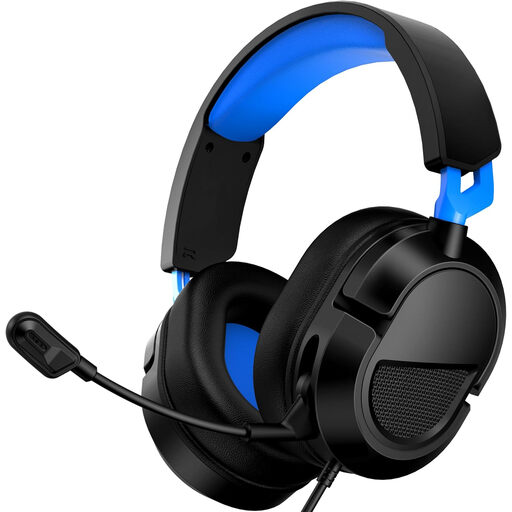 No image available
AOC wired gaming headset for PS5, Xbox and PC
May suit you if your recording device has a compatible 3.5 mm connection; listen back to a test recording to assess how the microphone sounds with your performance.
The product description lists a flexible microphone, an adjustable headband and compatibility with PS5, Xbox Series X|S, Xbox One and PC.
View at Joybuy
 No image available
Razer Kraken V3 X headset, black
May suit you if you’re looking for a headset with a microphone and headphone audio; make your own test recording to see whether the voice reproduction works for your poetry.
The product description lists a cardioid microphone for voice communications and a weight of 285 g.
View at Joybuy
 No image available
Jabra Evolve2 75 headset
May suit you if you want one headset for listening and speaking; check the connection and test whether the microphone sounds clear enough for a poetry reading.
The product description lists eight microphones, Bluetooth 5.2 and a USB-C cable included, with wireless or wired use. The microphones are described for professional communications.
View at Joybuy
Frequently asked questions
How can you check that a recording is usable before a series of practice sessions?
Select the intended microphone in your recording software, record a short passage with both quiet and powerful lines, then listen back. If the level meter shows clipping, lower the input level and test again. Audacity recommends aiming for a peak around −6 dB on its recording meter to avoid clipping.
Where should you position the microphone boom to reduce plosives?
For the SM35, Shure recommends positioning the microphone at the corner of your mouth, rather than directly in front of it. DPA explains that breath and speech airflow vary from person to person, so adjust the position to suit your own performance and listen back to a test recording.
Do you always need a licence for a wireless headworn microphone in the Netherlands?
No. According to the Dutch Authority for Digital Infrastructure, a licence is usually not needed for wireless microphones, but you must use the correct frequency band. Some bands require a licence, and the available frequencies can vary by location. Check the band you’re using and your location before setting up the system.
Can you share a recording of someone else’s poem online?
According to the Dutch Government, a private copy for personal use must not be distributed or made public. So, if someone else’s poem is protected by copyright, don’t assume you have permission to publish your performance. Check the rights and, where necessary, get permission from the rights holder. Practising in private is different from sharing publicly.
Does a headset always come with exactly two years of statutory warranty in the Netherlands?
No. According to the Dutch Government, the Netherlands has no fixed statutory warranty period: how long you’re entitled to a product that works properly depends on what you can reasonably expect from it. If a product is faulty, the retailer is your point of contact; ordinary wear and tear or damage you’ve caused isn’t automatically covered by free repairs.


