What should you look for?
If you can hear your housemates, start by checking the microphone’s position and how it works, then assess a test dictation. The term ‘noise cancellation’ alone won’t tell you what the software will recognise.
Wired USB headset
Choose this if: you mainly dictate on one computer and don’t want to manage a wireless connection or battery.
Bear in mind: a cable limits your movement. Also check whether the version uses USB-A or USB-C.
Wireless headset
Choose this if: you want to be able to leave your seat while putting your notes into words.
Bear in mind: pairing, range and charging. Nuance lists a flat battery or moving out of range as possible causes of Bluetooth dropouts with Dragon.
Dedicated dictation headset
Choose this if: you dictate often and genuinely need recording controls or different ways to wear the headset.
Bear in mind: check that the controls work with your software. Philips’ recognition claim doesn’t prove that the headset will transcribe better in your home.
| Key consideration |
What to look for |
Who is this important for? |
| Voice recording with household noise |
Check that you can position the microphone boom close to your mouth, then record a test dictation with typical background noise. |
If conversations or household noise end up in my study notes, I want to test the recording with the sounds I actually hear at home. Around 36% of consumers prioritise voice recording with household noise. |
| Concentration and comfort |
Distinguish between isolation from the earcups and filtering by the microphone; check whether the headset is mono or stereo. |
For longer study sessions, I want a comfortable fit and a level of isolation that suits my needs. Around 29% of consumers prioritise concentration and comfort. |
| Connection and microphone selection |
Compare your device’s port with the plug and any included adapter, then select the correct input microphone in your software. |
If I study on different devices, I want the headset to connect and be selected as the input source. Around 21% of consumers prioritise device compatibility. |
| Freedom of movement and controls |
For the exact version, check the wireless range, charging method and what the controls do with your application. |
If I move around while dictating or pause regularly, I want to be able to use the connection and controls in a way that suits my workflow. Around 14% of consumers prioritise freedom of movement and controls. |
Headsets on Joybuy
This selection includes wired and wireless headsets with different microphone designs. Choose based on your device, where you want the microphone positioned and whether you want to work wirelessly.
 No image available
HyperX Cloud III S Wireless with detachable microphone boom
The detachable microphone boom is useful if you want to position the microphone close to your mouth while dictating. Check that the wireless connection suits your device and workflow.
Joybuy
 No image available
Trust Ayda wired headset, USB Type-A
The product information describes a noise-cancelling microphone that mutes when you flip it up. Check that USB Type-A is compatible with your device, then test the recording with household noise.
The product information also lists volume control and an adjustable headband.
Joybuy
 No image available
Razer BlackShark V2 X wired headset
This version is an option if your device has a 3.5 mm connection. The product information says that the microphone can be positioned close to your mouth. Record a test dictation to see how it performs in your room.
The product information lists memory foam ear cushions and a weight of 240 grams.
Joybuy
 No image available
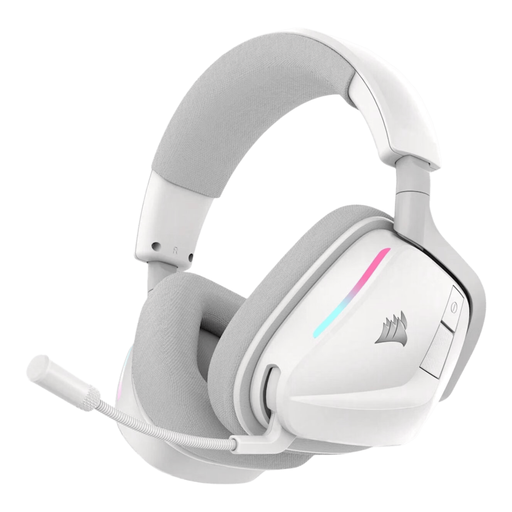
Corsair VOID RGB V2 Wireless, white
The product information lists a flexible microphone and earcup controls. The described background noise reduction via NVIDIA Broadcast requires a device with a compatible NVIDIA GeForce RTX graphics card. Check this requirement before relying on it.
The product information lists wireless connectivity via 2.4 GHz and Bluetooth.
Joybuy
 No image available
Samsung EO-IC100 wired in-ear headset, USB Type-C
This in-ear version has a built-in microphone rather than a microphone boom. Choose it if the USB Type-C connection and fit suit your device and how you use it. The microphone offers less flexibility for positioning close to your mouth than a microphone boom.
The product information lists microphone muting and in-line controls.
Joybuy
Frequently asked questions
Is active noise cancellation for your ears the same as a noise-cancelling microphone?
No. Ear isolation or ANC affects what you hear; microphone filtering affects the recorded signal. Check them separately and make a test recording with the kind of noise you hear at home before dictating.
What can I do if my dictation software picks up my housemates?
First, check that the headset is selected as the input microphone and keep the microphone boom in a steady position close to your mouth. If your software has a microphone check, use that too. For Dragon, Nuance recommends limiting background noise and keeping it reasonably consistent; this isn’t a guarantee for other software.
What should I check about the connection and any accessories?
Compare the connection on the exact headset version with the port on your device, and check whether any required adapter or receiver is included. For a wireless version, make sure the connection and charging method also suit how you use it.
What rules should I be aware of when buying a wireless headset?
Radio equipment sold on the EU market is covered by the Radio Equipment Directive, as explained by the European Commission. According to the European Union, CE marking is only required when applicable EU rules say so; check the documentation for the specific version.
Do I always have 14 days to change my mind when I buy a headset online?
The Dutch government says that consumers generally have 14 days to change their mind when buying at a distance, and notes that exceptions apply. Check the terms for your purchase. According to the Dutch government, an order from a private individual isn’t covered by the same distance-selling rules.


