
Speaker next to a fan
You want to know whether listeners will be able to hear you clearly while the fan is on. A microphone you can position close to your mouth helps you make a test recording; Logitech describes this adjustability for the H390.


Start by choosing a headset with a microphone you can position close to your mouth, then make a test recording while the fan is running. This lets you judge how clearly your voice comes through in your set-up. Next, choose a connection and fit that suit the device you use to practise. Jabra describes ANC as technology that reduces noise for the wearer, but this doesn’t replace assessing the microphone recording separately.
You want to know whether listeners will be able to hear you clearly while the fan is on. A microphone you can position close to your mouth helps you make a test recording; Logitech describes this adjustability for the H390.
You can hear the fan during longer practice sessions and want fewer distractions. Jabra describes ANC as being designed to reduce noise for the wearer; that alone says nothing about the sound picked up by the microphone.
You want to set up the headset on your computer and in your meeting app, then check which microphone is active before your presentation. Microsoft Support explains how to select the connected microphone in Teams.
Suitable if: you mainly practise on one computer and want to position the microphone close to your mouth.
Bear in mind: the cable limits your movement, and a claim about microphone noise cancellation won’t tell you how your recording will sound with a fan running.
Suitable if: the fan distracts you while practising and you also want to assess your recorded voice separately.
Bear in mind: ANC targets the sound reaching your ears. Test the microphone with a recording, and remember that the fit can affect ANC performance.
Suitable if: you’re giving your presentation through an app such as Teams and want to use the headset in that app.
Bear in mind: settings can vary by platform or organisation, and a local recording may sound different from the audio in the meeting.
First, assess how clearly your voice comes through. Then check the connection and app settings, and consider whether fit, listening comfort or freedom of movement matters most to you.
| What to consider | What should you check? | Who is this important for? |
|---|---|---|
| Clear speech | Make a recording with the fan on and listen back to check that even quieter words are still clear. | If I practise next to a fan, I want to know whether my voice is being picked up clearly. Around 42% of consumers say clear speech is their top priority. |
| Connection and app | Check the connection on the exact version you’re considering, then select the headset microphone in your presentation app. | If I’m presenting from a computer, I want to make sure it’s using the right microphone. Around 25% of consumers prioritise connection and app compatibility. |
| Concentration and comfort | Assess the fit; don’t treat ANC for your ears as proof of a quieter recording. | If I practise for longer and can hear the fan myself, I pay attention to comfort and distractions. Around 17% of consumers prioritise these factors. |
| Freedom of movement and switching devices | Check the connection or wireless link for each device you plan to use, and test the microphone again after switching. | If I switch between devices or move around while practising, I want to know whether the headset works in each set-up. Around 16% of consumers prioritise flexibility. |
Earcup ANC reduces the noise you hear; microphone noise cancellation relates to the sound being recorded. One doesn’t automatically tell you anything about the other.
Check both features separately and listen to a test recording with the fan on.
Connections and UC versions can vary within a headset range, so not every variant will suit your computer or presentation app.
Before buying, check the connection and version of the specific model.
A meeting app may select a different microphone or apply noise cancellation. As a result, participants may hear something different from what you hear in a local recording.
Test both locally and in the app you’ll use for the seminar, with the fan on.
The H390 is an example of a wired USB headset for practising at a computer.
The Blackwire 5200 series and Blackwire 8225 illustrate wired options with features that vary by version.
The Evolve2 30 SE is an example of a wired UC headset with two microphones and noise-isolating ear cushions.
These Joybuy products are wired headsets with microphones. Check each model to make sure its connection and microphone settings work with your practice device and presentation app.
 No image available
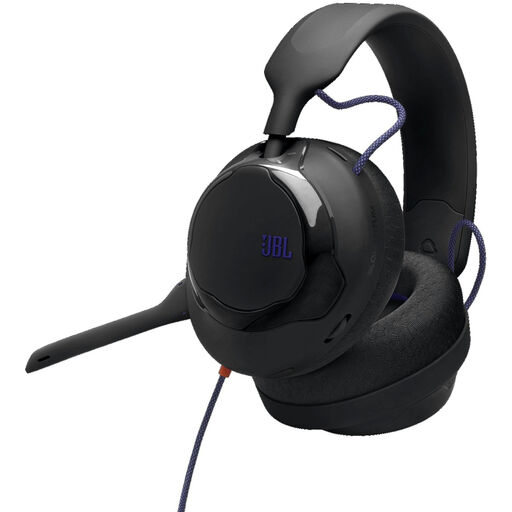
A wired option to consider if you need a boom microphone and a 3.5mm connection.
The product description mentions a detachable cardioid microphone and microphone noise cancellation.
The stated optimisation for keyboard noise is handled by JBL QuantumENGINE; test separately how the microphone sounds with your fan.
 No image available
An option to consider if you practise via USB and want to position the boom microphone close to your mouth.
The product description mentions an adjustable, 270-degree rotating boom microphone, USB and a 1.8-metre cable.
The description mentions passive noise cancellation for speech clarity and compatibility with Windows, Mac and Chromebooks; check your device’s connection.
 No image available
An option to consider if you practise online and want a microphone with a mute function.
The product description mentions a flip-up microphone that mutes when raised, volume control and a USB-A connection with a USB-C adapter cable.
The listing attributes background noise filtering to the microphone; test the results in your own set-up.
 No image available
An option to consider if your device has a 3.5mm connection and you can position the microphone close to your mouth.
The product description mentions a cardioid microphone and recommends positioning it around 1–2 inches from your mouth.
For a computer with separate audio outputs, the description mentions a splitter cable; check which connection your device uses.
 No image available
An option to consider if you’re looking for a wired USB headset with a detachable microphone.
The product description mentions a rotating, detachable microphone with noise cancellation and a mute function.
The listing states that it’s compatible with PC and Mac; check that the USB connection works with your device before use.
No. Earcup ANC targets the sound you hear. Assess the microphone separately by making a recording and listening back in your own set-up.
In Teams, select the connected headset as your microphone and test it with the fan on. Microsoft Support explains where to select the microphone and how to check the relevant noise cancellation settings; these may depend on the platform or your organisation’s policies.
Check that the connection is compatible, give the app access to your microphone if needed, and position the boom close to your mouth. Readjust the headband and ear cushions if the fit changes, and follow the instructions for your exact model when cleaning it or replacing any parts.
According to ACM ConsuWijzer, many online consumer purchases come with a 14-day cooling-off period from delivery; check which legal exceptions apply to your purchase. If a product doesn’t meet the requirements, the seller is responsible for the statutory guarantee. This is separate from any commercial warranty.
If your recording contains other participants’ personal data, the Dutch Data Protection Authority says you need a legal basis under the GDPR. Consent is one possible basis, but it isn’t automatically the only one; consider in advance which legal basis applies to your situation.