
Recording word examples
You want to listen back to your pronunciation and individual sounds. The Consumers' Association also assesses recorded sound when testing headphones and earbuds.


For straightforward recording on a computer, a wired USB headset is a practical choice. If you mainly want to assess the details of your voice, you could also compare a headset designed for recording. First check that the connection is compatible, then listen to a test recording of your own: specifications for calls don’t show how examples of Dutch words will sound.
You want to listen back to your pronunciation and individual sounds. The Consumers' Association also assesses recorded sound when testing headphones and earbuds.
You record words several times and listen back to them. A comfortable fit and easy-to-use controls can help make your practice sessions more practical.
You want to connect the headset to your computer or recording equipment. Check whether you use USB, a combined headset connection or separate audio inputs.
First check which connection your computer or recording equipment has. Then make a recording of your own to see whether the sound, fit and controls suit your practice.
| What to consider | What to look for | Who is this important for? |
|---|---|---|
| Voice and pronunciation recording | Record the same words several times, including soft sounds and words with plosive sounds. Listen back to check that your voice remains clear. | I want to assess individual sounds and my pronunciation, not just sound clear during a conversation. Around 33% of consumers put voice recording first. |
| Comfort and controls | Try the headset during a typical practice session and check that the mute and volume controls are easy to reach. | When practising repeatedly, I want to keep wearing the headset comfortably and adjust the controls quickly between takes. Around 27% of consumers prioritise comfort and controls while practising. |
| Connection | Check the exact USB or analogue connection and whether your recording software can use the microphone as an input. | I want to record with the computer or equipment I already have; an incompatible plug may mean you need a different connection or extra equipment. Around 20% of consumers make their existing audio setup their top priority. |
| Background noise | Make a short recording of silence in the room where you practise, then listen back to it. What you hear through the headset doesn’t necessarily tell you what the microphone is recording. | If I practise in a noisy room, I want to know how much background noise makes it into my recording. Around 20% of consumers put controlling audible background noise first. |
A feature described for calls doesn’t prove how clearly individual Dutch words will come across in a recording.
In your own practice space, record the same words with the headsets you’re considering, then compare the files by listening back to them.
A headset with analogue plugs may need different inputs or equipment from a USB model.
Before buying, check the headset connection as well as the microphone and headphone inputs on your device.
RØDE states that the NTH-Cable is a TRS cable and isn’t compatible with the NTH-100M headset microphone.
Check the exact model name and choose a cable that’s suitable for the NTH-100M.
An unsuitable replacement cable could mean you still need to buy the right one.
The H390 is a wired USB headset for computer use.
The PC 8 USB, product number 1000432, is a stereo USB headset for computer use.
The NTH-100M is an over-ear headset with a detachable microphone for an analogue setup.
The BPHS1 is a broadcast headset for a setup with separate microphone and headphone connections.
The Evolve2 40 SE is a wired office headset available in several USB versions.
These wired headsets are designed for recording and listening back via USB or a compatible 3.5 mm connection. Before choosing, check that the model’s connection is compatible with your device.
 No image available
A USB-A headset with in-line controls could suit repeated recording sessions on a computer with a compatible port.
The description lists two integrated microphones, stereo sound and volume and mute controls. If your device only has USB-C, check which adapter you’ll need.
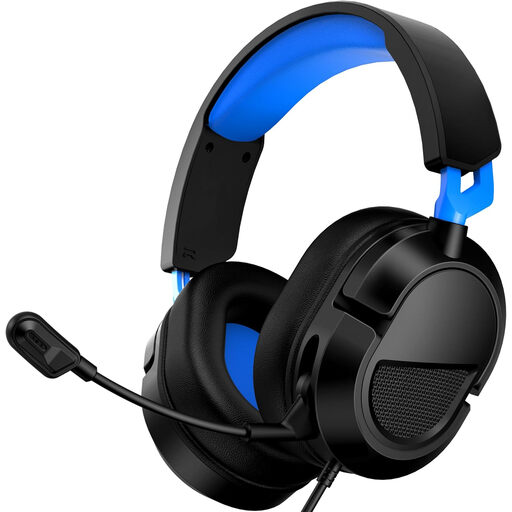 No image available
A headset with a 3.5 mm connection could suit recording on a device with a compatible analogue input.
The description lists a flexible microphone, an adjustable headband and a weight of 207 g. Check that your device has the right connection.
 No image available
This wired USB headset is an option for recording and listening back on a device with a compatible USB connection.
The product description lists a cardioid microphone, a weight of 285 g, and use with PC and PS4.
 No image available
The rotating microphone can be useful if you want to reposition the headset while practising.
The description lists stereo audio, in-line controls and a 3.5 mm connection. It also states that a splitter for separate microphone and headphone ports isn’t included.
 No image available
The wired USB connection and in-line controls could suit recording and listening back on a compatible computer.
The description lists an adjustable microphone, volume and mute controls, and use with PC, PS4 and Mac.
Select the headset as the input device in your recording software, then make a short test recording and listen back to it. With a USB headset, also check that the port matches the version you have. Some analogue models need separate microphone and headphone inputs.
That depends on the headset and the connections you already have. The Logitech H150 in this selection has a 3.5 mm connection, and the description states that a splitter for separate inputs isn’t included. Check your device’s ports and what’s in the box before buying anything else.
Record the same words with each headset you’re considering, in the room where you’ll be practising, then listen back to the files. Include soft sounds, plosive sounds and a short period of silence. Features listed for calls don’t automatically show how well a headset records individual words.
According to the Dutch Data Protection Authority, processing that is purely personal or domestic is exempt from the GDPR. If someone can be recognised by their voice and you process the recording outside that personal use, it may count as personal data and you’ll need an applicable GDPR legal basis. Which legal basis applies to a particular teaching or publishing project depends on the circumstances.
According to ACM ConsuWijzer, ordinary online consumer purchases generally come with a cooling-off period of up to 14 days after delivery, with some exceptions. In the Netherlands, there’s no fixed statutory warranty period for faulty products: if a product breaks sooner than you could reasonably expect under normal use, the seller must offer an appropriate remedy free of charge, according to ACM ConsuWijzer.