Who is this buying guide for?

Speakers who listen back on a computer

You’re rehearsing while seated and want to record your Dutch-language presentation so you can check your pronunciation, pace and clarity. Your device’s connection and the position of the microphone are important first checks.

Speakers practising through the venue sound system

You want to hear your voice through the museum’s sound system. Check which microphone input is available and what equipment you’ll need for the complete signal path.

Speakers with longer rehearsals

You’re practising longer passages and want a comfortable fit, easy-to-reach controls and a stable microphone position. Manufacturers describe adjustable headbands and ear cushions, but the fit will vary from person to person.

What should you look for?

Buying consideration What should you check? Who is this important for?
Recording and listening back Check the connection, the selected microphone input and the cable length. Record a short passage and listen back to it. If I want to listen back to my presentation on a computer, the headset needs to work as a microphone input. Around 33% of consumers make computer recording their top priority.
Connecting to the museum sound system Ask which input is available and whether you’ll need a transmitter, receiver and connection cable. If you’re going wireless, check the frequency at the venue too. If I want to hear my voice through the venue sound system, the complete signal path needs to work with the equipment. Around 27% of consumers prioritise venue amplification.
Clarity when speaking Dutch Check whether the microphone boom can be adjusted, and make a test recording that includes words with plosive sounds. If I want to hear my Dutch text clearly, I’ll pay attention to the microphone’s position near my mouth. Around 20% of consumers say clarity is their main buying consideration.
Comfort during rehearsals Check the fit, how easy it is to reach the mute button and the position of the microphone boom. Try on the headset if possible. For longer passages, I want a headset that feels comfortable and keeps the microphone in place. Around 20% of consumers make long-wearing comfort their top priority.

Common buying mistakes

  • Buying a USB computer headset for a venue with an unknown input

    A USB headset connects to a computer, but that doesn’t mean it will work with the input on the museum’s sound system.

    Before buying, ask which input is available and map out how the sound will travel from the microphone to the sound system.

  • Assuming a standalone headset microphone is a complete wireless system

    A headset microphone for a bodypack is not the same as a system with a transmitter and receiver. Check which components are included with the exact model.

    Compare the connectors and package contents with the equipment at the rehearsal venue.

  • Assuming any wireless frequency can be used without a licence

    The Netherlands Authority for Digital Infrastructure lists the conditions for licence-exempt frequency bands and notes that some other bands require a licence.

    Check the exact frequency variant, transmission power and usable frequencies at the museum venue.

Brands to compare

Logitech

For computer rehearsals, Logitech offers both USB headsets and models with a 3.5 mm combination plug.

  • According to Logitech, the H390 USB-A version described has an adjustable microphone, in-line controls and a 1.9 m cable.
  • The H151 manual mentions an adapter for computers with separate audio and microphone ports. Neither type of connection, on its own, proves that the headset will work with a PA input.

Jabra

Jabra describes computer headsets with a range of connection and usability features, including the Evolve2 30 SE and Evolve2 65.

  • According to Jabra, the Evolve2 30 SE has two microphones and memory foam ear cushions, while the Evolve2 65 is wireless.
  • Manufacturer claims about sound and comfort aren’t independent test results for a museum presentation. Check the exact UC or Teams version and its connection.

Shure

The PGA31 is a headset microphone for use with a compatible bodypack, not a complete computer headset.

  • Shure specifies an adjustable boom, windscreen and TA4F connector for compatible Shure bodypacks for the PGA31.
  • The standalone microphone doesn’t automatically include a transmitter, receiver or a connection that works with the museum’s sound system.

Sennheiser

According to Sennheiser, the XSW 1-ME3-BC is a wireless headset microphone set for presentations.

  • Sennheiser lists a bodypack, receiver and headset microphone; for the BC version, the manufacturer specifies 670–694 MHz.
  • Check the exact frequency variant, the usable frequency range at the venue and the connection to the museum’s sound system. Other XSW versions may have a different range.

EPOS

According to EPOS, the PC 8 USB is a stereo computer headset for use with a PC or Mac.

  • EPOS specifies USB connectivity, volume and mute controls on the in-line controller, and a unidirectional microphone.
  • These product specifications aren’t the result of an independent comparison test, and they don’t prove that the headset connects directly to a PA system.

Joybuy products for computer rehearsals

These product picks are wired headsets for computer rehearsals. Check separately that your chosen model’s connection is compatible with your recording device; a computer headset won’t necessarily work with a museum sound system.

Logitech H540 USB headset, wired

Logitech H540 USB headset, wired

A wired USB headset for recording and listening back to a museum presentation on a computer. Check that your computer supports this connection.

View at Joybuy
Logitech PC 960 USB headset, wired

Logitech PC 960 USB headset, wired

A wired USB headset for computer rehearsals. Check that the computer you’re recording on supports this connection.

View at Joybuy

Logitech H340 USB headset, black and wired

Logitech H340 USB headset, black and wired

A wired USB headset for recording a presentation on a computer. Check that the connection is compatible with your device.

View at Joybuy
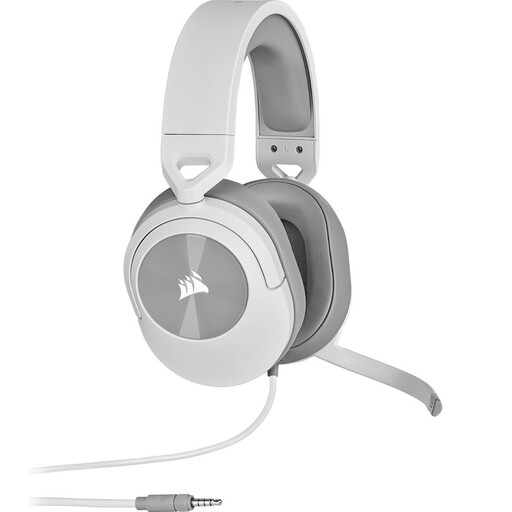
Corsair HS55 Stereo Gaming Headset, white, 3.5 mm

Corsair HS55 Stereo Gaming Headset, white, 3.5 mm

May suit computer recording via a compatible 3.5 mm connection. The product information lists an included Y-splitter for computers with separate headphone and microphone ports.

View at Joybuy

Trust Ayda headset, USB Type-A, black

Trust Ayda headset, USB Type-A, black

A wired headset for computer rehearsals via a compatible USB Type-A port. Check that your recording device has this connection.

View at Joybuy

Frequently asked questions

How do I connect a headset for a test recording?

First, check that the connection is compatible with your computer. Then select the headset as the microphone in your operating system and recording app, and make sure mute is switched off. The Logitech H390 manual recommends these steps to troubleshoot recording problems.

Where should I position the microphone boom?

For the Shure PGA31, Shure recommends positioning the microphone beside the corner of your mouth, rather than directly in front of it, to reduce plosive sounds. Then make a test recording using your own voice. This specific advice doesn’t necessarily apply to every model.

Can I use a wireless PA headset in the Netherlands without a licence?

That depends on the frequency and transmission power. The Netherlands Authority for Digital Infrastructure describes licence-exempt microphone bands with power limits and notes that some bands require a licence. Check the exact system variant and the usable frequencies at the museum venue.

Does a headset in the Netherlands always have exactly two years of legal guarantee?

No. According to the Government of the Netherlands, there’s no fixed statutory guarantee period: a product must meet the standard you could reasonably expect of it. If a product is faulty, contact the seller; a manufacturer’s guarantee may give you additional rights.

Which privacy rule applies if the museum also records other people?

If an organisation processes personal data that can be traced back to individuals, the Dutch Data Protection Authority says it must first establish which lawful basis under the GDPR applies. The right basis depends on who is being recorded and what happens to the recording.
