
Speaker in an echoey room
You’re recording a spoken appeal and want your words to come across clearly. Start by positioning the microphone close to your mouth, then check the sound with a test recording.


Start with a microphone boom arm that keeps the microphone close to your mouth, then make a test recording: a headset microphone won’t remove the room’s echo. A wired USB headset is practical for recording directly to a computer. A broadcast headset may suit you if you already have suitable recording equipment, but check the connections and whether you’ll need any additional equipment.
You’re recording a spoken appeal and want your words to come across clearly. Start by positioning the microphone close to your mouth, then check the sound with a test recording.
You want to connect a headset without first putting together a separate professional audio setup. Check that the connection matches the ports on your computer.
If you already have a suitable recorder or audio interface, you could also consider a broadcast headset with separate microphone and headphone connections. Check that they’re compatible with your equipment.
First, check whether you can position the microphone close to your mouth and make a test recording. Then choose a headset with connections that suit your recording equipment.
| What to consider | What to look for | Who is this important for? |
|---|---|---|
| Clarity in an echoey room | Check that the microphone boom stays in position and make a test recording in the room where you’ll be speaking. | If I’m speaking in an echoey room, my main concern is making sure my words are clear. Around 36% of consumers prioritise clarity in echoey conditions. |
| Direct connection | Compare the connection on the exact headset variant with the port available on your computer. | I want to record on my computer without a separate audio interface, and I need to know the plug will fit. Around 29% of consumers prioritise connecting directly to a computer. |
| Comfort and playback | Check the fit and make sure you can play back the recording on your chosen device. | For a longer recording session, I want a comfortable headset and a way to check the recorded voice. Around 21% of consumers prioritise wearing comfort and monitoring. |
| Compatibility with recording equipment | Check the full model variant, the microphone and headphone inputs, and whether you’ll need an interface or adapter. | If I already have recording equipment, I want to avoid buying a headset variant that won’t fit my existing connections. Around 14% of consumers give equipment compatibility top priority. |
Background noise and reflections of speech around a room are different things. A claim about noise cancellation during calls doesn’t prove that a recording will contain less echo.
First, record a few sentences with the microphone close to your mouth, then listen to the recording itself to assess the echo.
The standard Audio-Technica BPHS1 has separate connections for the microphone and headphones. The BPHS1-XF4 also has a different plug configuration.
Before buying, compare the full model variant and all its plugs with your recorder, computer or audio interface.
Sound that’s quieter to you through the earcups may still be present in the microphone signal.
Listen back to the actual recording to assess the voice and any echo.
The BPHS1 is a broadcast headset designed for uses including announcements and interviews. It’s most relevant if you already have suitable recording equipment.
The H340 is a USB-A computer headset for voice calls, designed for anyone who wants to connect directly to a computer.
The Evolve2 40 SE is an office headset with a microphone boom. It’s worth considering if fit and a consistent speaking position matter to you.
The SM39 is a separate cardioid headset microphone for speakers on the move; it isn’t a standard USB headset with headphones.
This selection focuses on wired USB headsets for computer recording. Check that the connection and any adapter are suitable for your computer.
 No image available
An option for anyone who wants to connect a wired headset directly to a computer and adjust the microphone position.
USB-A connection and two integrated microphones.
The description mentions an adapter for USB-C devices; check which connection your computer has.
 No image available
Suited to a computer setup where you’re looking for a USB headset with an adjustable microphone boom.
The microphone is adjustable and can be swung out of the way; the description mentions inline volume and mute controls.
Check that your computer has a suitable USB port.
 No image available
A wired USB headset that connects directly to a computer, with an adjustable microphone.
The description mentions a USB connection and an adjustable headband.
Check that your computer has a suitable USB port.
 No image available
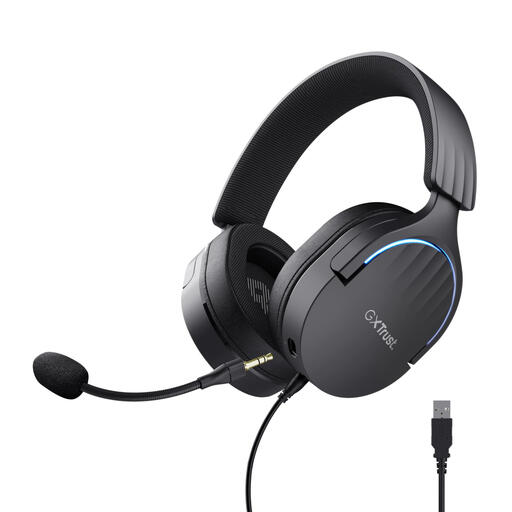
This USB gaming headset may suit a computer setup where you want to position a flexible microphone.
The description mentions a flexible, detachable microphone and USB connectivity with Windows PCs and PS5.
Check that the device you’re recording with supports the USB connection.
 No image available
An option for anyone looking for an adjustable microphone for a USB computer setup.
The description mentions inline volume and mute controls, and compatibility with Mac, PC and desktop computers via USB.
Check that your recording device supports the USB connection.
Don’t count on it: according to Shure, a microphone can’t effectively separate direct speech from reflected speech, and it won’t improve the room’s acoustics. Position the microphone closer to your mouth and check the sound with a test recording.
Not if your chosen version, such as the standard Audio-Technica BPHS1, has separate XLR and 6.3mm connections. Check which inputs you already have and whether you’ll need additional equipment.
Position the microphone boom close to your mouth, record a few sentences, then listen back to check clarity and echo. For the Evolve2 40 SE, Jabra recommends keeping the microphone close to your mouth.
When you buy as a consumer in the Netherlands, you’re entitled to a product that works as it should. According to the Government of the Netherlands, there’s no fixed statutory guarantee period in the Netherlands; if there’s a problem, contact the seller. A manufacturer’s guarantee is in addition to your statutory rights.
Not without first checking which privacy rules apply to your situation. A recognisable audio recording may be personal data, and processing it requires a legal basis under the GDPR. The Dutch Data Protection Authority states that, in most cases, you need permission to publish other people’s personal data online. What applies depends on who can be recognised and how you use the appeal.