
Vandaag of morgen in huis

Kwaliteit gegarandeerd

Welkomstaanbiedingen ontgrendelen: GRATIS bezorging | Tot 80% korting | Gratis 30 dagen JoyPlus-proefperiode
Download de app
Does this sound familiar? Driving in the dark with headlights that seem more like candles than modern automotive lighting. Especially in rain or fog, visibility with standard halogen bulbs can be seriously disappointing. Upgrading from halogen to LED isn't just a luxury; it's a direct improvement to your visibility and safety.
Many car owners are looking for a simple way to modernise their lighting. The market for HB4 LED headlights is vast, and it can be challenging to make the right choice. This article is designed to be a practical guide. We'll help you understand the specifications and highlight several popular choices, so you can make an informed decision.
Before you proceed with replacing your car's headlights, there are a few key points to consider. These will help you choose a set that not only fits but also performs as you expect.
The most crucial step is to verify which fitment your car requires. This article focuses on HB4 (or 9006) LED bulbs, which are often used as HB4 LED low beams. Some cars use a similar fitment, HB3 (or 9005), typically for the high beams. Always check your car's owner's manual or the markings on your current bulb.
Additionally, opt for a mini-sized LED bulb. Many modern LED bulbs have a 1:1 design, meaning they are the same size as the original halogen bulb. This makes installation much easier, as you won't need to make any modifications to the headlight housing. A true plug-and-play headlight saves you time and effort.
The brightness of a bulb is measured in lumens. More lumens mean more light, but a proper beam pattern is at least as important. A well-designed LED bulb prevents you from blinding oncoming drivers.
The colour temperature, expressed in Kelvin (K), determines the colour of the light. Standard halogen bulbs have a yellowish glow of around 3000K. Most LED headlights have a colour temperature of 6000K xenon white. This provides a crisp, daylight-like white light that makes objects on the road more clearly visible and gives your car a modern look. This results in bright car lights that significantly improve visibility.
Modern cars are equipped with a CAN bus system that monitors the vehicle's electronics. Because LED bulbs consume much less power than halogen bulbs, the system might think a bulb is burnt out. This results in an error message on your dashboard or flickering lights.
To prevent this, choose a CAN bus LED bulb. These bulbs have a built-in resistor or decoder that 'tells' the CAN bus system that everything is functioning correctly. Most manufacturers state that their bulbs are compatible with 99% of vehicles, but with highly sensitive systems, an external decoder may still sometimes be necessary.
Based on product specifications and ease of installation, we've highlighted some popular options for you.
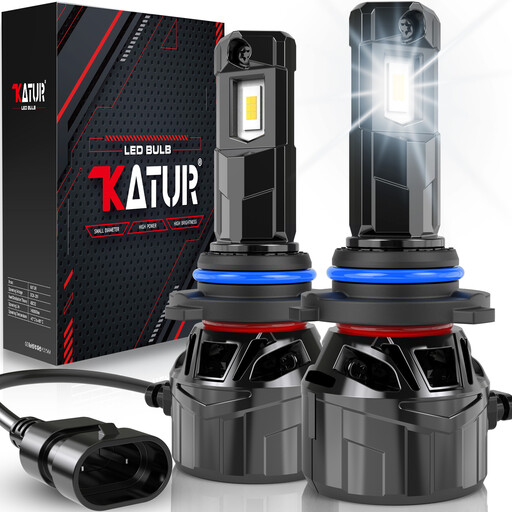
Why It Stands Out This set from KATUR focuses on maximum performance. According to the manufacturer, the set delivers a very high light output of 30,000 lumens per pair at a power of 120W. The active cooling system, featuring a built-in 16,000 RPM turbo fan and copper heat pipes, is designed to dissipate heat efficiently, which benefits the lifespan of the LED chips.
Advantages
Who Is This a Good Choice For? For drivers seeking one of the most powerful lighting upgrades and prioritising maximum visibility, especially on dark, unlit roads.
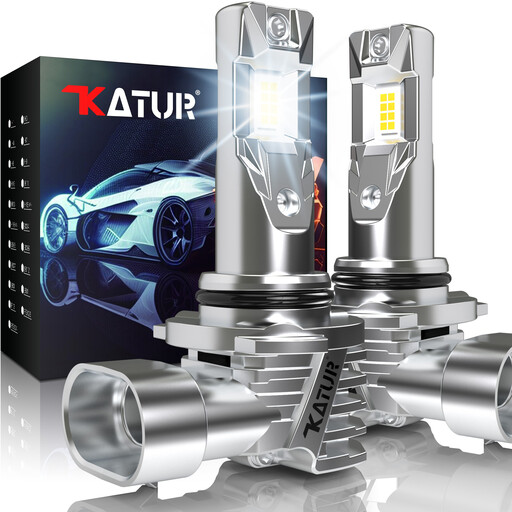
Why It Stands Out The key feature of this set is its fanless design. Instead of an active fan, this bulb relies on a housing made of 6063 aviation-grade aluminium for passive cooling. This means completely silent operation and no risk of a fan failure, which can be a common point of failure.
Advantages
Who Is This a Good Choice For? Ideal for DIYers looking for a reliable, silent, and extremely easy-to-install plug-and-play headlight, without compromising on a significant improvement in brightness.

Why It Stands Out This bulb from Roadsun is specifically designed for the 9005/HB3 fitment and focuses on durability. The manufacturer claims a lifespan of over 70,000 hours, which is significantly longer than many alternatives. The bulb is built to withstand harsh conditions, with waterproof, dustproof, and shockproof properties.
Advantages
Who Is This a Good Choice For? For drivers with a car that needs an HB3 LED bulb and are looking for a 'set it and forget it' solution with a focus on maximum lifespan and reliability under all conditions.
The choices above are a great starting point, but every car and driver is unique. Perhaps you're looking for a different brightness level, another brand, or a specific connector that wasn't highlighted here.
Check out our full range of LED Light Connectors for more options. Here you will find a broader selection of LED lighting solutions to match your specific needs and vehicle.
For most DIYers, this is a straightforward task. Thanks to plug-and-play models with a mini size, installation is often as easy as changing a standard halogen bulb. You twist the old bulb out and the new one in. No special tools or technical knowledge are usually required.
The main difference is in the fitment and the locking tabs at the base of the bulb. Although they may look the same at first glance, they are not interchangeable. HB4 (9006) is typically used for low beams, while HB3 (9005) is often used for high beams. Always check your car's manual to be sure which fitment you need.
A CAN bus LED bulb is specifically designed to prevent error messages. The built-in decoder ensures that the car's computer system recognises the bulb as a correctly functioning component. According to most manufacturers, this works for 99% of cars. In a small percentage of cars with a particularly sensitive system, a warning may still appear. In that case, an additional, external CAN bus decoder can be the solution.
