
Vandaag of morgen in huis

Kwaliteit gegarandeerd

Welkomstaanbiedingen ontgrendelen: GRATIS bezorging | Tot 80% korting | Gratis 30 dagen JoyPlus-proefperiode
Download de app
A hard-shell suitcase may seem easy to choose at first. But small differences in size, wheels and layout can have a big impact on your trip. For example, a cheap hard-shell case may be too large for hand luggage, while a spacious ABS case can take up more of your baggage allowance than you need.
So don’t focus only on the colour or an attractive offer. Check the dimensions, empty weight, fastening and how you plan to use the case.
An 18- or 20-inch cabin case won’t necessarily meet every airline’s requirements. Airlines set their own limits for height, width, depth and weight. What’s more, wheels and handles may be included in the external measurements.
Always check:
A case that’s 52 cm high may seem suitable for cabin use, but its overall depth could still exceed the limit.
A lightweight case is useful when you’re travelling with a restricted baggage allowance. However, always consider its empty weight alongside its capacity. A very lightweight case may offer less internal protection or have simpler wheel construction. So look at the combination of weight, material, capacity and load-bearing strength.
ABS is widely used for affordable hard shells. It’s relatively light and retains its shape, but its exact durability also depends on the thickness, construction, edges, zip and wheels. Treat a brand’s claims about strength or testing as information provided by the seller. According to JOYFURNOS’s product description, the model has been tested for use; this isn’t a guarantee for every travel or transport situation.
A suitcase with spinner wheels can roll in every direction, but not all pairs of wheels perform equally well on tiles, cobbles or carpet. Check the type of wheel and how it’s attached. Four 360° wheels generally make it easier to manoeuvre through stations and airports than a model with two wheels, although two wheels may take up less space at the bottom of the case.
Check the telescopic handle, too. A handle with several height settings is useful for people of different heights, but it should lock firmly into place without too much play.
Choose a size based on the length of your trip and baggage rules:
Capacity in litres is useful for comparison, but the internal layout determines how efficiently you can pack. A divider, mesh pocket and packing straps help keep clothes and accessories in place. A wet-and-dry compartment is handy for items such as swimwear or shoes, but always use an extra waterproof bag for liquids.
An ABS suitcase is a popular choice for travellers looking for a hard shell and relatively low weight. As well as the material, check for:
No plastic shell is completely immune to scratches or dents when used as checked baggage. So don’t pack fragile items against the outer wall, and make good use of the internal compartments.
A suitcase with a TSA lock can be useful for international air travel. A TSA lock won’t stop someone damaging or opening the case with the right tools. It’s designed to allow authorised airport inspections without the lock being forced open. Reset the default code as soon as you buy the case and keep your new code somewhere safe.
An expandable suitcase offers extra packing space via an additional zip. Only use this space if you’re still within the size and weight limits. Overpacking puts strain on the zips, seams and shell. The JOYFURNOS models come with a recommendation not to pack beyond the internal dimensions.

Why it suits this type of traveller: This cabin case is compact for short trips and has a capacity of 30 litres. It measures 34 x 22 x 52 cm and weighs 2.5 kg. Be sure to check your airline’s current rules before you travel.
The product information includes the external dimensions, weight and capacity. This means you can compare the case with baggage rules in advance, rather than relying on the inch size alone.
ABS shell, internal compartments, a combination lock and an extendable handle reaching 100 cm. The four swivel wheels help you move the case in different directions.
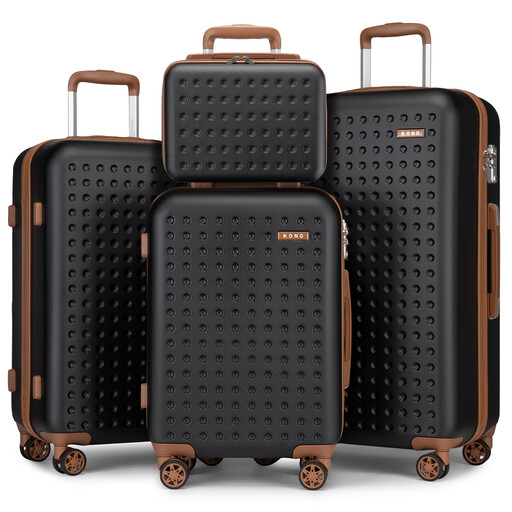
Why it suits this type of traveller: The set includes a beauty case, cabin case, medium suitcase and large suitcase. It’s ideal for travellers who want a range of sizes for business trips, weekends away and longer holidays.
The product page lists the external dimensions, capacity and weight for each case. It also states that the measurements include the wheels and handle. Be sure to check your airline’s rules before you travel.
The 20-inch case holds around 40 litres, the 24-inch around 65 litres and the 28-inch around 100 litres. It also features 360° spinner wheels, packing straps, a mesh pocket and a TSA combination lock.
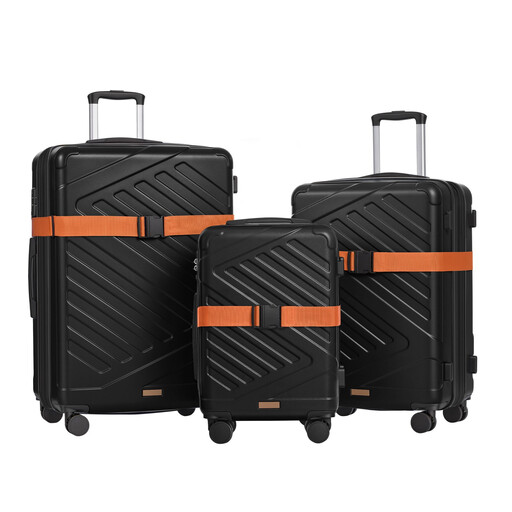
Why it suits this type of traveller: The three sizes are designed for different types of trip: cabin use, medium-length breaks and checked baggage. It’s a practical choice for frequent travellers or families who want to split their luggage between cases.
The set lists the dimensions and weight of each case separately. This lets you choose the right size for each trip and avoid routinely travelling with a case that’s larger than you need.
ABS shell, expandable storage, TSA locks, 360° spinner wheels and an interior with a wet-and-dry divider. The set includes a cabin case, a medium suitcase and a large suitcase.
We’ve put together a full, up-to-date list of products that meet these strict selection criteria and the current European safety regulations.
Pack heavier items at the bottom and place delicate items between layers of clothing. If your case is expandable, leave some space around the zip. Before you leave, check that the lock is set correctly and take a photo of the case and its contents. A distinctive luggage strap or colour can make your suitcase easier to spot on the baggage carousel.
Clean the outside with a soft, damp cloth. Don’t use abrasive products on ABS or plastic details. Store the case somewhere dry, and place smaller suitcases inside larger ones if the set is designed for nesting.
It can be, but only if its overall external dimensions and weight are within your airline’s limits. Pay particular attention to the depth, wheels and handle. A case accepted as cabin baggage by one airline may exceed another airline’s limits.
Its lifespan depends on how it’s used, how heavily it’s packed, how it’s transported and the quality of its zips, wheels and handle. Avoid overpacking, don’t drag the case down stairs unless necessary, and check the wheels and fittings regularly. A hard shell may get scratched or damaged as checked baggage, but that doesn’t necessarily mean the case can no longer be used.
A luggage set can be practical if you need several sizes. You’ll often get a cabin case, a medium suitcase and a large suitcase that fit inside one another for storage. However, only buy a set if you’ll use the different sizes regularly. If you usually take short trips, one well-fitting cabin case may be a more practical choice.
