A foldable slicer is handy if you want to put it away after use, but check how much worktop space it needs when unfolded, too. If the slicer will usually stay on your worktop, compare its width and depth, adjustable slicing thickness, blade and cleaning requirements. Manufacturer specifications are not an independent test of how well it slices hard cheese.
Which slicer is right for you?
Cheese lover with limited cupboard space
If you want to slice hard cheese yourself and put the slicer away afterwards, consider both whether it folds and how much space it needs when unfolded. FRITEL and DOMO describe foldable models designed for foods including cheese.
Regular user with a narrow worktop
If you’re looking for a permanent spot for your slicer, compare its depth as well as its width, and check the recommended operating time. ritter lists the compact¹ as 20.5 cm wide and 33.0 cm deep.
For those who clean their slicer often
If you regularly slice cheese or other foods, check which parts can be removed and cleaned according to the manual. DOMO lists a removable blade, while the Severin manual provides cleaning instructions for each model.
What should you look for when choosing?
| What to consider |
What to look for |
Who is this important for? |
| Storage and space while in use |
Measure your cupboard and worktop space, then compare the slicer’s dimensions when set up for use. |
Do you want to put the slicer away after use, and have limited worktop space? Around 34% of consumers focus mainly on storage space and the room needed to use the appliance. |
| Slicing hard cheese |
Check which blade is included, which types of cheese the manufacturer mentions and the available slicing-thickness settings. |
Do you mainly want to slice hard cheese to your preferred thickness, with space or extra features being less important? Around 33% of consumers prioritise slicing cheese. |
| Cleaning after use |
Check which parts can be removed and follow the cleaning instructions for your specific model. |
Do you slice cheese regularly and want to be able to remove any leftover pieces thoroughly? Around 20% of consumers focus mainly on cleaning and disassembly. |
| Easy-to-manage operation |
Check the food holder, any finger guard and the switch, and read the instruction manual. |
When using the slicer, do you want to pay particular attention to guarding and positioning smaller pieces of cheese? Around 13% of consumers say ease of use is their top priority when choosing. |
Common pitfalls
-
Comparing only the folded dimensions
A foldable appliance may take up less room when stored, but it still needs a suitable, clear space while you’re slicing.
Measure both your storage space and the area where you’ll use the slicer when it’s unfolded.
An appliance that takes up too much room in use can be awkward to set up or clean.
-
Assuming ‘suitable for cheese’ means it can slice hard cheese paper-thin
A manufacturer’s claim that a slicer is suitable for cheese is not, by itself, independent test evidence for slicing a particular hard cheese or achieving a specific thickness.
Check the blade, adjustable slicing-thickness range and maximum size of food that can be sliced. Treat stated uses as guidance, not as a comparative slicing test.
-
Confusing a manufacturer’s warranty with your statutory rights
A manufacturer’s warranty or paid add-on plan is separate from your statutory right to receive a product that is fit for purpose. The Dutch government states that there is no fixed two-year statutory warranty period in the Netherlands.
Check what an add-on plan actually covers. If a product is faulty, contact the seller.
An add-on warranty plan may cost extra, so compare the cover it offers with your existing rights.
Brands to compare
ritter
According to ritter, the compact¹ is a slim, fixed slicer designed to stay on your worktop.
- The manufacturer lists a serrated blade, a width of 20.5 cm and a depth of 33.0 cm.
- The model does not fold. The manufacturer lists a maximum operating time of five minutes per use. This does not indicate how the model performs with a particular hard cheese.
FRITEL
FRITEL describes the SL 3110 as a foldable household slicer for foods including cheese.
- The manufacturer lists a removable 170 mm serrated blade, a food holder and adjustable slicing thickness from 0–15 mm.
- Check how much space the appliance needs when unfolded and whether the specified version suits your needs.
DOMO
DOMO describes the DO523S as a foldable slicer for foods including cheese.
- The manufacturer lists a removable 17 cm serrated blade, a food holder and a safety switch.
- Check how much room you’ll need to use the appliance when unfolded, and follow the manual for cleaning and operation.
Severin
According to Severin, the AS 3915 is a fixed metal slicer with interchangeable blades.
- Severin lists a slicing thickness of 0–15 mm and several blades, including a smooth blade for cold cuts.
- The stated product width is 38.2 cm. Having several blades does not prove better slicing performance with hard cheese.
GRAEF
According to GRAEF, the STYLE S10002 is a fixed slicer with a 17 cm serrated blade.
- The manufacturer lists a removable blade and adjustable slicing thickness from 0–20 mm.
- GRAEF’s guidance on serrated blades is manufacturer information, not an independent model-specific test with hard cheese.
Joybuy products
These Joybuy electric slicers can be compared by slicing thickness, blade type, cleaning requirements and the space they take up.
 No image available
Ritter Sono¹ electric food slicer
Worth comparing if adjustable slicing thickness and a removable carriage for cleaning are important to you.
The product description lists a serrated blade, slicing thickness up to 20 mm and a removable carriage.
Joybuy
 No image available
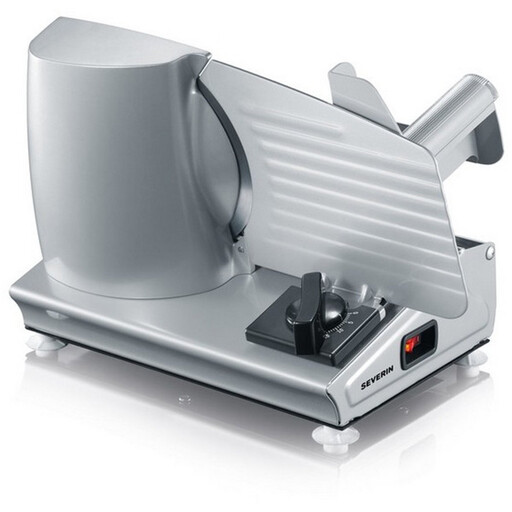
Severin AS 3915 electric food slicer
Worth comparing if adjustable slicing thickness and several blades are important to you. These stated features are not the result of an independent slicing test with hard cheese.
The product name lists a slicing thickness of 0–15 mm, two blades and a finger guard. The stated product width is 38.2 cm, so consider the space available on your worktop.
Joybuy
Frequently asked questions
Which blade should you choose for hard cheese?
Check which blade comes with the specific model and what types of cheese and slicing thickness the manufacturer recommends. GRAEF describes serrated blades as suitable for foods including thicker slices of cheese, while ritter says its standard serrated blade is for hard and soft foods. These are manufacturer recommendations, not the results of a comparative test.
How do you clean an electric slicer?
Unplug the slicer before cleaning it and follow the manual for your specific model. The Severin manual calls for thorough cleaning and says the appliance must not be immersed in water. Check it for instructions on disassembly and which parts can be washed, too.
What do warranties and the cooling-off period mean when buying online in the Netherlands?
If a product is faulty, the seller must provide a solution. The Dutch government states that there is no fixed two-year statutory warranty period in the Netherlands. In many cases, you have 14 days to change your mind about an online purchase from a business, subject to statutory exceptions.
Is CE marking required for an electric slicer in the Netherlands?
CE marking is mandatory for electrical products covered by the relevant regulations. The NVWA states that the low-voltage rules apply to a rated AC voltage of 50–1000 V. A product listing alone does not prove that a specific item for sale meets all requirements. CE marking also says nothing about how well a slicer cuts hard cheese.
How should you store freshly sliced cheese?
Keep cheese slices in a sealed container in the fridge and follow the storage advice for your type of cheese. Voedingscentrum recommends keeping slices of 40+ cheese in the fridge for up to four days and setting your fridge to 4 °C.


