
Detail photographer on the quayside
You want to be able to examine or crop stonework, boat hulls and other fine textures later. To do that, consider the sensor, lens and shooting method as a complete combination.


Choose based on the framing you want and how much kit you want to carry: a mirrorless camera offers interchangeable lenses, while a compact camera can combine a zoom range in a single fixed lens. Fine detail depends on the sensor, lens and shooting conditions. With boats in motion, image stabilisation won’t freeze your subject.
You want to be able to examine or crop stonework, boat hulls and other fine textures later. To do that, consider the sensor, lens and shooting method as a complete combination.
You want to switch quickly between a wide view of the harbour and distant details while out walking, without having to change lenses each time.
You also photograph boats moving through the frame. Alongside resolution, consider autofocus and how you capture movement.
First decide what field of view you need and whether you’d rather change lenses or use a single fixed zoom lens. Then consider the details you want to retain, and whether your subjects are still or moving.
| What to consider | What should you check? | Who is this important for? |
|---|---|---|
| Fine textures | Compare the photo resolution of the exact model, the supplied lens and sample images at the crop or print size you have in mind. | If I want to crop details in a façade, pier or boat hull, I consider the camera and lens as a complete set. Around 33% of consumers say retaining fine textures is their top priority. |
| Wide views and distant details | Compare the zoom range on the same basis, for example as a 35mm equivalent, and check the lens included with the exact version. | If I want to frame both the harbour and details on the opposite shore from one spot, I look at the zoom range without changing lenses or at suitable interchangeable lenses. Around 27% of consumers prioritise framing and lens range. |
| Easy to carry | Consider the complete kit you’ll carry, including the lens; an interchangeable lens adds to the camera body. | If I don’t want to carry lots of separate kit on a walk, I weigh the convenience of a fixed lens against the choice offered by interchangeable lenses. Around 20% of consumers put portability first. |
| Boats in motion | Check the autofocus on the exact model and assess stabilisation according to the stated conditions; stabilisation won’t compensate for the boat’s movement. | If I want to photograph boats under way, I consider focusing and the shot itself, not just stabilisation. Around 20% of consumers prioritise moving subjects. |
The camera specification doesn’t tell you which lens comes with the version you’ve chosen or what field of view that lens offers.
Check the camera body, lens mount and exact kit contents together before comparing models.
You may need a different compatible lens to get the crop you want.
Fujifilm explains that Pixel Shift Multi-Shot combines several images; movement between shots can cause misalignment.
This technique is best used when both the subject and camera remain still enough throughout the sequence. Assess moving parts separately.
A tripod and processing with the stitching software may be part of this technique.
Nikon offers Z5II kits with different lenses, including 24–105 mm f/4–7.1 and 24–200 mm f/4–6.3.
Compare the full model name and supplied lens, not just the camera body.
Stabilisation is designed to compensate for camera shake; a moving subject places different demands on the shot.
For moving subjects, check the autofocus and shooting settings too. Read stabilisation specifications alongside the stated test conditions.
The X-T5 is a mirrorless camera worth considering if fine detail and a choice of XF lenses are important to you.
The EOS R7 is an APS-C mirrorless camera to consider if both detail and focusing on moving subjects matter to you.
Sony offers different types of camera: the RX100 VII has a fixed zoom lens, while the α7C II is a mirrorless camera.
The Z5II is a full-frame mirrorless camera available in Dutch kits with different zoom ranges.
This selection includes pocket cameras and a digital camera with zoom. Compare the features listed with your needs for still photos of the harbour and how much kit you want to carry.
 No image available
Consider this pocket-sized model if you’re looking for a compact camera; check whether its fixed wide-angle lens suits the framing you want.
The product description lists a 1-inch CMOS sensor and a 20 mm f/2.0 wide-angle lens.
 No image available
This pocket-sized model could suit you if you’re looking for a compact camera with zoom; check whether the stated range works for the framing you want.
The product name lists a 1-inch CMOS sensor and 2× lossless zoom. The stated 4K/240fps video is limited to slow-motion mode.
 No image available
Consider this model if you’re looking for optical zoom to capture distant details; compare sample photos with the crops you want to make.
The product information lists 12× optical zoom, 64 MP photos and 4K video.
 No image available
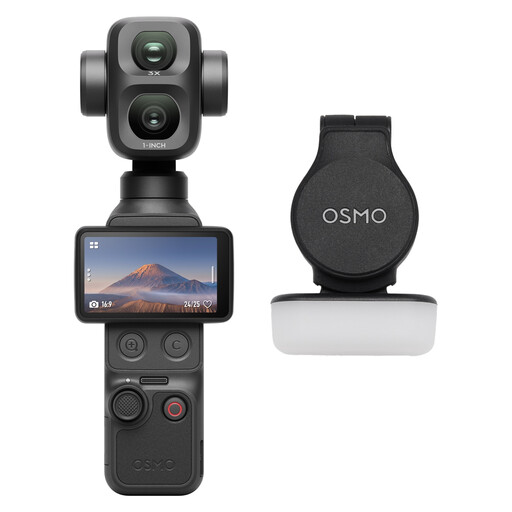
Consider this pocket-sized model if you want a compact camera for a walk; check whether its fixed lens suits the field of view you’re after.
The product description lists a 1-inch CMOS sensor, 4K/120fps video and 3-axis stabilisation. The stated 4K/120fps refers to video.
 No image available
This pocket-sized model is an option if you want to take a small camera on a walk; check whether its fixed lens can capture the harbour views you have in mind.
The product description lists a 1-inch CMOS sensor, 4K/120fps video, 3-axis stabilisation and a weight of 179 g.
Not necessarily. Decide which crops you want to make, then compare the range of the fixed lens or kit lens. With a mirrorless camera, any extra lens must fit the lens mount.
Don’t assume you’ll get a well-combined result: Pixel Shift Multi-Shot uses several images, and Fujifilm warns that movement between them can cause misalignment. Take separate, standard photos of moving parts too.
Protect the camera from dirt and take care when changing lenses. The Dutch Consumers’ Association recommends keeping your camera clean, especially if it has interchangeable lenses. Also consult your camera and lens manuals.
Not automatically. According to the Dutch government, you have a legal guarantee in the Netherlands that a product will work properly, and there is no fixed statutory guarantee period. Check whether the terms of an extended warranty actually give you extra rights; if there’s a problem, contact the seller.
First check which privacy rules apply to the specific photo and publication. The Dutch Data Protection Authority notes that identifiable people in photos count as personal data; what you can do with an image depends on the circumstances.