
Preserving fragile letters
You want to capture old or bound originals without pressing them flat. Check scans for damage, creases and missing text; the National Archives describes these checks as part of digitisation.


For fragile or bound letters, an overhead scanner is a good choice if you don’t want to press the original against glass. Loose letters that can safely lie flat can also be scanned with a flatbed scanner. With either method, check a test scan for legibility, creases and text showing through from the reverse. Standard OCR doesn’t guarantee an accurate transcription of handwriting.
You want to capture old or bound originals without pressing them flat. Check scans for damage, creases and missing text; the National Archives describes these checks as part of digitisation.
You want to be able to find handwritten content and distinguish between a scanned image, standard OCR and dedicated handwriting recognition. Transkribus describes handwriting recognition as a separate application.
You scan different loose items at a shared desk and want to manage files and access for each user. The Dutch Data Protection Authority stresses that organisations must protect personal data appropriately and manage access rights properly.
Choose this approach: if letters are bound or mustn’t be pressed flat. Check a test scan around the fold and where the ink is faint.
Bear in mind: a stated correction feature doesn’t mean that every type of handwriting or book fold will be legible.
Choose this approach: if the studio mainly scans loose letters that can lie flat and several people use the same workstation.
Bear in mind: CZUR positions the Shine 800 A3 Pro for flat, loose pages. Don’t treat this model as equivalent to a scanner with book correction for heavily curved pages.
Choose this approach: if loose letters can safely lie on the glass and you want to check each side of the scan carefully.
Bear in mind: an A4 flatbed scanner, such as the Epson Perfection V39II, isn’t suitable for originals larger than its scanning area; glass isn’t suitable for every fragile item.
| What to consider | What to look for when buying | Who should consider this most? |
|---|---|---|
| Fragile or bound originals | Check whether the letter is loose or bound. Check the scanning size and, for bound items, make a test scan of the fold. | If I want to preserve a fragile or bound letter, I don’t want to press it flat unnecessarily, and I check the fold for missing text. Around 40% of consumers say preserving the original is their main reason for buying. |
| Legibility and transcription | Compare test scans of the same letter and assess any handwriting recognition separately from standard OCR. | If I want to read the handwriting clearly and possibly transcribe it, I want to be able to check the text output against the scanned image. Around 30% of consumers prioritise legibility and transcription. |
| Shared workspace and files | Check compatibility with your computer and software, export options and how users can keep their files separate. Set up appropriate access rights if an organisation processes personal data. | If several people use the same scanning station, I want to know where files are stored and who can access them. Around 20% of consumers prioritise a shared workflow. |
| Space and cost | Measure the available workspace and the largest original. Then compare the current price and software terms of models that are suitable for the original. | If I share a scanner with others, I want the device to fit the available space and my budget. Around 10% of consumers give space and cost the highest priority. |
CZUR positions the Shine 800 A3 Pro for flat pages and distinguishes it from ET models with book correction. This means the method you choose may not be suitable for a bound letter.
Choose based on the condition and binding of the letters, and test whether the text remains legible around the fold. An unsuitable method could mean having to scan the same letter again.
IRIS lists a native 13 MP sensor for the Desk 6 Pro, as well as a software-interpolated resolution of 21 MP. These are different specifications.
Compare the native specification and the legibility of a test scan of the same letter.
Standard OCR and handwriting recognition aren’t the same; a searchable file doesn’t guarantee that handwritten text has been converted accurately.
Keep the scanned image and check important transcriptions against the original.
ScanSnap positions the SV600 as a contactless overhead scanner for items including fragile and bound documents.
CZUR describes its ET range as designed for bound books, with curvature correction, and the Shine 800 A3 Pro as suitable for flat, loose pages.
IRIS describes the IRIScan Desk range as document cameras for documents and books.
According to Epson, the Perfection V39II is an A4 flatbed scanner for loose letters that can lie on the glass.
These Joybuy products are designed for loose letters, from placing them flat on glass to feeding in loose sheets. Choose a method to suit the condition of the paper; a sheet-fed scanner isn’t necessarily suitable for fragile or bound originals.
 No image available
An option for loose letters that can be placed gently on the glass; the combination of flatbed and ADF gives you two ways to scan documents.
A4; 600 × 600 dpi.
 No image available
For loose letters that are suitable for scanning through a paper feeder. If your originals are fragile, check that this feeding method is appropriate for the condition of the paper.
A4; 600 × 600 dpi.
 No image available
A sheet-fed scanner for loose documents in a shared scanning workflow. Check that the letters are flat and sturdy enough for the chosen feeding method.
A4; 600 × 600 dpi.
 No image available
For scanning several loose letters in succession, provided they are suitable for feeding. If your originals are delicate, first check that the scanner and paper path are suitable for the material.
A4; 600 × 600 dpi.
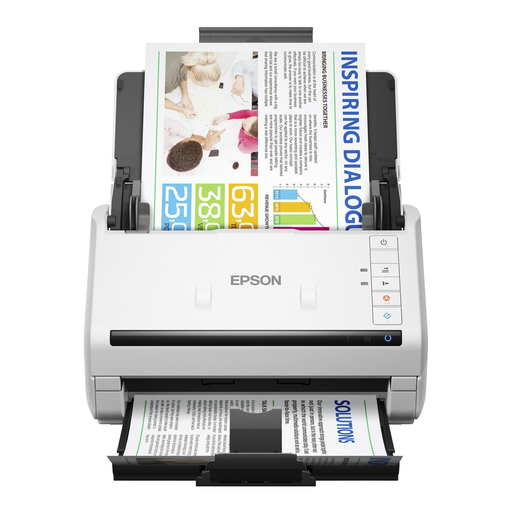 No image available
For loose letters that can be processed using an automatic document feeder. If the sheets are creased or fragile, check whether this approach is suitable for the original.
A4; 600 × 600 dpi; 50-page ADF; USB 3.0.
Not reliably, based on a standard OCR specification alone. Standard OCR is designed for printed text; assess handwriting recognition as a separate application and check the transcription against the scan.
Make a test scan of the front and back, and check for cropped edges and missing pages. Agree where files will be saved. If an organisation processes personal data from letters, it must set up appropriate access rights.
Check which software, updates and service are included with the model you’ve chosen. Don’t assume that a separate transcription service is included with the scanner.
Not automatically. The Dutch Government explains that copyright-protected texts may be copied for personal use; this doesn’t give you the right to distribute or publish them. If an organisation processes personal data, it must determine which GDPR legal basis applies. What’s permitted for a particular letter and intended distribution depends on the circumstances.