
Vandaag of morgen in huis

Kwaliteit gegarandeerd

Welkomstaanbiedingen ontgrendelen: GRATIS bezorging | Tot 80% korting | Gratis 30 dagen JoyPlus-proefperiode
Download de app
A hand blender may seem like a simple kitchen appliance, but the differences between models can be significant. Some are mainly designed for soft ingredients, while others come with a whisk, chopper or measuring jug. Motor power alone also does not determine how easy a blender is to use.
If you focus only on wattage or a long list of accessories, you could end up with a blender that splashes, is difficult to clean or does not suit your everyday cooking. This buying guide compares the key features and shows which models are best suited to different uses.
Higher power can be useful for hard vegetables, nuts or larger quantities, but the result also depends on the blade design, blending foot and speed control. A basic 150 or 300-watt hand blender may be suitable for soft vegetables and sauces. If you regularly chop or blend more intensively, a model with more power and several settings is more practical.
A hand blender with accessories can be versatile, but check exactly what is included. A whisk is useful for whipped cream, light batters and dressings. A chopper is better suited to herbs, onions and small portions. For cake batter and dough, an electric hand mixer with beaters and dough hooks is usually a more sensible choice than a hand blender.
Making smooth soup is convenient, but keeping your kitchen splash-free is just as important. Look for a splash guard around the blades and check how the blending foot is detached. A dishwasher-safe hand blender can reduce cleaning, but always check which parts are suitable for the dishwasher. The motor unit must never be placed in water or in the dishwasher.
For everyday use with soups, smoothies, baby food and sauces, models of around 450 to 650 watts are often a practical choice. If you regularly process hard ingredients, consider a powerful hand blender with 850 to 1000 watts.
A turbo setting is useful for short, intensive blending tasks. However, a hand blender with a turbo function does not automatically produce a smoother result. The quantity, blending time and amount of ingredients remain important. Variable speed control gives you more control when working with soft ingredients, mayonnaise or dressings.
A covered blade guard helps guide ingredients towards the blades and can reduce splashing. According to the product descriptions of some brands, its shape is also designed to reduce contact with the bottom of cookware. Treat this as a product feature, not a guarantee for every type of pan.
When blending hot soup, follow the instructions in the manual. For example, the Philips HR2531/00 states that ingredients must not be hotter than 80 °C. Lower the hand blender sufficiently into the pan before switching it on, then move it slowly up and down. This helps to reduce splashing.
Check the following before buying:
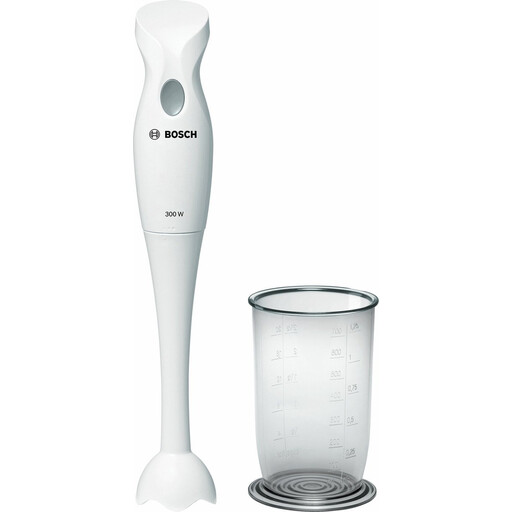
Why it suits this profile: This model has a compact design, 300 W of power and comes with a measuring jug. This makes it suitable for simple preparations such as sauces, soft vegetables and milkshakes.
The product specifications explicitly mention a turbo function and dishwasher-safe removable parts. Before use, check exactly which parts may be placed in the dishwasher.
300 W of power, one speed, turbo function and a measuring jug.

Why it suits this profile: The combination of 1000 W, 21 speed settings and a variable speed wheel provides plenty of control for soups, smoothies, dips and small portions.
You are not limited to a single fixed setting. The product description also mentions splash control, dishwasher-safe parts and BPA-free parts that come into contact with food.
1000 W, 21 speeds, splash control and dishwasher-safe parts according to the product information.

Why it suits this profile: This set combines a blending foot, whisk, 500 ml chopper and 500 ml measuring jug. The extended 36.5 cm housing is designed for use in deeper pans and tall beakers.
The product description mentions normal and turbo settings, an anti-splash design and protection against direct contact with the bottom of cookware. Always check the pan instructions and user manual.
2-in-1 operation, 500 ml chopper, 500 ml measuring jug, 1.5-metre cable and dishwasher-safe removable accessories according to the product information.
We have put together a complete, up-to-date list of products that fully meet these strict selection criteria and the applicable European safety regulations.
A hand blender for soups and smoothies is ideal when you want to blend directly in a pan, bowl or beaker. It takes up little space and is quick to use. Choose a model with a measuring jug if you often prepare small portions.
A hand mixer is a different type of product. The Philips 5000 Series HR3745/00, for example, has an automatically rotating 3-litre bowl, six speeds, two beaters and two dough hooks. This makes it more suitable for cake batter and dough than for soups or smoothies.
A hand blender generally uses electricity only while blending, which keeps energy consumption per preparation relatively low. Total operating time depends on the motor power and the task. Do not use the appliance continuously for longer than stated in the manual, and allow the motor to cool down when instructed.
Always unplug the appliance before changing an accessory or cleaning the blades. Keep fingers, cutlery, hair and loose clothing away from moving parts. The motor unit must not be submerged. These basic rules also apply to a hand blender, chopper and whisk.
You can with models designed for this purpose, but follow the manufacturer’s instructions. Lower the blade guard fully into the soup before starting and avoid excessively high temperatures when the manual sets limits. Moving too quickly can cause splashes from the lid and pan.
Its lifespan depends on how often it is used, how it is cleaned and the workload it handles. Do not overload the motor, process ingredients the model is not designed for or leave the accessories uncleaned after use. In the European Union, many new electrical appliances come with at least a two-year statutory guarantee, in addition to any extra terms offered by the seller or manufacturer.
Not necessarily. A more powerful model may complete a preparation faster, but it also uses more power when operated for longer or at a higher setting. Therefore, consider the combination of power, operating time, capacity and the functions you genuinely need.
