
Vandaag of morgen in huis

Kwaliteit gegarandeerd

Welkomstaanbiedingen ontgrendelen: GRATIS bezorging | Tot 80% korting | Gratis 30 dagen JoyPlus-proefperiode
Download de app
A hand blender may seem simple at first glance: switch on the motor, add the ingredients and blend away. However, models vary considerably in power, controls, accessories and ease of cleaning. You often only notice you have made the wrong choice when your pan of soup is not smooth, the motor heats up quickly or the separate parts are difficult to clean.
Pay particular attention to these three common pitfalls:
The stated power is a useful comparison point, but it does not guarantee overall performance. A simple hand blender rated at 150 or 300 watts may be suitable for soft vegetables, sauces and small portions. For soup, smoothies, nuts or firmer ingredients, a higher power rating is more practical.
The range includes models from 150 watts for the Nedis Hand Blender to 1000 watts for the Braun MultiQuick 5 MQ50001. The Philips HR2531/00 and HR2534/00 models have 650 watts, while the Kenwood Triblade XL HBM40 has 850 watts.
Adjustable speed gives you greater control. A low setting helps prevent splashing when blending soft ingredients, while a higher setting can help produce a smoother purée. According to the product specification, the Braun MQ50001 has 21 speeds. The Braun MQ30202 has two speeds and a motor power of 900 watts.
The blending foot determines how effectively ingredients are directed towards the blades and how much splashing occurs. A splash guard around the blades is particularly useful when working directly in a pan or tall beaker.
The Kenwood HBM40 has a foot with three blades. The Philips ProMix models use a wave-shaped splash guard and have either a metal or plastic shaft, depending on the version. When comparing models, also check whether the foot is detachable and whether it is dishwasher-safe.
Looking for a BPA-free hand blender? Check whether this is explicitly stated in the product specification and whether it applies only to the parts that come into contact with food. The Braun MQ50001 and MQ30202 specify BPA-free materials for food-contact parts. The Monsga S100 states that its detachable accessories are BPA-free.
A standard hand blender often comes with a mixing beaker. A beaker of around 500 to 600 ml is useful for smoothies, dressings and small portions. A hand blender with accessories may also include a whisk or chopper.
Bear in mind that a hand blender is not automatically a replacement for a food processor. A hand blender works directly in a pan or beaker and takes up very little space. A food processor sits firmly on the worktop and is more practical for prolonged whisking or kneading.
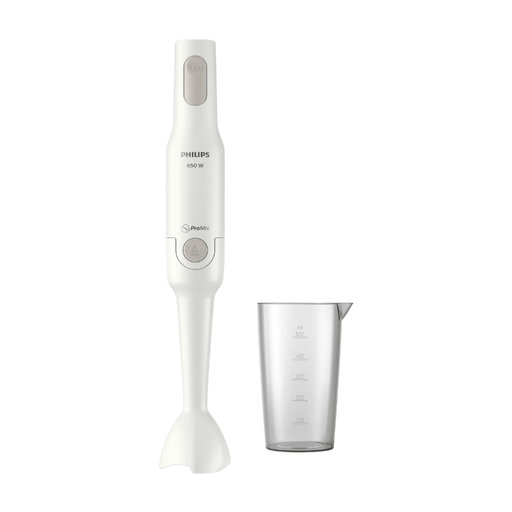
Why it suits this profile: An uncomplicated model for everyday puréeing of soup, sauce and soft ingredients, without a large selection of accessories.
The product specification states 650 watts, one speed, a splash guard and an included measuring beaker. This makes the key features clear and easy to assess.
650 watts, a 1.2-metre cord, one-button operation and a detachable foot according to the product information.
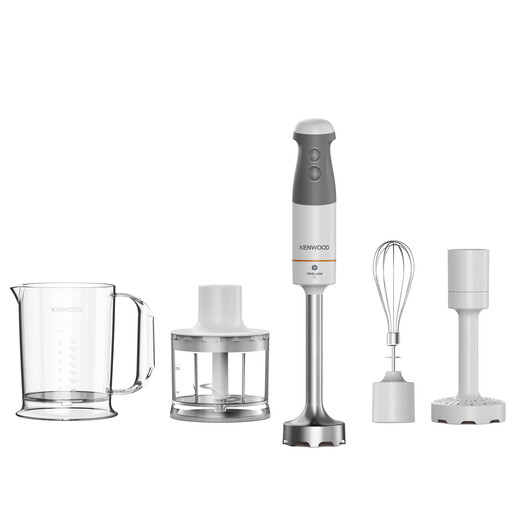
Why it suits this profile: A powerful hand blender for households that regularly prepare large pans of soup, sauces or other dishes.
The 850-watt motor, three blades and XL design provide more insight into its intended use than a marketing term alone.
850 watts, three blades and BPA-free parts according to the stated product specifications; available in white, grey and transparent.

Why it suits this profile: Ideal if you want to do more than purée, with multiple speed settings and expandable accessories.
You are not just paying for the wattage: the product information lists 21 speeds, a variable speed wheel and the EasyClick Plus system.
1000 watts, BPA-free food-contact parts and dishwasher-safe components according to the product specification.
We have compiled a complete, up-to-date list of products that fully meet these strict selection criteria and the applicable European safety regulations.
Always follow the manufacturer's instructions. Only immerse detachable parts in water if this is permitted in the manual. Clean the motor housing with a slightly damp cloth.
Also bear the following points in mind:
Yes, you can with many models, as long as the blending foot is fully immersed and the pan is suitable for use with that particular foot. Take care to avoid splashing hot soup and follow the manufacturer's temperature and usage instructions. A plastic foot may have different limitations from a metal one.
For simple sauces and soft vegetables, 150 to 450 watts may be sufficient. For regularly puréeing soup, smoothies and firmer ingredients, 650 to 1000 watts is a sensible choice. Also consider the speed control, blade design and maximum operating time.
A hand blender generally has a lower power rating than some food processors and is often used for shorter periods. As a result, electricity consumption per preparation is usually limited. The effect on your energy bill depends on the power rating, operating time and how often you use the appliance. When buying, focus above all on the functions you genuinely need.
