
Vandaag of morgen in huis

Kwaliteit gegarandeerd

Welkomstaanbiedingen ontgrendelen: GRATIS bezorging | Tot 80% korting | Gratis 30 dagen JoyPlus-proefperiode
Download de app
A hand blender may seem simple: switch on the motor, put the ingredients in a bowl and blend away. However, there are clear differences between models. A low purchase price may be tempting, but awkward controls, limited accessories or parts that are difficult to clean can quickly lead to frustration.
For everyday use in a Dutch household, three pitfalls are particularly important:
Power is measured in watts. A model rated at 150 to 350 watts may be suitable for light tasks such as sauces, soft vegetables and baby food. For thicker soups, nuts, hard cheese or larger portions, a model rated at 600 to 1,000 watts will generally offer more reserve according to the stated product specifications.
An electric hand blender with several speed settings gives you more control over the texture. A low speed is practical for liquids and soft ingredients, while a higher setting can help with thicker mixtures. Also check the stated operating time. Some models, for example, may run continuously for one minute and then need to cool down.
A metal blending foot is practical for regular use and may be suitable for hot preparations according to the product description. However, allow hot ingredients to cool first, in line with the safety instructions for the model you choose. Splash protection around the foot helps keep your worktop and clothes cleaner.
Brands sometimes use their own names for blade or foot designs. For example, Braun lists PowerBell VPlus technology on certain MultiQuick models and states in its own product information that it delivers a finer blending result. Treat this as a brand-specific product specification, not a universal guarantee for every recipe.
A hand blender with accessories may include a whisk, measuring jug and chopper. A hand blender with whisk is useful for whipped cream, egg whites or batter. A hand blender with chopper is better suited to herbs, vegetables, nuts or small quantities of meat, provided the capacity and usage instructions are appropriate.
Before placing your order, check:
A hand blender and a hand mixer are sometimes confused. A hand blender is designed for puréeing and blending with a blade foot. A hand mixer uses beaters and is mainly intended for batter and light, airy mixtures. Some hand blenders combine both functions with additional accessories.
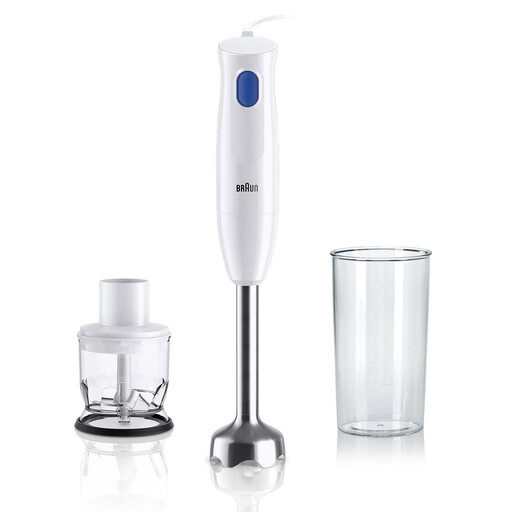
Why it suits this profile: The one-button control and low weight are practical for smoothies, sauces and simple soups. The set includes a 600 ml measuring jug and a 350 ml chopper.
The product description lists 450 watts, simple one-speed control and an EasyTwist system. This means you are not paying for features you may never use.
450 watts, metal blending foot, 600 ml BPA-free measuring jug and included 350 ml chopper.
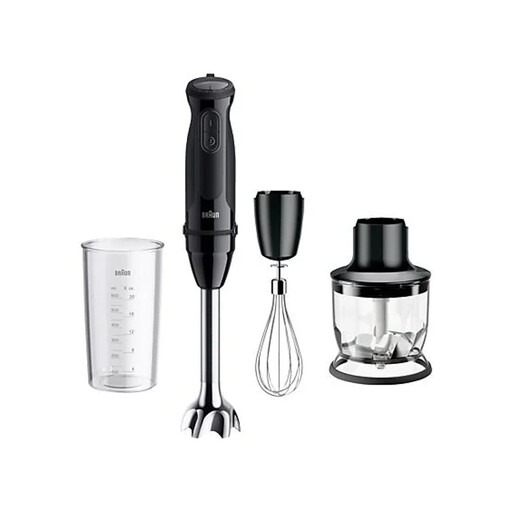
Why it suits this profile: If you cook regularly and having control over the texture matters to you, you get 21 speeds, a 1,000-watt motor and a whisk alongside the blending foot.
The variable speed control prevents you from having to use just one fixed high setting for every preparation. EasyClick Plus is designed to make changing accessories quicker.
1,000 watts, 21 speeds, splash protection, whisk, beaker and dishwasher-safe parts according to the product information.

Why it suits this profile: This set is aimed at users who want to whisk and chop as well as purée. The included beaker, chopping bowl and whisk are useful for a range of everyday kitchen tasks.
The description specifies a maximum operating time of one minute, followed by one minute of rest. This makes the usage limit clearer than a wattage figure on its own.
1,000 watts rated power, up to 1,200 watts according to the product listing, variable speed control, 700 ml beaker and 500 ml chopper.
We have put together a complete, up-to-date list of products that fully meet these strict selection criteria and the applicable European safety regulations.
That depends on the model. Check the instruction manual and the maximum temperature. Some product descriptions advise allowing ingredients to cool below 80 °C. Also blend in a sufficiently deep pan or beaker and fully submerge the foot to minimise splashing.
For light preparations, 150 to 450 watts may be enough. If you often make thick soups, hummus, nut mixtures or larger portions, consider a model rated at 600 to 1,000 watts. Always compare the blades, speed settings, capacity and permitted operating time as well.
First unplug the appliance and remove the blending foot or accessories. Clean the detachable parts according to the instruction manual. The motor unit must not be submerged. Also take care around sharp blades and check whether the parts are actually dishwasher-safe.
