
Vandaag of morgen in huis

Kwaliteit gegarandeerd

Welkomstaanbiedingen ontgrendelen: GRATIS bezorging | Tot 80% korting | Gratis 30 dagen JoyPlus-proefperiode
Download de app
A hand blender may seem simple at first glance: switch on the motor, add your ingredients and blend. But models vary considerably in power, controls, accessories and ease of cleaning. You may not realise you’ve made the wrong choice until you’re cooking: the motor heats up quickly, soup splashes everywhere or the whisk that came with it sits unused in a kitchen cupboard.
This buying guide helps home cooks, families and busy households turn marketing claims into practical features. That way, you can choose a hand blender that suits your recipes and how often you use it.
A powerful hand blender with a high wattage sounds appealing, but wattage doesn’t tell you everything about how it performs. The blade design, shape of the blending foot, speed control and recommended running time all matter too. A 1,000 W model isn’t automatically better suited to every kitchen task than a 450 W model.
So consider the whole picture:
A hand blender with accessories can come in handy for whipping cream, making batter, preparing pesto and chopping vegetables. But a comprehensive set takes up more space and means more cleaning. Check whether a whisk, chopper, measuring beaker or masher really fits your cooking routine.
A simple electric hand blender with a measuring beaker may be enough for soup, sauces and baby food. If you often make batter or chop vegetables, a multi-function hand blender may be a better choice.
On many models, the motor unit must not be submerged in water. Check whether the blending foot is detachable and whether the parts are dishwasher-safe. Also look for a splash guard and a clearly marked release button.
The blades are sharp. Always unplug the hand blender before changing accessories or removing food residue. Follow the maximum running time in the instructions too; some models have a limit of around one minute per cycle.
For soup, sauces and soft vegetables, a lower-powered model may be practical. For thick mash, nut butter or larger quantities, a powerful hand blender with several settings is often a better choice. Multiple speeds give you more control: start on a low setting to reduce splashing, then increase the speed as the ingredients soften.
A hand blender with a whisk is useful for whipping cream, beating eggs and making light batter. A hand blender with a chopper is better suited to pesto, herbs, onion or small portions of vegetables. Always check which accessories are actually included; an accessory that’s only available separately shouldn’t count in your comparison.
A stainless steel hand blender has a blending foot or blade section made of stainless steel. This material is practical for regular use and suits the need for a detachable, easy-to-clean blending foot. A plastic housing can keep the weight down, but on its own it says nothing about performance.
Check the number of blades, the shape of the guard and the diameter of the blending foot. A wider foot can be useful for larger pans, while a compact model is easier to fit into a measuring beaker.
A cord measuring around one to one and a half metres gives you plenty of room to move around in most UK kitchens. A lightweight model is comfortable to use for quick jobs; for soup for the whole family, a longer blending foot or larger measuring beaker may be more important.
Check the capacity of the beaker included. A 500 to 700 millilitre beaker is suitable for smaller portions of smoothies and baby food. For larger quantities, models with a 0.9 or 1 litre beaker are more practical. Only blend hot ingredients as instructed by the manufacturer, and avoid splashing by keeping the blending foot fully submerged.
The options below are based on verifiable product specifications and stated features. Claims about technology or results are presented as product information from the relevant brand.
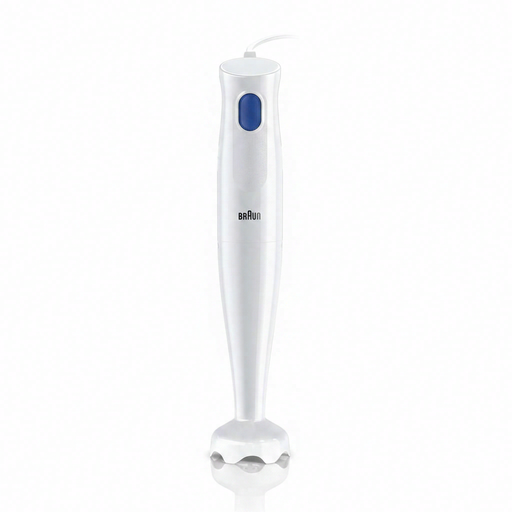
Why it suits this profile: This model has a 450 W motor, one speed, weighs 550 g and comes with a dishwasher-safe blending shaft. It’s designed for simple preparations such as smoothies, sauces and small portions of mash.
The straightforward controls mean you don’t pay for accessories or settings you don’t need. The product information lists a detachable, dishwasher-safe blending shaft.
450 W, 550 g, one speed and a measuring beaker with a stated capacity of 600 ml.

Why it suits this profile: For anyone looking for plenty of versatility, the product information says this model combines a 1,000 W motor, 25 speeds, a turbo setting, a whisk and a 3-in-1 chopper.
The powerful motor is paired with multiple speeds, so you don’t have to rely on a single high-powered setting. The accessories are detachable for cleaning.
1,000 W, 25 speeds, turbo setting, whisk and chopper; according to the product information, the parts are dishwasher-safe.
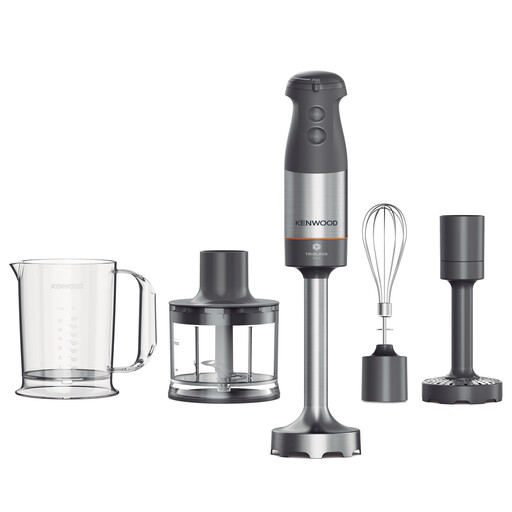
Why it suits this profile: The product information lists a 1,000 W motor, an XL blending foot and accessories including a whisk, mini chopper, measuring beaker and masher. This makes it a good fit for large batches of soup and versatile cooking.
The longer blending foot is designed for use in larger pans. Check the dimensions and running time in the instructions before blending large quantities one after another.
XL blending foot, 1,000 W and four listed accessories; according to the product information, the parts are dishwasher-safe.
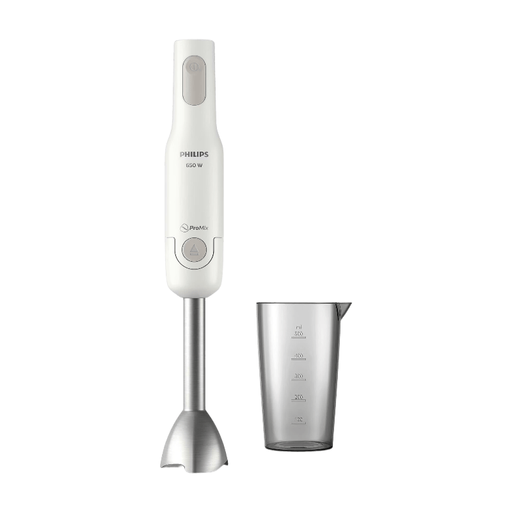
Why it suits this profile: According to the product information, this model has 650 W of power, one speed, a metal blending shaft, a measuring beaker and a 1.2-metre cord. It’s a good fit for everyday blending without an extensive set of accessories.
The specifications are straightforward: one speed, a detachable foot and a measuring beaker. So you can see at a glance which features you do and don’t get.
650 W, metal blending shaft, splash guard, measuring beaker and one-click release, according to the product description.
We’ve put together a complete, up-to-date list of products that meet these strict selection criteria and the applicable European safety regulations.
It depends on the model and its instructions. Don’t blend soup while it’s boiling, and keep the blending foot fully beneath the surface to reduce splashing. Always check the temperature limit in the instructions.
Its lifespan depends on how often you use it, how well you maintain it, the load it handles and how you store it. A model used within its stated running time and cleaned carefully will be put under less strain. In the European Union, consumers are generally entitled to a statutory guarantee of at least two years; additional rights may also apply.
Energy use depends on the power rating and how long you use the hand blender. A 1,000 W model theoretically uses more power per minute than a 450 W model, but a short blending time usually keeps total energy use low. So don’t look at wattage alone; consider how long you need to prepare your recipes too.
