
Student with limited cupboard space
Wants to whip cream for a get-together and put the mixer away easily afterwards; separate beaters matter more than a mixing bowl.


For occasional cream-whipping at a student party, a handheld mixer supplied with beaters and variable speed control is usually the most practical choice; you don’t need a mixing bowl for this. A model with a powered mixing bowl may be suitable if you often mix larger quantities and have enough room to store the bowl and stand. Check which attachments are included with each model and how to clean them, and keep the cream chilled.
Wants to whip cream for a get-together and put the mixer away easily afterwards; separate beaters matter more than a mixing bowl.
Will also use the mixer for batter, so looks for variable speed control and a comfortable grip.
Often makes mixtures for a group and is considering a powered mixing bowl, provided there’s enough space to store it.
Start by thinking about how often you’ll use the mixer and how much space you have. Then consider whether extra controls or a mixing bowl would be useful for your other mixing tasks.
| What to consider | What should you look for? | Who is this important for? |
|---|---|---|
| Storage and occasional use | Check whether beaters are included and whether the appliance will fit in the cupboard space you have available. | I want to whip cream for one get-together and then put the mixer away easily. Around 40% of consumers in this situation prioritise compact storage and occasional use. |
| Controls and grip | Check the speed settings, grip and weight of the specific model. | I’ll also use the mixer for batter and want to be able to adjust the speed while holding it. Around 30% of consumers prioritise this level of control. |
| Cleaning | Check the cleaning instructions for each part; don’t assume that attachments are dishwasher-safe. | I want the beaters to be easy to clean afterwards. For around 20% of consumers, ease of cleaning is the top priority when choosing. |
| Mixing bowl | Weigh the convenience of a powered bowl against the extra space needed to store the bowl and stand. | I regularly make larger mixtures and don’t want to hold the bowl myself. Around 10% of consumers in this situation prioritise having a mixing bowl. |
Wattage alone doesn’t prove that a mixer will whip cream better. Models can also differ in their attachments, controls and how you hold the bowl.
Choose based on how often you’ll use it, the beaters included, the controls and the storage space available. Don’t use wattage as your only measure of whipping performance.
Cleaning instructions can vary between parts and models. For the Tristar MX-4151, the information on the product page conflicts with the specifications; Philips does not list any dishwasher-safe parts for the HR3745/00.
Check the manual for the exact model and clean the motor housing according to the instructions. A claim that removable beaters are dishwasher-safe doesn’t automatically apply to the motor housing.
The Voedingscentrum advises putting whipped cream back in the fridge at 4 °C soon after use. According to the Voedingscentrum, highly perishable food should not be left out of the fridge for more than two hours.
Arrange chilled transport and storage at the venue, or whip the cream only once refrigeration is available.
The THM3001B is a handheld mixer for whipping and mixing.
The ErgoMixx MFQ36400 is a handheld mixer for anyone who also makes batter and values a comfortable grip and easy controls.
The HR3745/00 combines a hand mixer with an automatically powered mixing bowl.
The MultiMix 3 HM 3000 WH is a handheld mixer with several speed settings.
The MX-4151 is a handheld mixer with attachments for whipping and mixing.
This selection includes handheld mixers for whipping cream and other mixing tasks, as well as a model with a powered mixing bowl for those who mix more often and have room to store it.
 No image available
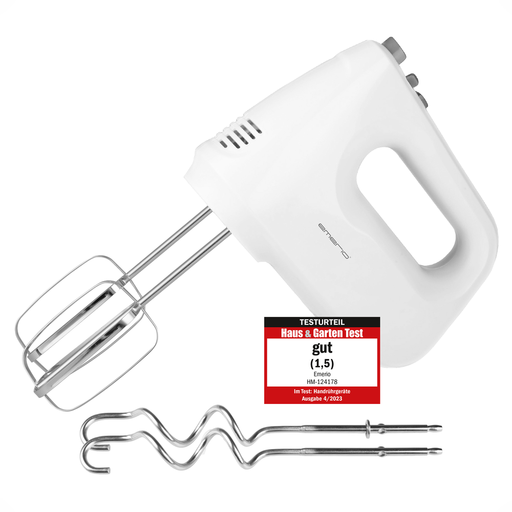
A handheld mixer with beaters included, for anyone who wants to whip cream and adjust the speed.
The product name lists six speeds and a turbo function.
According to the product description, the appliance is not intended for children under 8; children aged 8 and over may use it only under close supervision.
 No image available
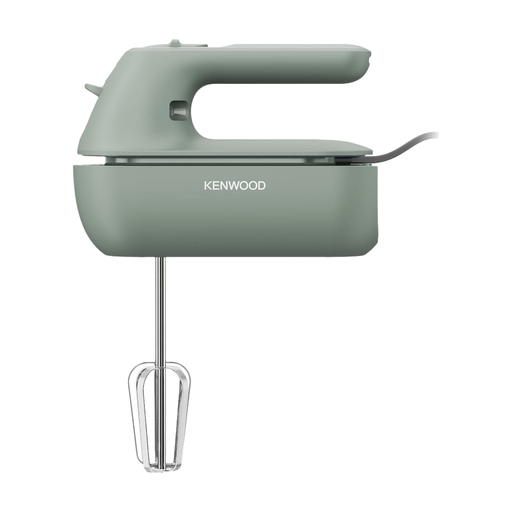
A handheld mixer with beaters for whipping cream and other mixing tasks; the product description mentions a storage system for the attachments and cord.
The product name lists 400 W, five speeds and dough hooks as well as beaters.
 No image available
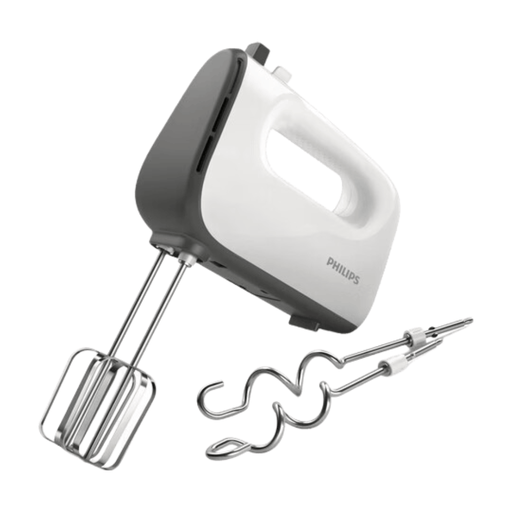
A handheld mixer with a double balloon whisk, for whipping cream without a separate bowl and stand.
The product description lists five speeds and a turbo function.
 No image available
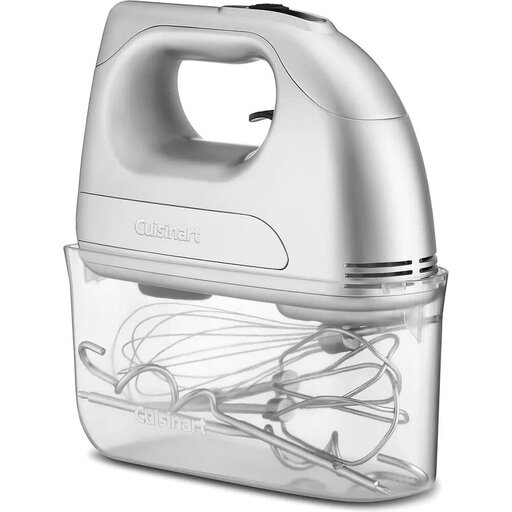
A handheld mixer with beaters and a whisk, for whipping cream and adjusting the speed to suit different mixing tasks.
The product description lists seven speeds and a storage case for the attachments.
 No image available
The powered mixing bowl is an option for anyone who mixes more often and doesn’t want to hold the bowl themselves; the stand and bowl need extra storage space.
According to Philips, this model has a 3-litre bowl, two beaters, six speeds and a power rating of 450 W. Philips does not list any dishwasher-safe parts.
Check that the model you choose includes beaters or whisks. Dough hooks are different attachments and don’t automatically mean that beaters are included too.
The Voedingscentrum advises putting whipped cream back in the fridge at 4 °C soon after use. Highly perishable food should not be left out of the fridge for more than two hours, so arrange refrigeration during transport and at the venue.
This varies by model and attachment. Tomado says the beaters and dough hooks for the THM3001B are dishwasher-safe, while Philips does not list any dishwasher-safe parts for the HR3745/00. If in doubt, check the manual for your model.
According to the Dutch government, online purchases from a business often come with a 14-day cooling-off period. Separately, ACM ConsuWijzer says the seller must resolve the issue if a product does not meet what you could reasonably expect when used normally. The manufacturer’s warranty period does not automatically set the limit of your statutory rights.
The NVWA states that CE marking is mandatory for electrical products covered by the applicable rules. For the Low Voltage Directive, the NVWA specifies a rated AC voltage of 50 V to 1000 V or a DC voltage of 75 V to 1500 V. Exactly which rules apply depends on the model; check the markings on the product you buy.