
Vandaag of morgen in huis

Kwaliteit gegarandeerd

Welkomstaanbiedingen ontgrendelen: GRATIS bezorging | Tot 80% korting | Gratis 30 dagen JoyPlus-proefperiode
Download de app
Choosing a hand mixer might seem straightforward: check the wattage, pick a few speed settings and you’re done. In practice, models can vary considerably in how they perform, the accessories they include and how well they handle heavier jobs. If you focus only on an impressive-looking number or a low price, you could end up with a mixer that splashes, heats up quickly or sits unused at the back of a kitchen cupboard.
This buying guide from the Joybuy Product Recommendation Officer will help you choose the right hand mixer. We compare hand mixers, hand blenders and stand mixers using verifiable specifications and a range of everyday uses.
A high wattage sounds appealing, but it doesn’t automatically mean an appliance is easy to use. The design of the beaters and dough hooks, the motor controls and the drive system all play a part too. A 500-watt hand mixer may be suitable for cake batter and whipped cream, while a stand mixer with a bowl is more practical for prolonged kneading.
So treat wattage as just one factor. Also check the recommended uses, the number of speeds and whether the instruction manual specifies any rest periods.
A hand mixer with beaters is mainly designed for whisking and mixing. A hand mixer with a blender attachment, or a hand blender, can also be used to make soups, sauces and smoothies. Be sure to check which accessories are actually included, as the blender attachment, chopper or measuring beaker may vary by version.
A hand mixer with dough hooks is useful for biscuit, pizza or light bread dough. If you regularly make heavier dough, a stand mixer with a fixed bowl is usually more practical, as you won’t have to hold the appliance throughout.
Accessories that are difficult to remove, cause lots of splashing or aren’t dishwasher-safe can make an appliance less convenient for everyday use. Look for an eject button and removable parts, and check the cable length and how you’ll store the beaters and dough hooks.
Check the safety instructions too: unplug the appliance before changing accessories, and never immerse the motor unit in water.
For light batters, whipped cream and egg whites, a mid-range model is often enough. A powerful hand mixer with around 450 to 500 watts gives you more capacity for thick batters and lighter doughs. However, wattage doesn’t guarantee good performance with very heavy dough.
A stand mixer makes more sense if you regularly prepare larger quantities. The Kenwood Go KZM35, for example, has a 4-litre stainless steel bowl and a stated capacity of up to 1.4 kg of dough, including a maximum of 800 grams of flour. To avoid overloading the appliance, never exceed the capacity stated in the manual.
A hand mixer with several speed settings gives you more control. When mixing liquid ingredients, start on a low setting to reduce splashing, then increase the speed gradually. A hand mixer with a turbo function can provide a temporary boost, but it isn’t designed to replace unlimited use at maximum speed.
Consider the controls too. You should be able to reach the slider, speed dial or button while mixing without losing your grip. The Braun MQ50051M, for example, has 21 speed settings and variable control, giving you plenty of options for different mixtures.
Decide in advance what you actually want to make:
Check what’s in the box, not just the product title. Bowl or measuring beaker capacity is also important for families and meal prep.

Why it suits this profile: This 450W hand mixer has 6 speeds and a bowl that rotates automatically, making it suitable for everyday baking such as cake batter and whipped cream.
The included bowl rotates automatically, so you don’t have to steady both a bowl and a hand mixer at the same time.
3-litre bowl, 450W power, 6 speeds, two beaters and two dough hooks.

Why it suits this profile: This hand blender is designed for people who want plenty of control and several functions for soups, sauces, smoothies and chopping.
The set includes a 3-in-1 chopper and an accessory system with dishwasher-safe parts.
1000W power, 25 speeds plus a turbo function, and a chopper with three texture settings.

Why it suits this profile: Home bakers who regularly make larger quantities of batter or dough benefit from a fixed bowl and hands-free operation.
The fixed 4-litre bowl means you don’t have to hold a heavy mixer for long periods. Its stated dough capacity also helps prevent overloading.
800W power, 6 speeds, pulse function, dough hook, whisk and K-beater.
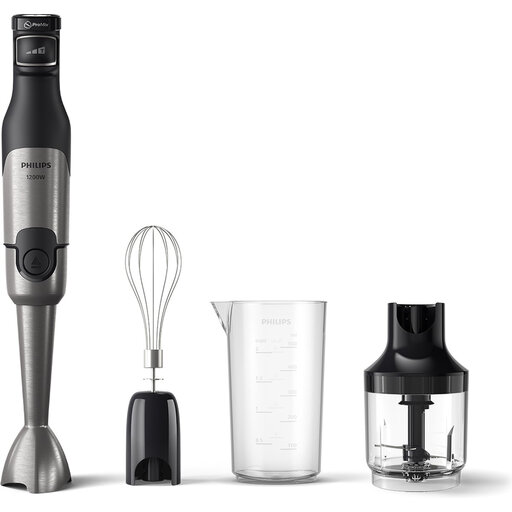
Why it suits this profile: This hand blender combines blending, chopping and whisking for everyday use with soups, sauces, smoothies and smaller recipes.
The 3-in-1 set clearly shows which functions are included: a chopper, measuring beaker and whisk. The splash guard helps when preparing liquids.
1200W power, 3 speeds, 500 ml measuring beaker, and accessories for whisking and chopping.
We’ve put together a complete, up-to-date list of products that meet these strict selection criteria and the applicable European safety regulations.
For occasional biscuit or pizza dough, a hand mixer with dough hooks and around 450 to 500 watts may be enough. If you regularly make heavy bread dough, a stand mixer with a fixed bowl is a better choice. Check the stated maximum dough capacity and take breaks as instructed in the manual.
For most household tasks, 5 or 6 speeds are practical. A model with 20 or more settings offers finer control, but you don’t need that many for standard cake batter. A turbo function is useful for a brief extra boost.
A hand mixer uses beaters or dough hooks for whisking, mixing and kneading. A stick blender, also known as a hand blender, is designed for puréeing and blending liquid or soft ingredients. Choose a combination model only if you’ll actually use the extra accessories.
