
Vandaag of morgen in huis

Kwaliteit gegarandeerd

Welkomstaanbiedingen ontgrendelen: GRATIS bezorging | Tot 80% korting | Gratis 30 dagen JoyPlus-proefperiode
Download de app
At first glance, a hand mixer seems simple: plug it in, choose a speed and start mixing. But models can vary considerably in power, accessories, controls and how easy they are to clean. A budget buy may not be up to mixing bread dough, while a feature-packed model could take up unnecessary space if you only whip cream now and then.
For home bakers, families and keen cooks, there are three main pitfalls to watch out for:
Read on to find out which specifications to assess before buying a hand mixer.
Power is usually given in watts. On paper, a 500-watt hand mixer offers more capacity for thick batters and heavier mixtures than a 200- or 250-watt model. However, you should also consider how you plan to use it and the recommended operating time.
More power doesn’t mean you can knead heavy dough indefinitely. Let the motor cool from time to time when working with thick mixtures, and always follow the instructions. Also check whether the stated wattage is the rated power or peak power. For example, Russell Hobbs lists 185 watts and 350 watts peak power. These figures aren’t directly comparable with a model that lists only 500 watts.
A hand mixer with a turbo function can provide an extra burst of power for a short time. This is useful for a quick final mixing stage, but the turbo button isn’t a substitute for good speed control.
Look out for these features:
Always start at a low speed when working with liquid ingredients. This helps prevent splashing and avoids putting unnecessary strain on the motor and accessories.
Check that the set includes everything you actually need. A hand mixer with dough hooks makes more sense for pizza or bread dough than a set with whisks alone. A hand mixer with a blender may also come with a blending foot for soups, sauces or smoothies.
Look out for:
A hand mixer with a bowl can be handy if you want to keep both hands free. Check the bowl’s capacity and stability, and whether it rotates automatically. Bear in mind that a large bowl takes up more cupboard space.
The recommendations below are based on the listed product specifications, accessories and features. Before buying, always check the current product page for the latest price, availability and included parts.
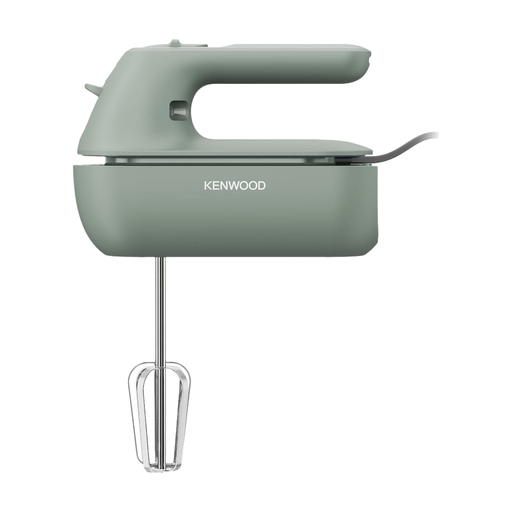
Why it suits this profile: With five speeds, a slow-start function and compact storage, this is a straightforward choice if you mainly make cake batter and whipped cream, with the occasional batch of dough.
The storage system keeps the whisks, dough hooks and cable together, so you won’t end up with loose accessories and nowhere to store them.
350 watts, five speeds, slow start, plus stainless steel whisks and dough hooks included.
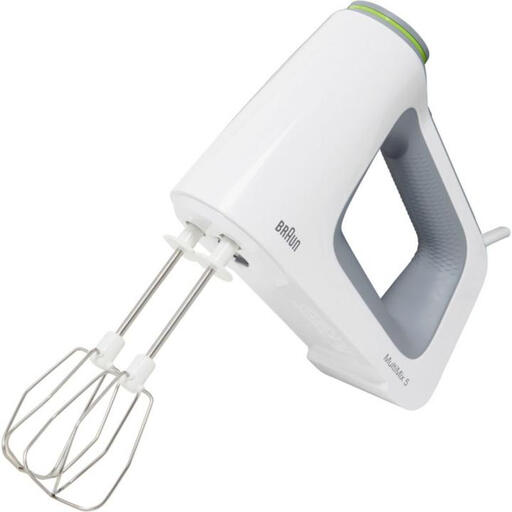
Why it suits this profile: This model is designed for people who want plenty of control when baking and value a powerful motor and comfortable handling.
The variable control from 1 to 9 means you aren’t limited to just a few fixed speed settings.
750 watts, nine speed settings, a Softgrip handle and EasyClick for changing accessories.
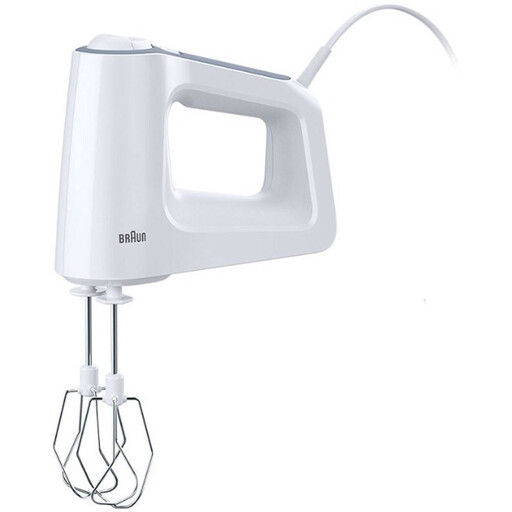
Why it suits this profile: This 3-in-1 set is for anyone who wants to blend and chop as well as mix, without having to store several separate appliances.
The included blending foot, chopper and measuring beaker make it clear which extra functions you’re actually getting.
500 watts, five speeds plus turbo, two whisks, two dough hooks, a blending foot, a 500 ml chopper and a 600 ml measuring beaker.
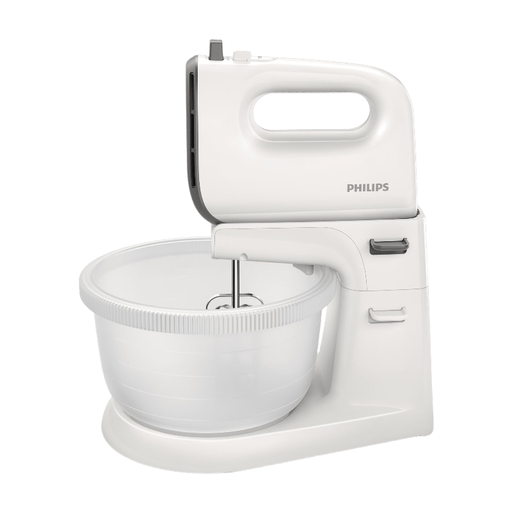
Why it suits this profile: The automatically rotating 3-litre bowl is useful for larger quantities of batter when you don’t want to keep turning the bowl yourself.
The bowl, suction cups and automatic rotation are clearly specified, so you know in advance what support the set offers.
450 watts, six speeds, a 3-litre bowl, two whisks and two dough hooks.
We’ve put together a complete, up-to-date list of products that meet these strict selection criteria and the applicable European safety regulations.
According to the product specifications, a 500-watt hand mixer may be suitable for heavier mixtures, especially if it comes with dough hooks. However, bread dough puts considerable strain on the motor. Work in short bursts, start at a low speed and follow the maximum operating time in the manual. If you regularly make large quantities of heavy dough, a stand mixer may be more practical.
Its lifespan depends on how often you use it, the workload, how you clean it and how you store it. Don’t run the motor for longer than necessary, use the right accessories and never immerse the motor unit in water. Many of the models listed come with a statutory warranty period of at least two years in the EU; check the specific product warranty terms before buying.
A hand mixer usually runs for only short periods, so its overall running cost mainly depends on its power and how long you use it. A 500-watt model running for ten minutes would theoretically use around 0.083 kWh. In practice, you’ll often use it for less time, and the motor won’t always run continuously at full power.
