
Vandaag of morgen in huis

Kwaliteit gegarandeerd

Welkomstaanbiedingen ontgrendelen: GRATIS bezorging | Tot 80% korting | Gratis 30 dagen JoyPlus-proefperiode
Download de app
A hand blender set can replace several appliances in a small kitchen. With one hand blender, you can purée soup, blend smoothies, chop vegetables and whisk cream or egg whites. But the range can be more complicated than it first appears. A higher wattage doesn’t automatically mean an appliance is easier to use, and a long list of accessories is only useful if you’ll actually use them.
So pay attention to the design, controls, capacity and cleaning options. That way, you can choose a multifunctional hand blender that suits the way you prepare food every day.
A motor rated at 1,000 or 1,200 watts sounds appealing, but it doesn’t tell you everything about the results. Blade design, gearing, speed settings and recommended running time all play a part too. For soup, sauces and soft fruit, 500 to 600 watts may be enough. If you regularly chop hard ingredients, a suitable chopper and clear controls are more useful than a big number on the box.
A hand blender with accessories may come with a whisk, measuring beaker, chopper, purée attachment or extra blade. Check in advance which parts are actually included. A separate whisk makes it suitable as a hand mixer with whisk, while a chopper bowl is essential for a hand blender with chopper. Check the capacity too: a 500 ml bowl is handy for small quantities, but less suitable for a large batch of soup.
Food can easily get stuck around the blade guard or inside a chopper. Removable parts make cleaning easier. If the product says that parts are dishwasher-safe, check exactly which parts and what temperature they can withstand. The motor unit, plug and cable must not be immersed in water.
The blades are sharp. Always unplug the appliance before changing or cleaning attachments. When working with hot liquids, follow the safety instructions for the model in question. For example, Russell Hobbs advises that hot liquids should first be allowed to cool below 80 °C when using model 27141-56. Fritel gives a limit of 60 °C for model HB 2870.
The stated power is measured in watts. Treat it as one point of comparison, not a guarantee of a particular result. A model with two settings is easy to use for simple jobs. Variable speed or a turbo setting gives you more control when working with soft vegetables, nuts or thicker sauces, for example.
A powerful hand blender is most useful if you prepare larger quantities, work with hard ingredients or chop food regularly. Also check the maximum continuous running time. Some models need to cool down after about a minute of use.
These accessories are useful for everyday cooking:
A blender for soup and smoothies should have enough capacity for the portions you make. A 600 to 800 ml beaker is suitable for one or two small servings. If you want to purée a larger pan of soup in one go, check the length of the blending shaft and the manufacturer’s instructions.
A stainless steel blending shaft is practical for regular use and easy to wipe clean. Plastic parts can be lighter, but check the product information for heat resistance and care instructions. A dishwasher-safe hand blender usually means that only the removable accessories can go in the dishwasher.
Also consider the weight, cable length and handle shape. An appliance weighing around 900 grams feels very different from a set weighing over two kilograms with lots of accessories. In a small kitchen, a compact set is often more convenient than a larger system with parts you rarely use.
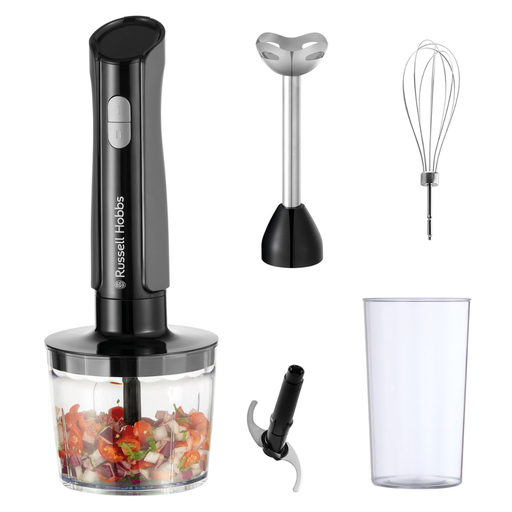
Why it suits this profile: This set lets you blend, chop and whisk with one compact appliance. The two speeds keep the controls simple for beginners.
The product information clearly lists a 500 ml chopper bowl, a 600 ml blending beaker and removable dishwasher-safe parts. So you know exactly what you’re getting.
500 watts, two speeds, whisk, chopper and removable parts.
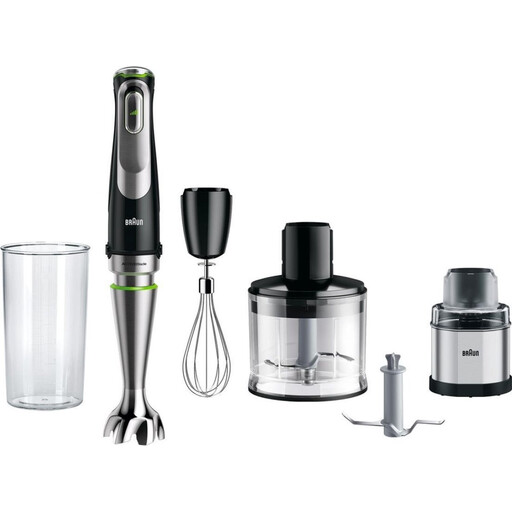
Why it suits this profile: For home cooks who prepare a variety of dishes, this set includes a whisk, chopper, ice blade, herb and coffee grinder, and a 600 ml measuring beaker.
The accessories are listed individually, so you don’t have to rely on a vague ‘all-in-one’ claim. According to the product information, selected parts are dishwasher-safe.
1,200 watts, a 600 ml measuring beaker and several specialist accessories.
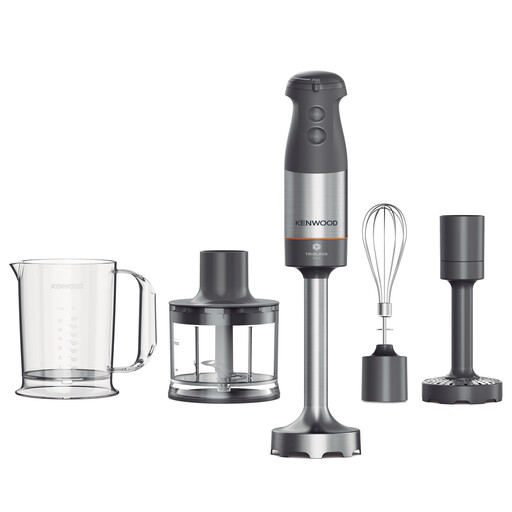
Why it suits this profile: The longer XL blending shaft is designed for larger pans and quantities. The set also includes a whisk, mini chopper and purée attachment.
The longer blending shaft makes its intended use clear: according to the product description, you’re less likely to need to transfer ingredients to another bowl.
1,000 watts, an XL blending shaft and dishwasher-safe accessories according to the product information.
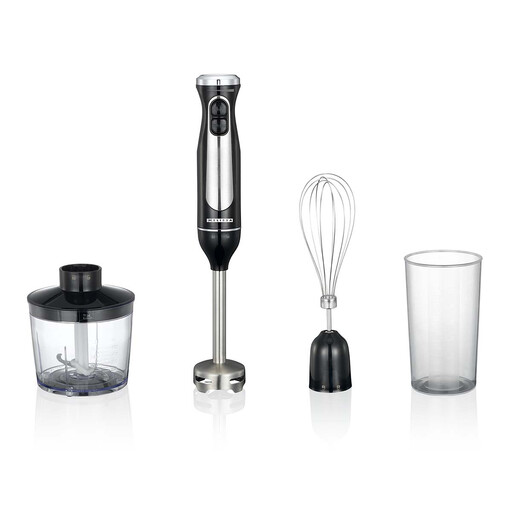
Why it suits this profile: This 3-in-1 set combines a hand blender, mini chopper and whisk. The included 700 ml measuring beaker and 500 ml chopper bowl are suited to a range of everyday tasks.
The specifications list two fixed speeds as well as variable speed control. This lets you adjust the settings to suit both soft and firmer ingredients.
600 watts, variable speed, a stainless steel shaft and dishwasher-safe parts according to the product specifications.
We’ve put together a complete, up-to-date list of products that meet these strict selection criteria and the applicable European safety regulations.
It depends on how you cook. A chopper is handy for onion, herbs, nuts, pesto and small quantities of vegetables. A separate food processor is usually better for larger quantities or dough. Always check the chopper bowl’s capacity and which ingredients it can handle.
Its lifespan depends on how you use and maintain it, and whether you follow the running-time guidance in the manual. Let the motor cool when instructed, don’t force the blades and clean the accessories straight after use. In the European Union, consumers are entitled to the statutory guarantee of conformity. Several of the models mentioned also come with a stated two-year warranty.
A hand blender typically uses electricity for only a short time. Actual consumption depends on its wattage and how long you use it. A 600-watt model running for one minute theoretically uses about 0.01 kWh. The final cost depends on your energy tariff. Ease of use, safety and maintenance are therefore often more important when choosing than a small difference in energy consumption.
