
Soup maker with limited cupboard space
You mainly want to blend pumpkin soup in the pan and store as few separate parts as possible.


If you mainly blend pumpkin soup in the pan and have limited cupboard space, a simple hand blender with a detachable blending foot and few separate parts is the obvious choice. A chopper or whisk needs extra storage space, so it is only worth considering if you regularly use those attachments for other recipes too.
You mainly want to blend pumpkin soup in the pan and store as few separate parts as possible.
You want to use the same motor unit for soup and chopping, and weigh up that convenience against the extra space needed for a chopper.
You want controlled blending and easy cleaning, so you check the instructions for the appliance you choose.
A good fit if: you mainly blend soup and want to store as few separate parts as possible.
The trade-off: without a chopper or whisk, you won't have those functions to hand.
A good fit if: you regularly chop ingredients as well as making soup, and will actually use the chopper.
The trade-off: the chopper and any beaker take up extra cupboard space.
A good fit if: you want to chop and whisk, and regularly use both attachments.
The trade-off: more separate parts mean extra storage space and cleaning.
| What to consider | What should you look for? | Who is this important for? |
|---|---|---|
| Cupboard space | Check everything included in the set and how much room the separate parts take up. Also check whether the blending foot is detachable. | If I mainly make soup, I don't want to store beakers or attachments I don't need. Around 33% of consumers say limited storage space is their top priority. |
| Even blending | Consider the controls and blending foot. To compare performance, a test of the exact model you are considering is more relevant than wattage alone. | If the texture of my pumpkin soup is the priority, I want to know how that exact model blends. Around 27% of consumers say texture is their main concern when buying. |
| Controlled use and cleaning | Read the instructions for using the blender in a pan and check the cleaning guidance for each part. | If I blend soup in the pan, I want to use the foot safely and clean the parts as instructed. Around 20% of consumers give this their highest priority. |
| Extra functions | Choose attachments only for recipes you actually make, and check which parts are included with that version. | If I also regularly chop or whisk ingredients, I want to know whether an attachment can replace a separate kitchen tool. Around 20% of consumers name extra functions as their main reason for buying. |
Consumentenbond advises placing the blending foot on the bottom of the pan or bowl before switching on the hand blender. Also follow the instructions for the model you choose, especially when working with hot ingredients and when cleaning it.
A chopper or whisk adds functions beyond blending, but the separate parts also need to be stored.
First work out which recipes you actually make, then compare what is included in the specific set.
The ErgoMixx MSM66110 is one model to compare if you mainly blend soup and don't need many separate attachments.
The MultiQuick 5 MQ50201M is worth considering if you want to use a chopper as well as blending.
The Quickchef HB659838 is a set with a detachable metal foot, chopper and measuring jug.
The Daily Collection HR2531/00 comes with a measuring jug and is worth comparing as a simple hand blender.
The range includes hand blenders and separate attachments, so you can factor in the accessories you want when making your choice.
This selection includes hand blenders for soup, from simple models to sets with extra attachments.
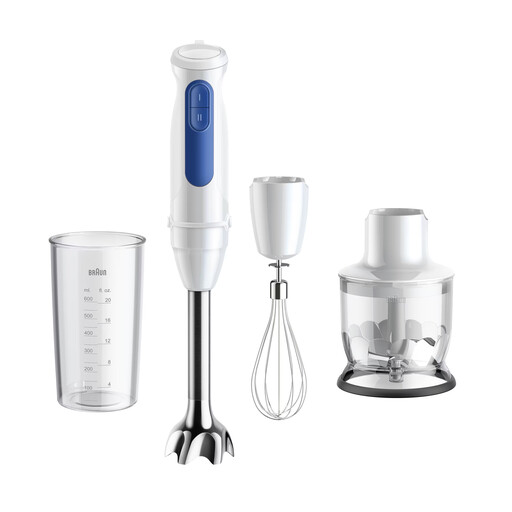 No image available
Worth considering if you want to blend soup without extra attachments in the set.
The product information lists two speeds and a detachable shaft. Maximum continuous use is 1 minute.
The instructions say to place the shaft in the ingredients before switching it on.
 No image available
A model with adjustable speeds to compare if you value this type of control when making soup.
The product information lists 20 speeds, a turbo function, a detachable foot and splash protection.
The cord is 0,95 m long, so bear that in mind when choosing a position near a socket.
 No image available
This set is worth considering if you use the chopper and whisk as well as making soup.
The product information lists a detachable stainless steel shaft, two stainless steel blades and a measuring jug.
For hot ingredients, the product information recommends using a heat-resistant bowl and small quantities. Take care of escaping steam.
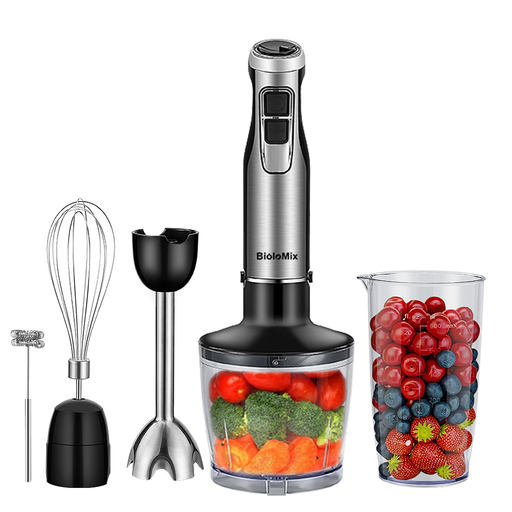 No image available
A set to compare if you want to use the listed chopping and whisking functions as well as blending.
The product name lists six speeds, 1200 W, a stainless steel blade, splash protection and a detachable design.
Extra functions also mean more parts to store.
 No image available
Worth considering if you use a chopper as well and want to adjust the speed.
The product information lists 25 speeds, a turbo function, SplashControl and an included chopper.
The product information warns against processing boiling liquids.
Yes, blending in a pan is a recommended use for a hand blender. To reduce splashing, follow Consumentenbond's tip and place the foot in the pan before switching on the appliance. Also follow the instructions for your model.
For a model with a plug, unplug it first and detach the removable parts. Check the instructions before putting any parts in the dishwasher; cleaning guidance for an attachment doesn't automatically apply to the motor unit.
No, statutory protection also applies in the Netherlands without buying an extra guarantee. If a product breaks sooner than you could reasonably expect with normal use, the seller must offer an appropriate solution according to ACM ConsuWijzer. There isn't a fixed number of years that applies to every hand blender.
For a standard online consumer purchase, there is usually a statutory cooling-off period of 14 days after delivery. Check the relevant exceptions and conditions, especially before using the appliance beyond what is necessary to assess it.
The Netherlands Food and Consumer Product Safety Authority classifies kitchen appliances as electrical equipment. CE marking is compulsory for electrical equipment within the applicable voltage limits under low-voltage rules. Check the product information and restrictions on use for the specific version; CE marking isn't a performance test.